
died 20 May 370·Feast May 20
St. Lucifer of Cagliari
Bishop of Cagliari and fiery opponent of Arianism
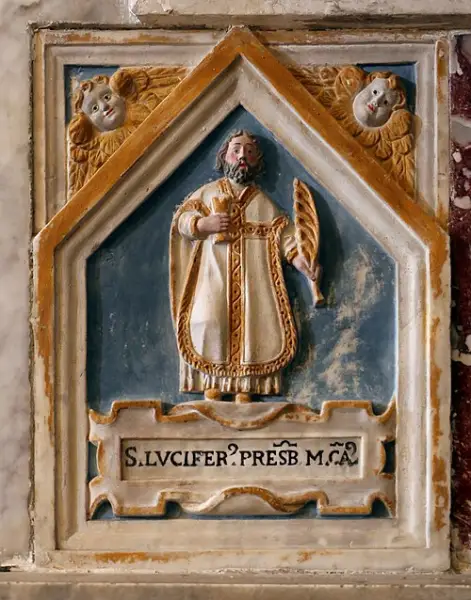
Overview
Lucifer of Cagliari, in Latin Lucifer Calaritanus, was a fourth-century bishop of Cagliari in Sardinia, celebrated and criticized in equal measure for his passionate opposition to Arianism. He first enters history as an envoy of Pope Liberius to Emperor Constantius II, and at the Council of Milan in 355 he defended Athanasius of Alexandria against attempts to secure his condemnation, suffering confinement in the imperial palace for his defiance. Exiled alongside Eusebius of Vercelli and Dionysius of Milan, he was banished in turn to Germanicia, Palestine, and the Thebais of Egypt, from where he wrote fiery pamphlets to the emperor. Allowed home after the accession of Julian in 361 or 362, he refused all reconciliation with former Arians and prolonged the schism at Antioch by consecrating Paulinus bishop without licence. He returned to Cagliari, where Jerome reports his death on 20 May 370. His surviving writings, all from exile, attack Arianism and its toleration, quote Scripture extensively, and remain valuable witnesses to the Vetus Latina. Venerated in Sardinia, his sanctity was debated for centuries, yet his memorial persists at Cagliari on 20 May.
The Complete Life
Formation of a Zealous Scholar
The origins of Lucifer of Cagliari are cloaked in obscurity; he was born in the early fourth century, but where and to what family the record does not say. The tradition preserved in his biography makes him a disciple of Saint Eusebius of Rome, through whom he received the formation that would carry him to the episcopate. He became a scholar of the Greek and Hebrew languages, an unusual and valuable accomplishment for a Western bishop of his generation, and was baptized by Pope Eusebius. This philological training matters for understanding the man: his later writings show a mind steeped in Scripture, capable of quoting the sacred text at length and in both its Greek and Latin forms. His devotion to his teacher's memory endured to the end, for he would eventually compose a well-documented Life of Saint Eusebius of Vercelli, the exile and confessor with whom his own career became so closely entwined. From these early years of study and discipleship came the convictions and the combative temperament that would place him, within a decade, at the very center of the fourth-century struggle over the divinity of Christ.
§ Life
Envoy and Defender at Milan
Lucifer first appears in history as an envoy sent from Pope Liberius to the Emperor Constantius II to request the convening of a church council. The mission brought him into the whirlwind of imperial church politics, and by 355 he stood at the Council of Milan as one of the few unbroken reeds in a yielding reed bed. When the Arian party pressed the Western bishops to condemn Athanasius of Alexandria, Lucifer defended the exiled patriarch with unyielding firmness. It was reported that Constantius II, himself a supporter of Arian theology, confined the bishop for three days inside the Imperial Palace, where he went on arguing Athanasius's case with undiminished vehemence even from detention. Neither persuasion nor coercion moved him. The consequence followed swiftly: the same penalty that struck Eusebius of Vercelli and Dionysius of Milan fell on Lucifer, banished for resisting the emperor's ecclesiastical policy. His banishment led him first to Germanicia, the see of Bishop Eudoxius, then to Palestine, and finally to the Thebais in Egypt. Even from these remote places of confinement he kept up the fight, writing pamphlets addressed to the emperor, declaring himself prepared to die a martyr's death for his beliefs.
§ Life
Return and the Schism at Antioch
When Constantius died and Julian the Apostate took up the empire, the exiled bishops went home in 361 or 362, but freedom did not soften Lucifer. Reconciliation with former Arians, however, he refused outright, and at precisely the moment when other Nicene leaders were extending the hand of penitential mercy, he chose severity. At Antioch he opposed Bishop Meletius, a man who had come to accept the Nicene Creed and for that very reason had been driven out by the Arians; although many champions of Nicene theology in the city stood behind Meletius, Lucifer threw his weight behind the Eustathian party, which had stood unflinchingly by the Nicene creed. Worse followed: he consecrated a Eustathian, Paulinus, as bishop without licence, and so prolonged the schism between Meletians and Eustathians that wounded the church of Antioch for generations. When in 362 the Council of Alexandria, assembled by Athanasius with Eusebius of Vercelli and Asterius of Petra assisting, decreed that repentant bishops who had lapsed only briefly and under compulsion should retain their sees, Lucifer found this indulgence intolerable. The lapsed, however repentant, could no longer be admitted to the rank of bishop or priest in his judgment.
§ Life
Zeal Without Compromise
The spirituality that emerges from Lucifer's life and letters is one of absolute, uncalculated fidelity. His surviving writings, all composed during exile, are directed against Arianism and against any reconciliation with heresy; cast as speeches delivered directly to Constantius, their second-person address to the ruler never flags, an audacious form that treats the ruler less as judge than as accused. His texts quote the Bible extensively, and their scriptural richness makes them useful sources today for the Vetus Latina, the Old Latin Bible that preceded Jerome. Among the treatises are On not Coming Together with Heretics, On Apostate Kings, two books Concerning Athanasius, On not Sparing those who Commit Offences Against God, and above all The Necessity of Dying for the Son of God, whose title is the man's whole creed. A pair of letters allegedly exchanged with the emperor's secretary Florentius shows the notoriety his inflammatory works had won. Yet the same severity that made him a hero to some made him an embarrassment to others: Athanasius himself condemned his excessive severity toward the fallen, and posterity has debated whether Lucifer was the champion of correct belief against Arianism or a fanatic who ferociously berated his opponents.
§ Works
Last Years at Cagliari
After the rupture at Antioch, Lucifer went back afterward to Cagliari, and there, Jerome reports, his life ended in 370, on 20 May, the date his island church still remembers. The end of his life was shadowed by ambiguity. Excommunication may have marked his last years; the writings of Ambrose of Milan and Augustine of Hippo leave hints to that effect, and Jerome afterwards refers to his followers simply as Luciferians, a party name that suggests how far the bishop had drifted from the communion he had suffered so much to defend. Two Luciferian clergy, Faustinus and Marcellinus, left a Libellus precum ad Imperatores, a petition to the emperors that preserves the voice of his movement. Jerome discussed Lucifer and his supporters twice over: in the polemic Altercatio Luciferiani et orthodoxi, a dialogue against the schismatics, and in his survey of Christian authors, De Viris Illustribus, where the bishop's career is described in chapter 95. Thus the man who had gone into exile rather than betray Athanasius ended his days as the founder of a schism that the greatest minds of the following generation labored to dismantle, honored and censured in the same breath.
§ Life
A Contested Sanctity
Few saints of the ancient church have had their status examined as carefully as Lucifer. The Church of Cagliari celebrated the feast of a Saint Lucifer on 20 May, but whether that Lucifer was the bishop whose career is recounted above was itself disputed. Two Archbishops of Sardinia wrote for and against his sanctity, and the quarrel rose high enough that the Congregation of the Inquisition silenced both sides and ruled that Lucifer's cult was to remain exactly as it stood. The Bollandists defended this decree, contending that the Lucifer honored at Cagliari was not the author of the schism at all, but a different Lucifer, martyred when the Vandals persecuted the church. Cagliari's cathedral contains a chapel honoring a Saint Lucifer, and there Marie Josephine Louise of Savoy, wife of Louis XVIII, lies buried. Among Catholics who know of him, opinion remains divided to this day: some name him a champion of right belief against Arianism and companion of Saint Athanasius; others judge him a fanatic who lashed his opponents without measure. His optional memorial is accordingly observed in the Church of Cagliari alone, on 20 May.
§ Veneration
Texts, Manuscripts, and Posterity
Lucifer's literary corpus, small but distinctive, has had a curious afterlife in the manuscript tradition. Bishop Jean du Tillet printed the first edition of the works at Paris in 1568. When Wilhelm von Hartel prepared his modern edition for the Corpus Scriptorum Ecclesiasticorum Latinorum in 1886, only one manuscript of the works was known, the Vaticanus Reginensis 133. In 1893 a second came to light in the Sainte-Geneviève Library in Paris, the Genouefensis 1351, though scholars paid it serious attention only after dom André Wilmart's article of 1921. A third manuscript, the Corbiensis deperditus, survives only as an entry in a library catalogue of Corbie Abbey, and a note in the Paris codex records its descent from an ancient volume of the abbey. Gerardus Frederik Diercks, editing the works for the Corpus Christianorum in 1978, concluded that the Genouefensis is an indirect copy of the Vatican manuscript through a lost Corbie intermediary, yet Lambert Ferreres demonstrated that certain superior readings survive uniquely in the Paris codex, a fact difficult to explain on that hypothesis. The Luciferian party he inspired kept his name alive long after his death, and the scholarship continues.
§ Textual tradition
Timeline
- 355
Defended Athanasius of Alexandria against Arian attempts at condemnation at the Council of Milan and was confined three days in the Imperial Palace.
§ Life
- 355
Exiled with Eusebius of Vercelli and Dionysius of Milan for opposing the imperial ecclesiastical policy.
§ Life
- 361
Allowed home after Constantius died and Julian the Apostate took the throne.
§ Life
- 362
Displeased by the indulgent policy toward repentant Arian bishops adopted at the Council of Alexandria.
§ Life
- 20 May 370
Died at Cagliari, according to Jerome, after returning to his see.
§ Life
- 1568
Bishop Jean du Tillet printed the first edition of his writings at Paris.
§ Textual tradition
- 1886
Wilhelm von Hartel published his works in the Corpus Scriptorum Ecclesiasticorum Latinorum, based on the single manuscript then known.
§ Textual tradition
- 1893
A second manuscript of his works was discovered in the Sainte-Geneviève Library in Paris.
§ Textual tradition
In Their Own Words
The Church of Cagliari celebrated the feast of a Saint Lucifer on the 20th of May. Two Archbishops of Sardinia wrote for and against the sanctity of Lucifer. The Congregation of the Inquisition imposed silence on both parties, and decreed that the veneration of Lucifer should stand as it was.
The Record
- Major works
- De non conveniendo cum haereticis (On not Coming Together with Heretics)·De regibus apostaticis (On Apostate Kings)·Quia absentem nemo debet iudicare nec damnare, sive De Athanasio, 2 books·De non parcendo in Deum delinquentibus (On not Sparing those who Commit Offences Against God)·Moriundum esse pro Dei filio (The Necessity of Dying for the Son of God)·Epistulae Luciferi et aliorum (Letters by Lucifer and Others)·Vita S. Eusebii Vercellensis (Life of Saint Eusebius of Vercelli)
- Canonization
- Venerated in Sardinia; his cult was contested, and the Congregation of the Inquisition decreed that his veneration should stand as it was
Prayer
Bibliography
Show 8 sources
- "Lucifer (bishop of Cagliari)." Encyclopædia Britannica.
- Cross, F. L., and Elizabeth A. Livingstone. "Lucifer." Oxford Dictionary of the Christian Church (pg. 841). Second Edition. New York: Oxford University Press, 1984.
- MC GUIRE, M.R.P. "Lucifer of Cagliari", New Catholic Encyclopedia (Volume 8, pp. 1058). McGraw-Hill Co., New York, 1967.
- LECLERCQ, H. "Lucifer of Cagliari." Catholic Encyclopedia (Volume IX, pg. 410). Robert Appleton Company. New York, 1907.
- John Henry Blunt, Dictionary of Sects, Heresies, Ecclesiastical Parties, and Schools of Religious Thought (1874), p. 263.
- Butler, Alban, Butler's Lives of The Saints, "St Athanasius", bartleby.com. Accessed 23 September 2022.
- Hartel, Wilhelm, ed. Luciferi Calaritani opuscula. Wien, 1886 (CSEL, vol. 14)
- Diercks, G. F. ed. Luciferi Calaritani Opera quae supersunt. Turnhout: Brepols, 1978 (Corpus Christianorum, vol. 8)
Profile text adapted from the Wikipedia article, licensed CC BY-SA 4.0.
Pray with this saint every day
Save St. Lucifer of Cagliari to your favorites, read the full profile, and get feast-day reminders in the Saints app.
Get the Saints AppFree on the App Store for iPhone and iPad