
1st century·Feast May 6
St. Lucius of Cyrene
Apostle of the Seventy and founder of Antioch's church
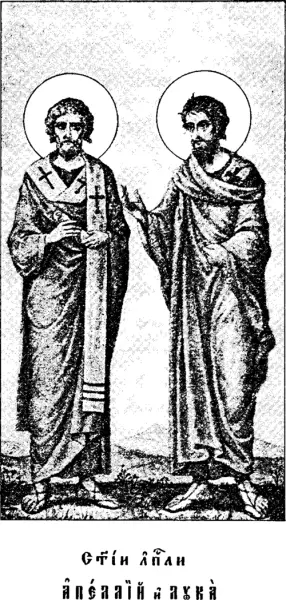
Overview
Lucius of Cyrene, in Greek Loukios ho Kurenaios and in Eastern tradition also known as Luke and Lucius of Laodicea, stands among the quiet founders of Gentile Christianity. According to the Acts of the Apostles he was one of the prophets and teachers of the church at Antioch, named alongside Barnabas, Simeon called Niger, Manaen, and Saul, and according to Eastern Orthodox tradition he belonged to the rank of the Seventy Disciples. By inference from an earlier passage of Acts, he is counted among the men from Cyprus and Cyrene who first dared to speak of the Lord Jesus to Greeks at Antioch, opening the door of the faith to the Gentile world. When that community prayed and fasted together, Lucius shared in the inspiration that commissioned Barnabas and Paul for their missionary journeys. Later tradition made him one of the first bishops of Laodicea, or the first bishop of Cyrene. A Lucius is also greeted in Romans 16:21, and Origen identified him with the evangelist Luke, though certainty is impossible. He is venerated in the Eastern Orthodox and Roman Catholic churches, with feasts on 22 April, 6 May, 10 September, and 4 January.
The Complete Life
A Cyrenaean in the Church of Antioch
Everything known of Lucius begins with his name: he was a Cyrenaean, a man from the Greek city of Cyrene on the North African coast, and he surfaces in history only within the worshipping community of Antioch. The Book of Acts names him among the prophets and teachers of that church, in distinguished company: Barnabas, Simeon called Niger, Manaen, reared at the court of Herod the tetrarch, and Saul himself. This was no random gathering but the leadership of the first Christian community in which Gentiles were deliberately and joyfully received. Eastern Orthodox tradition goes further, reckoning Lucius among the Seventy Disciples whom the Lord sent out on mission, a rank that placed him within the widest circle of the Savior's own companions. His vocation, as the Acts narrative presents it, was therefore twofold: a teacher charged with expounding the faith within the assembled church, and a prophet open to the Spirit's sudden inspirations. It was while this group prayed and fasted together that the Holy Spirit directed them to set apart Barnabas and Paul, and Lucius stood among those who laid hands on the first great missionary journey of Christian history.
§ Lucius of Cyrene
First Preacher to the Greeks
Lucius's deepest claim on Christian memory lies in an inference the Acts of the Apostles invites its readers to draw. An earlier passage records that after the killing of Stephen the persecution scattered believers to Phoenicia, Cyprus, and Antioch, where at first they preached to Jews alone; then certain Cypriots and Cyrenaeans among them reached Antioch and took the further step of addressing Greeks with the good news about the Lord Jesus. Lucius of Cyrene is counted among these pioneers, and by that reckoning he helped found the Antiochene church, the community in which the disciples of Jesus were first called Christians. The step he and his companions took was momentous: they carried the Gospel across the ethnic frontier that the earliest church had barely dared to cross, preaching not to diaspora Jews alone but to Greeks. Later tradition honored this founding role with episcopal dignity, counting Lucius among the first bishops of Laodicea, or, in another strand, the first bishop of his native Cyrene. A Lucius is also greeted by Paul at the close of Romans, and Origen identified him with the evangelist Luke, though no certainty is possible in either identification.
§ Lucius of Cyrene
Feasts of a Silent Founder
For a figure so sparsely recorded, Lucius of Cyrene has kept a remarkably wide place in the calendars of the churches. He is venerated as a saint in both the Eastern Orthodox Church and the Roman Catholic Church, a continuity of honor stretching back to antiquity and requiring no formal process of canonization. In the East his commemoration is especially rich: he is remembered on 22 April and again on 10 September, in each case alongside Saints Apelles of Heraklion and Clement of Sardis, fellow names of the Seventy, and on 4 January he shares in the joint feast of all the Seventy Disciples, the missionary rank to which tradition assigned him. In the West the Roman Martyrology fixes his feast on 6 May. The very spread of these dates testifies to the reverence his memory attracted across Christendom. His legacy is ultimately the church of Antioch itself, the first community to preach to Greeks and to welcome Gentiles without requiring them to become Jews first, and from which Barnabas and Paul were sent to the wider world. Every subsequent chapter of Gentile Christianity descends, humanly speaking, from the preaching of the men of Cyrene.
§ Veneration
In Their Own Words
In the church at Antioch there were prophets and teachers: Barnabas, Simeon called Niger, Lucius of Cyrene, Manaen (who had been brought up with Herod the tetrarch) and Saul.
The Record
- Canonization
- Pre-congregation; venerated as a saint since the earliest Christian centuries
Prayer
Bibliography
Show 3 sources
- "Holy Apostles of the 70 Apelles, Luke (Loukios), and Clement". www.oca.org. Retrieved 2024-08-16.
- Walsh, Michael. A New Dictionary of Saints: East and West. London: Burns & Oats, 2007. ISBN 0-86012-438-X, p. 372.
- Origen, Commentary on Romans 10.39.
Profile text adapted from the Wikipedia article, licensed CC BY-SA 4.0.
Pray with this saint every day
Save St. Lucius of Cyrene to your favorites, read the full profile, and get feast-day reminders in the Saints app.
Get the Saints AppFree on the App Store for iPhone and iPad