
c. 283 – 304·Feast December 13
St. Lucy
Virgin martyr of Syracuse and light of winter
Overview
Lucia of Syracuse, known to the whole Church as Saint Lucy, was born around 283 in Syracuse, Sicily, to wealthy and noble parents of Roman and Greek descent. Her father died when she was five, leaving her with her mother, Eutychia. Consecrated to virginity, Lucy hoped to give her dowry to the poor, but her mother, unaware of the vow and anxious for her future, arranged a marriage with a young pagan. A pilgrimage to the shrine of St. Agatha at Catania brought Eutychia an unexpected cure, and Lucy persuaded her to let the family riches be distributed to the poor. The disappointed suitor denounced her to the governor Paschasius as a Christian. Refusing to sacrifice to the emperor's image, she was condemned to a brothel, then to fire, and finally died by the sword in 304, during the Diocletianic Persecution. Later tradition added the gouging of her eyes, which were said to have been miraculously restored at her burial, making her the patroness of the blind. Devotion to her travelled outward from Syracuse to Rome and, within a few centuries, embraced all of Christendom; she is still numbered among the best loved virgin martyrs of the Christian calendar, honoured on December 13, the feast of light in the depth of winter.
The Complete Life
A Daughter of Syracuse
Lucy was born around the year 283 in Syracuse, the great Greek city of southeastern Sicily, into a family of wealth and rank. Her father was of Roman origin; her mother, Eutychia, bore a Greek name that pointed to the Hellenic roots of their city. The security of the household collapsed early: Lucy's father died when she was only five years old, and the child grew up alone with her mother in a world where a widow without a male guardian was dangerously exposed. Perhaps this vulnerability shaped the resolve Lucy would later show. While still young she consecrated her virginity to God and formed a plan worthy of her inheritance: rather than pass her dowry to a husband, she would distribute it to the poor. Eutychia, knowing nothing of this secret vow and fearful for her daughter's future, chose a suitor from a rich pagan household to be her husband. Healing came by an unexpected road. Eutychia suffered from a disorder of bleeding, and the two women made a pilgrimage to the shrine of St. Agatha at Catania, less than fifty miles away, where so many miracles had been reported. There, in a dream, Agatha promised the mother's cure and promised that Lucy would bring to Syracuse the renown that Agatha gave to Catania.
§ Life
The Vow and the Widow's Mite
The cure at Catania settled the great question of Lucy's life. Her mother, restored to health, could no longer refuse the daughter who had obtained the favour, and Lucy gained permission to give away a great part of the family's riches to the poor. When Eutychia suggested that such sums would serve better as an inheritance, Lucy answered with the words that have preserved her practical holiness ever since: whatever is given away at death is given only because it cannot be kept, but the true Savior should receive the gift now, while the giver is still in health. So the patrimony and the jewels went out to the destitute of Syracuse. The distribution could not be hidden. News of it reached the pagan to whom Lucy had been betrothed, and the young man, robbed of both bride and bride's fortune, turned upon her with the deadliest weapon a Roman could wield: he denounced her to the governor as a Christian. Thus the evangelical counsel Lucy had chosen, poverty for the sake of God, became the very accusation that brought her to trial. Her wealth, surrendered in freedom, was taken from her by force, and her body, promised to no man, was claimed by her persecutors for the arena of their cruelty.
§ Life
Trial and Martyrdom
Lucy was brought before Paschasius, the governor of Syracuse, in the year 304, amid the storm of the Diocletianic Persecution. Ordered to burn a sacrifice to the image of the emperor, she refused, and the governor condemned her to shame in a house of prostitution. Christian tradition tells that the soldiers sent to seize her could not budge her, though they yoked her to a team of oxen; still she could not be hauled from the spot. Bundles of wood were heaped around her and set alight, but the fire would not burn her. At last she received the death she had not been able to receive otherwise, the sword thrust into her throat. Later tradition enriched the account with the trial of her eyes: in the versions told from the fifteenth century onward, her eyes were gouged out before her execution, either by the cruel order of the enraged Paschasius after she foretold the end of the persecution, or, in another telling, by her own hand, to repel an importunate wooer captivated by them. As her body was made ready for the family tomb, her eyes were discovered to have been wonderfully given back. Before dying she had prophesied the punishment of Paschasius and the speedy fall of the persecution itself.
§ Life
A Cult That Filled the Church
Lucy needed no formal canonisation; the Church recognized her martyrdom from the beginning. The earliest surviving witness to her veneration is movingly personal: the grave stele of Euskia, a young woman of twenty-five who died on St. Lucy's day in the late fourth or early fifth century, found in the catacombs of Syracuse and now kept in the archaeological museum of that city. By the sixth century her story had spread so far that her image appeared among the procession of virgins in the Basilica of Sant'Apollinare Nuovo at Ravenna, and her name entered the Sacramentary of Pope Gregory I and the ancient Roman Martyrology. Her fame crossed into England early: St. Aldhelm, who died in 709, and the Venerable Bede, who died in 735, both attest her popularity, and and England observed her feast, a celebration of the second grade, right up to the Reformation. In the eleventh century the monk Sigebert of Gembloux composed a passio in her honour for the cult at Metz. The General Roman Calendar once carried a duplicate commemoration on September 16, but this was removed in 1969 as a repetition of her true feast of December 13. She stands among the eight women, with the Virgin Mary, named in the Canon of the Mass.
§ Veneration
Relics, Patronage, and the Feast of Light
Lucy's body lay undisturbed in Sicily, according to Sigebert of Gembloux, for four hundred years before the Duke of Spoleto carried it to Corfinium in Abruzzo; Emperor Otto I removed it to Metz in 972. Other relics reached Constantinople and, after its capture in 1204, Venice, where Enrico Dandolo placed them in the monastery of St. George; the head was given to Louis XII of France in 1513. In 1861 the Venetian church of Santa Lucia was demolished for the new railway station, and the relics passed to San Geremia, where in November 1981 thieves seized every bone but the head, recovered by police five weeks later on her feast. Syracuse has preserved portions of her body from antiquity. Her patronage embraces the blind, whose protector she became through the story of her eyes, and also martyrs, epidemics, throat infections, salesmen, writers, Perugia, Syracuse, and Malta; the Caribbean island of St. Lucia bears her name. Her feast of December 13 once coincided with the winter solstice, and so she became the bearer of light in the darkest season: in Sweden and Scandinavia, girls crowned with candles walk in procession in her honour, while Sicily keeps the day with cuccia, whole grain in memory of the famine that ended when ships of wheat entered her harbour.
§ Relics
Timeline
- 283
Born at Syracuse, Sicily, to rich and noble parents.
§ Life
- 288
Her father died, leaving Lucy, aged about five, with her mother Eutychia.
§ Life
- 304
Denounced by a rejected suitor, condemned by Governor Paschasius, and put to death by the sword at Syracuse during the Diocletianic Persecution.
§ Life
- 972
Emperor Otto I removed her relics from Corfinium to Metz, depositing them in the church of St. Vincent.
§ Relics
- 1204
After the capture of Constantinople, Enrico Dandolo secured relics of the saint for the monastery of St. George at Venice.
§ Relics
- 1513
The Venetians presented the saint's head to Louis XII of France, who placed it in the cathedral of Bourges.
§ Relics
- 1861
The church of Santa Lucia in Venice was demolished for a railway terminus, and her relics were transferred to San Geremia.
§ Relics
- 1969
The duplicate commemoration of 16 September was removed from the General Roman Calendar.
§ Veneration
- 7 Nov 1981
Robbers carried off her bones from the Venetian church of San Geremia, leaving only the head; the relics were traced by police five weeks afterwards, on her feast.
§ Relics
In Their Own Words
Whatever you give away at death for the Lord's sake you give because you cannot take it with you. Give now to the true Savior, while you are healthy, whatever you intended to give away at your death.
The Record
- Patron of
- The blind·Martyrs·Epidemics·Throat infections·Eye illnesses·Salesmen·Writers·Perugia, Italy·Syracuse, Italy·Mtarfa, Malta
- Symbols
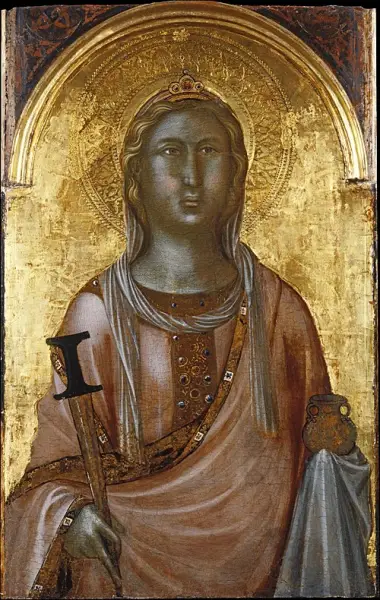
- Eyes on a dish·Palm branch·Lamp·Sword·Cord·Blindfold·Yoke of oxen
- Canonization
- Pre-congregation martyr, venerated as a saint from the earliest centuries of the Church
Prayer
Bibliography
Show 6 sources
- Bridge, James (1910). "St. Lucy". In Herbermann, Charles (ed.). Catholic Encyclopedia. Vol. 9. New York: Robert Appleton Company.
- Calendarium Romanum (Libreria Editrice Vaticana, 1969), p. 139
- Pirlo, Paolo O. (1997). "St. Lucy". My first book of saints. Sons of Holy Mary Immaculate - Quality Catholic Publications. p. 302. ISBN 971-91595-4-5.
- Cord, David (2024). St Lucy of Syracuse: A Biography. ISBN 9798345203378.
- Sigibert von Gembloux (2007). Acta Sanctae Luciae. Heidelberg: Ed. Tino Licht. (Editiones Heidelbergenses, vol. 34.)
- Butler, Alban. Lives of the Saints.
Profile text adapted from the Wikipedia article, licensed CC BY-SA 4.0.
Pray with this saint every day
Save St. Lucy to your favorites, read the full profile, and get feast-day reminders in the Saints app.
Get the Saints AppFree on the App Store for iPhone and iPad