
1672 – 1732·Feast March 25
St. Lucy Filippini
Founder of the Religious Teachers Filippini
Overview
Lucy Filippini, in Italian Santa Lucia Filippini, was an Italian religious foundress who devoted her life to the education of girls, especially the poor. Born at Corneto-Tarquinia on 13 January 1672, she was orphaned young and raised by an aristocratic aunt and uncle who nurtured her religious inclination and placed her with the Benedictine nuns at Santa Lucia. Under the patronage of Cardinal Marcantonio Barbarigo she took up the founding of schools for young women in the diocese of Montefiascone, and in 1692, trained by Rose Venerini, she co-founded the Pious Teachers, the congregation now known as the Religious Teachers Filippini or Filippini Sisters. Her pupils learned reading, Christian doctrine, and the domestic arts of weaving and embroidering. In 1707 Pope Clement XI summoned her to Rome to open schools there under his special protection, and by the end of her life fifty-two schools had been established. Her congregation is credited with the religious and social advancement of Italian women long before compulsory education existed. She died of breast cancer at Montefiascone on 25 March 1732, aged sixty, was beatified in 1926 and canonized in 1930 by Pope Pius XI.
The Complete Life
An Orphan of Corneto-Tarquinia
Lucy Filippini was born on 13 January 1672 at Corneto-Tarquinia in the Papal States, the youngest of the five children of Filippo Filippini and Maddalena Picchi. Bereavement came early and repeatedly. Her mother died before the child had completed her first year and was laid to rest in the Church of San Marco; six years later she lost her father as well, a man she loved deeply, buried in the Church of Santa Margherita in Corneto. Orphaned before she could form lasting memories of either parent, the little girl was taken in at the age of six by an aristocratic aunt and uncle. Their household proved providential rather than merely comfortable, for they encouraged her religious inclination and placed her schooling in the hands of the Benedictine nuns of Santa Lucia. Thus the convent school that would later become her life's work first received her as a pupil. In the disciplined rhythm of Benedictine teaching she absorbed both learning and piety, and the pattern of her future vocation was quietly fixed: a woman formed by the education of girls, destined to give the same formation to generations she would never meet.
§ Life
Called by Cardinal Barbarigo
Lucy's career began under the patronage of Cardinal Marcantonio Barbarigo, who entrusted her with the demanding task of establishing schools for girls, poor ones above all, in his diocese of Montefiascone. The model came ready-made: Cardinal Giovanni Francesco Barbarigo, a relative of Marcantonio, had assisted Rose Venerini in establishing such schools at Viterbo, and when Venerini's own foundations at Viterbo required her presence, Marcantonio handed the Montefiascone schools over to Lucy. In 1692, with Rose Venerini training the school teachers, Lucy co-founded with the cardinal the Pious Teachers, a congregation dedicated to the education of girls, today known as the Religious Teachers Filippini or, more familiarly, the Filippini Sisters. Twelve years on, the cardinal drew up a rule of life to direct Lucy and her companions, giving the young institute a stable form. The curriculum was practical and deeply Christian: the girls of Montefiascone received instruction in reading, Christian doctrine, and the handcrafts of weaving and embroidery. In Lucy's hands, education was neither luxury nor mere trade but an instrument of both salvation and dignity for girls whom society had overlooked.
§ Life
Fifty-Two Schools
The work grew beyond anything the diocese of Montefiascone alone could hold. In 1707 Pope Clement XI summoned Lucy to Rome to open schools there, taking them under his personal protection, an extraordinary mark of confidence that carried her institute from regional enterprise to national significance. Through the Religious Teachers Filippini, the work she built is credited with advancing the religious and social condition of Italian women generations before schooling became compulsory, when schooling for poor girls depended almost entirely on such voluntary foundations. Fifty-two schools had been founded by the time Lucy died, each staffed by sisters trained in the double discipline of classroom and convent. The measure of her achievement is easiest to see in what it preceded: generations before the state assumed responsibility for educating girls, Lucy had already organized a network of women religious who taught reading, doctrine, and the skills of livelihood to those who would otherwise have received nothing. The schools she founded and the congregation she formed to keep them running became her single, unified work, and the Filippini Sisters carried it forward long after her death, spreading her method of faith-filled instruction through Italy and beyond.
§ Life
Death at Montefiascone
Lucy's laborious life closed where so much of it had been spent, at Montefiascone. She died there on 25 March 1732 of breast cancer, aged sixty, having given six decades to the church, roughly half of them in the active government of her institute and its schools. She was buried at the Cathedral of Montefiascone, the city whose schools had been the first field of her apostolate and where her remains still rest as her principal shrine. There is a fitting symmetry in the date and place of her death: the woman who had opened schools for poor girls in small towns died on the feast of the Annunciation, a feast of quiet, hidden fruitfulness, in the episcopal city that had first believed in her. Her congregation mourned not a distant foundress but a teacher who had worked alongside them, and the request for her canonization would come in time from the church whose daughters she had educated. The story that began with an orphaned child sheltered by Benedictine nuns ended with a network of schools, a religious family, and a reputation for holiness that Rome would formally recognize two centuries later.
§ Life
Honored by Pius XI
Recognition of Lucy Filippini's sanctity came with unusual speed once the modern processes began. On 13 June 1926 she was beatified by Pope Pius XI in Saint Peter's Basilica, and scarcely four years later, on 22 June 1930, the same pope canonized her in the same basilica, in the presence of the church that her sisters had served for nearly two and a half centuries. Her feast is kept on 25 March, the anniversary of her death. The supreme honor, however, was architectural as much as liturgical: in Saint Peter's Basilica, where founders of orders are commemorated with statues in the bays of the nave, Lucy was given the last available niche, and her statue, carved by Silvio Silva in 1949, stands in the upper tier, first bay reached from the main entrance along the left, southern flank of the nave. There she appears in her religious habit among the founders of the great religious families, a woman of the eighteenth-century Papal States taking her place beside saints of every age. For the Filippini Sisters, the statue in the basilica of the popes remains the visible sign that their foundress's work belongs to the whole church.
§ Veneration
The Filippini Sisters
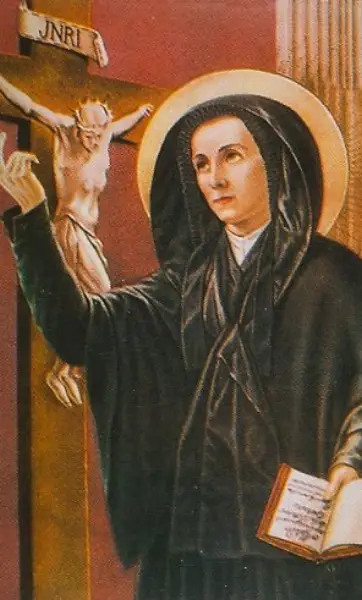
Lucy's most enduring monument is the congregation she founded, the Institute of the Maestre Pie, known universally as the Religious Teachers Filippini or the Filippini Sisters. The institute she organized to staff her schools outlived the schools themselves and outgrew the Papal States, carrying her ideal of the Christian education of girls to new places and centuries. The judgment of historians and church writers alike has been that the congregation is credited with lifting the religious and social standing of Italian women long before the state made schooling compulsory, a rare distinction for a foundress who never sought anything beyond classrooms and catechism. Her patronage is claimed by the Religious Teachers Filippini themselves, who look to her as their mother and model. Pilgrims and the faithful honor her at Montefiascone Cathedral, where her body lies, and at Rome, where her image presides over the nave of Saint Peter's. The attributes of her iconography remain simple and legible: the religious habit of her institute, the book and classroom of the teacher, and the poor girls whose education was her single passion. Few founders have concentrated so entirely on one work, and few works have proved so durable.
§ Veneration
Timeline
- 13 Jan 1672
Born at Corneto-Tarquinia to Filippo Filippini and Maddalena Picchi, the youngest of their five children.
§ Life
- 1692
Co-founded the Pious Teachers with Rose Venerini and Cardinal Marcantonio Barbarigo, dedicated to the education of girls.
§ Life
- 1707
Called by Pope Clement XI to Rome to start schools placed under the pope's special protection.
§ Life
- 25 Mar 1732
Died of breast cancer at Montefiascone, aged sixty, and was buried at the Cathedral of Montefiascone.
§ Life
- 13 Jun 1926
Beatified by Pope Pius XI in Saint Peter's Basilica.
§ Veneration
- 22 Jun 1930
Canonized by Pope Pius XI at Saint Peter's Basilica.
§ Veneration
- 1949
Her statue by Silvio Silva was placed in Saint Peter's Basilica, occupying the last niche.
§ Veneration
The Record
- Major works
- Institute of the Maestre Pie (Religious Teachers Filippini, the Filippini Sisters)·Fifty-two schools for young women founded in her lifetime
- Patron of
- Religious Teachers Filippini
- Symbols
- Religious habit
- Canonization
- Beatified 13 June 1926 and canonized 22 June 1930 by Pope Pius XI at Saint Peter's Basilica
Prayer
Bibliography
Show 6 sources
- Butler, Alban (1 January 1999). Butler's Lives of the Saints: November. Liturgical Press. ISBN 9780814623794.
- "The Life of St. Lucy Filippini", St. Nicholas of Tolentine, Philadelphia. Archived from the original on 30 June 2016. Retrieved 1 June 2016.
- "Lucy Filippini", Catholic News Service, 22 March 2018.
- "Profile of Saint Lucy Filippini", filippiniusa.org; accessed 31 October 2014.
- Bunson, Matthew; Bunson, Margaret; Bunson, Stephen (1 January 2003). Our Sunday Visitor's Encyclopedia of Saints. Our Sunday Visitor Publishing. ISBN 9781931709750.
- "Saint Lucia Filippini". FIND THE SAINT. Retrieved 16 May 2024.
Profile text adapted from the Wikipedia article, licensed CC BY-SA 4.0.
Pray with this saint every day
Save St. Lucy Filippini to your favorites, read the full profile, and get feast-day reminders in the Saints app.
Get the Saints AppFree on the App Store for iPhone and iPad