
died 1202·Feast February 12
St. Ludan
Scottish Pilgrim Who Died in Alsace
Overview
Ludan, whose name the old records also carry as Ludain and Luden, was a wandering pilgrim out of Scotland whose brief but vivid memory joined noble birth to radical generosity. Tradition calls him the son of Hildebod, a duke in Scotland, and when his father died the young heir disposed of the whole inheritance in works of mercy instead of keeping it. Among his benefactions stood a hospital that received foreigners, the sick, the poor, and the infirm. Having stripped himself of everything, he undertook the long pilgrimage to Jerusalem, then made his way home through Alsace. At Scherkirchen, near Strasbourg, the journey closed: on 12 February 1202 he died of cold beneath a tree at Nordhouse, and at the hour of his death the bells of a nearby church were said to ring on their own. Written words found in his wallet told strangers who he was and why he had wandered so far. The people of Hipsheim recovered his body and laid it in their village church, the Scheerkirche, where his tomb drew honor until the Swedish war destroyed it. His entrance into heaven has been kept on 12 February ever since.
The Complete Life
A Duke's Son Who Chose the Poor
Ludan was born in Scotland, the child of Hildebod, a duke of that northern kingdom, and rank and wealth were his by inheritance. What he did with them is the reason he is remembered. When his father died, the young man did not settle into the life of a nobleman; he took the fortune that had come to him and poured it out for those who had nothing. Chief among his works was a hospital built to shelter foreigners, the sick, the poor, and the infirm — the people most likely to be turned away from every other door in a medieval town. In an age when a duke's son was expected to add land to land and castle to castle, Ludan spent himself instead of hoarding, and his giving seems to have had no calculation of return in it. The poor of his homeland knew him as a benefactor before the Church ever knew him as a pilgrim, and the habit of mercy formed early in him would carry him, once his money was gone, onto the roads of Europe and beyond.
§ Life
Pilgrim for the Love of God
Once his inheritance had been transformed into shelter and care for the suffering, Ludan chose the vocation that medieval Christians understood as the purest image of the soul's journey: pilgrimage to Jerusalem. To walk to the Holy Land was to give up home, status, and safety for months and years of road, trusting entirely in God and in the charity of strangers. Ludan, who had already made himself poor by choice, set out with nothing left to protect. The journey reached its goal, and he turned his face homeward, crossing Europe toward Scotland by way of Alsace. A single sentence said to have been found in his wallet after his death sums up the spirit in which he traveled: there he named himself the son of the noble Hildebod, duke of Scotland, and declared that he had made himself a pilgrim for the love of God. It was a life reduced to one motive — love — and one identity — pilgrim — written down so that anyone who found his body would know both. The road between Scotland and Jerusalem ran through kingdoms and coasts he never saw again; Alsace became the ground where that single-minded journey reached its purpose.
§ Life
Death Beneath the Tree
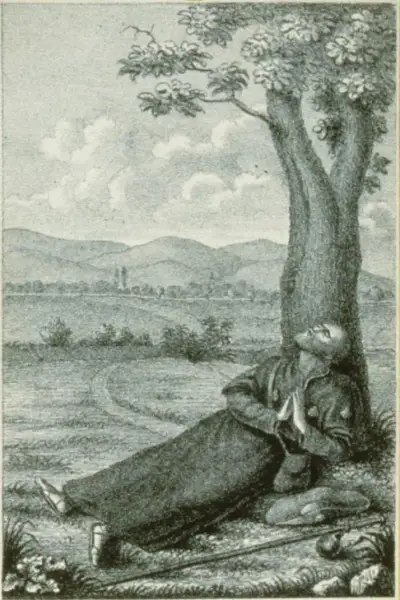
On his return from the Holy Land, Ludan never reached Scotland. At Nordhouse in Alsace, near Scherkirchen and not far from Strasbourg, he was overcome by cold, or by some affliction of the kind, and died on 12 February 1202 beneath a tree, a poor man in appearance and a duke's son in fact. The legend records that at the hour when he died the bells of a church nearby sounded on their own, though no hand touched the ropes, as though heaven itself announced the arrival of a pilgrim who had died for love of God. The villagers of Hipsheim recovered the body and buried it in their village church, the Scheerkirche, where his grave became a place of remembrance. There it remained until the Swedish war swept through the region and destroyed the tomb, yet the memory of the Scottish pilgrim survived the loss of his monument. The Benedictine dictionary of saints compiled at St. Augustine's Abbey, Ramsgate, still records his death in Alsace in 1202 and his feast, kept on 12 February, in the calendar promulgated in 1969.
§ Life
In Their Own Words
I am the son of the noble Hildebod, a Duke of Scotland, and I made myself a pilgrim for the love of God.
The Record
- Major works
- A hospital for foreigners, the sick, the poor, and the infirm, raised from his father's inheritance
- Canonization
- Pre-congregation; venerated since the Middle Ages at Scherkirchen in Bas-Rhin
Prayer
Bibliography
Show 1 sources
- St. Ludan. Catholic Online.
Profile text adapted from the Wikipedia article, licensed CC BY-SA 4.0.
Pray with this saint every day
Save St. Ludan to your favorites, read the full profile, and get feast-day reminders in the Saints app.
Get the Saints AppFree on the App Store for iPhone and iPad