
c. 742 – 809·Feast March 26
St. Ludger
Apostle of Saxony and First Bishop of Münster
Overview
Ludger, called in Latin Ludgerus and in some records Lüdiger or Liudger, was a Frisian missionary whose patient work earned him the title Apostle of Saxony. Born around 742 at Zuilen near Utrecht to wealthy Christian nobles, Thiadgrim and Liafburg, he was formed in the cathedral school at Utrecht and deepened his learning at York under Alcuin, whose friendship he kept for life. Witnessing Boniface's martyrdom in 753 left a lasting mark, and Ludger gave himself to the conversion of the Frisians and Saxons — first in East Frisia from Dokkum, then, after exile in Rome and Monte Cassino, among the still-pagan districts east of the Lauwers. He declined the bishopric of Trier to evangelize Saxony, built the monastery from which Münster took its name, founded Werden Abbey, and in 805 was consecrated first Bishop of Münster by Hildebold of Cologne at Charlemagne's command. Contemporaries said his gentle methods accomplished more for the faith than the emperor's armies did. He died at Billerbeck on 26 March 809, worn out at sixty-six, hours after preaching twice and celebrating his final Mass.
The Complete Life
A Frisian Noblemen's Son
Ludger came into the world around 742 at Zuilen near Utrecht, the child of Thiadgrim and Liafburg, wealthy Frisian Christians of noble blood. Faith was his inheritance on both sides, but a single encounter set its direction. In 753 the boy saw Boniface, the great apostle of Germany, and when word followed of the old man's martyrdom at Dokkum, the impression left on Ludger never faded. At his own request his parents sent him to the Utrecht Cathedral School, the Martinsstift founded by Gregory of Utrecht, and there he advanced quickly. In 767 he traveled with Alubert to York, where Ethelbert of York ordained him deacon and where he sat at the feet of Alcuin, the most celebrated teacher of the age. A year later he returned to Utrecht, though the friendship with Alcuin endured for the rest of his life. Danger drove him home again in 772, when strife between Anglo-Saxons and Frisians made the island unsafe; he carried back with him a trove of books. After Gregory died in 775, Ludger honored his old master with a written life, the Vita Gregorii, and was sent to Deventer, where he rebuilt the chapel the Saxons had destroyed and found the remains of the missionary Lebuinus.
§ Early life to ordination
Ordination and the Frisian Missions
On 7 July 777 Ludger was ordained at Cologne, and the missions of Ostergau — East Frisia — were placed in his hands, with Dokkum, the very place of Boniface's martyrdom, as their center. The symbolism did not escape him: he labored where the great martyr had died, preaching through the autumn circuits and returning each year to Utrecht to teach in the cathedral school. For about seven years the work held, until 784, when Widukind of the Saxons roused the Frisians against them: the preachers were expelled, the churches put to the torch, and the old gods restored. Ludger escaped with his disciples and turned south. In 785 he reached Rome, where Pope Adrian I received him kindly and granted him counsel and special faculties; from there he withdrew to Monte Cassino, living under the Benedictine rule without binding himself by vows. He might have stayed in that retirement, but in 787 news of Widukind's submission and Charlemagne's arrival at Monte Cassino called him back. His new field comprised five territories beyond the Lauwers — country about the estuaries where the Hunze, the Fivel, and the Ems meet the sea, districts still held almost entirely by paganism — and he began with an advantage no other preacher had: he knew the language and the habits of the people from his childhood.
§ The Netherlands
Apostle of Saxony
Ludger's Frisian work bore fruit in places whose names have half vanished — the island of Bant, long since swallowed by the sea — and in places still known: on Heligoland, the old Fossitesland where Willibrord had preached, he cleared the remains of paganism, raised a Christian church, and re-consecrated a well once held sacred to the old gods as his baptismal font. Returning from the islands he met the blind bard Bernlef, the last of the Frisian skalds, and is said to have restored his sight and won his soul. In 793 Charlemagne offered him the bishopric of Trier; Ludger refused it, asking instead for the evangelization of the Saxons, and the emperor granted him north-west Saxony as his field. At Mimigernaford he built a house for canons regular that gave the place its lasting name — Münster — living there with his monks under the rule of Chrodegang of Metz. He raised churches at Billerbeck, Coesfeld, Hersfeld, and Nottuln, settled his consecrated sister Gerburgis near the last with the women who gathered around her, founding the first convent in Westphalia around 803, and carried out his long-cherished plan of a Benedictine house at Werden, founded about 800 and consecrated in 804 on ground he had bought himself.
§ Westphalia and Saxony
The Gentler Weapon
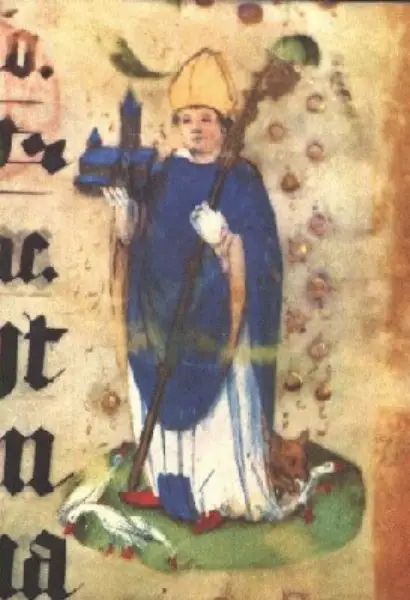
It was said of Ludger that his peaceful methods accomplished more for Christianity than the aggressive campaigns of Charlemagne himself, and the judgment explains both his success and his character. Where the empire advanced with fire and tribute, the bishop advanced with language, school, and alms. He knew the Frisians from within — their tongue, their customs, their songs — and he treated that knowledge as a missionary instrument, meeting the peoples of the northern coasts as a neighbor rather than a conqueror. His care for clergy ran in the same vein: he educated his students personally and took them along on his missionary journeys, forming a generation of pastors by companionship rather than decree. The same freedom of spirit appeared when Charlemagne offered him Trier; the more brilliant see meant nothing beside the work he believed was his. He was criticized during his lifetime for spending on the poor money that critics thought should have adorned his churches, and he suffered for it, but he was able to convince the emperor that no fault lay in the practice. The image that grew up around him — a bishop at prayer over his Breviary, standing between two swans — preserves the memory of a man whose authority was gentleness.
§ Later life
The Last Day at Billerbeck
Consecrated first Bishop of Münster on 30 March 805 by Hildebold, Archbishop of Cologne, at Charlemagne's recommendation, Ludger spent his final years as he had spent his life: teaching, traveling, and founding. He built the monastery of Helmstad in the duchy of Brunswick, afterward called Ludger's Cloister in his memory, and kept up his circuits among the communities he had planted. His death came as his biography describes it, almost liturgically. On Passion Sunday in 809 he heard Mass at Coesfeld early in the morning and preached there; he went on to Billerbeck, where at nine in the morning he preached a second time and celebrated his last Mass. That evening, in the company of his followers, he died peacefully, sixty-six years old, his voice spent on that single day's double harvest of preaching. A quarrel followed over his remains: Münster and Werden each claimed the body, and his brother Hildegrim, consulting with the emperor, decided for Werden, where the relics still rest, though portions have since been brought to Münster and Billerbeck, the towns of his last journey. Few medieval bishops died so completely in harness: his final day held two sermons, one last Mass, and an evening deathbed surrounded by the disciples he had formed.
§ Death and relics
A Cult That Grew From Memory
Ludger was never canonized by formal process; the Church of his region received him as a saint because the memory of his life demanded it. The successive Vitae trace that growth of devotion from history toward legend: the serious contemporary biography by his successor Altfrid stands at the head, followed by the Vita Secunda and the Vita Tertia, and finally by the Little Book of Münster on the Miracles of Saint Ludger, written around 1170. Each retelling carried the founder's memory further into the miraculous, but the core of the cult remained simple: a bishop who had given the region its faith, its clergy, and its churches. In Münster itself, votive practice centered on a great and elaborate cross that held relics of the saint. The devotion never became broadly international; it stayed mostly local, attached to the places he had served, and it largely faded in the later Middle Ages. Yet the communities that kept it were exactly the ones he had founded — Werden, East Frisia, Deventer, and Münster — which have honored him as their patron from the earliest times to the present day.
§ Veneration
What Remained
Ludger's legacy is written in the map of north-western Europe. Münster, the city that grew from his monastery at Mimigernaford, became the seat of a prince-bishopric and one of the great cities of Westphalia. Werden Abbey endured for a millennium as a center of learning and faith on the Ruhr. The diocese he governed as its first bishop still bears his name in its patronage, and East Frisia, Deventer, Groningen, and Werden claim him likewise. His bloodline continued in the Church as well: his sister Gerburgis founded the first convent in Westphalia, and his brother Hildegrim carried on episcopal duties in the generation after him. Artists have pictured him for twelve centuries as a bishop holding a church, or reciting his office, or standing between two geese that legend made swans — images that keep alive the stories of a man who preached to sailors and Saxons in their own speech. He is numbered among the missionary saints of the Catholic Church in the company of Boniface, Willibrord, and Ansgar, and in his own corner of Europe he remains what his contemporaries called him: the apostle of the Saxons, the gentle founder whose quiet work outlasted the emperor's wars.
§ Veneration
Timeline
- 742
Born at Zuilen near Utrecht to the Christian Frisian nobles Thiadgrim and Liafburg.
§ Early life to ordination
- 753
Saw the missionary Boniface, an encounter that shaped his sense of vocation.
§ Early life to ordination
- 767
Traveled to York with Alubert, was ordained deacon by Ethelbert of York, and began studies under Alcuin.
§ Early life to ordination
- 772
Left York for home amid friction between Anglo-Saxons and Frisians, carrying a load of valuable books.
§ Early life to ordination
- 775
Restored the destroyed chapel at Deventer and recovered the relics of Lebuinus after Gregory's death.
§ Early life to ordination
- 7 Jul 777
Ordained at Cologne and given charge of the East Frisian missions, centered at Dokkum.
§ The Netherlands
- 784
Fled with his disciples when Widukind persuaded the Frisians to expel the missionaries and burn the churches.
§ The Netherlands
- 785
Received by Pope Adrian I in Rome, then withdrew to Monte Cassino to live under the Benedictine rule without taking vows.
§ The Netherlands
- 787
Appointed missionary to five still-pagan districts east of the Lauwers after Widukind's submission.
§ The Netherlands
- 793
Declined the see of Trier and offered instead to evangelize north-western Saxony, which Charlemagne accepted.
§ Westphalia and Saxony
- 800
Founded the abbey at Werden on ground he had acquired himself, fulfilling a long-cherished design.
§ Westphalia and Saxony
- 803
Saw the first convent in Westphalia arise near Nottuln around his sister Gerburgis and her companions.
§ Westphalia and Saxony
- 804
Saw the abbey church of Werden consecrated, completing its foundation.
§ Westphalia and Saxony
- 30 Mar 805
Consecrated first Bishop of Münster by Archbishop Hildebold of Cologne at Charlemagne's request.
§ Later life
- 26 Mar 809
Preached at Coesfeld and Billerbeck, said his last Mass, and died peacefully that evening at Billerbeck.
§ Death and relics
The Record
- Major works
- Vita Gregorii, a life of Gregory of Utrecht·Werden Abbey·The monastery at Mimigernaford, from which the city of Münster took its name·The first convent in Westphalia, near Nottuln·St. Ludger's Abbey at Helmstedt
- Patron of
- Groningen, Netherlands·Deventer, Netherlands·East Frisia·diocese of Münster, Germany·Werden, Germany
- Symbols
- Bishop holding a cathedral·Reciting his Breviary·A swan or goose on either side
- Canonization
- Pre-congregation; acclaimed as a saint by popular devotion shortly after his death
Prayer
Bibliography
Show 6 sources
- Monks of Ramsgate. "Ludger". Book of Saints, 1921. CatholicSaints.Info, 9 November 2014.
- Mershman, Francis. "St. Ludger." The Catholic Encyclopedia Vol. 9. New York: Robert Appleton Company, 1910.
- Duffy, Patrick. "St Ludger of Münster (742-809)". Catholic Ireland, March 26, 2012.
- Shea, John Dawson Gilmary. "Saint Ludger, Bishop". Pictorial Lives of the Saints, 1889. CatholicSaints.Info, 6 February 2014.
- Butler, Alban. "St. Ludger, Bishop of Munster", Lives of the Saints.
- "Saint Ludger". New Catholic Dictionary. CatholicSaints.Info, 11 August 2018.
Profile text adapted from the Wikipedia article, licensed CC BY-SA 4.0.
Pray with this saint every day
Save St. Ludger to your favorites, read the full profile, and get feast-day reminders in the Saints app.
Get the Saints AppFree on the App Store for iPhone and iPad