
c. 860 – 921·Feast September 16
St. Ludmila of Bohemia
Martyred Grandmother of Good King Wenceslaus
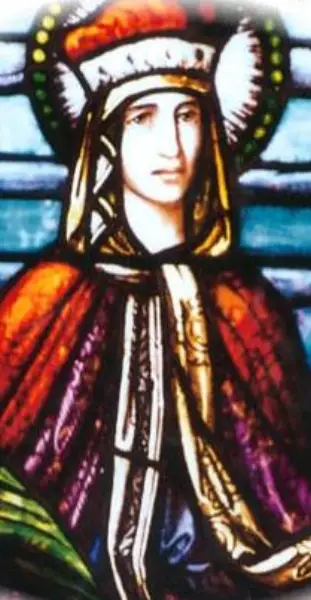
Overview
Ludmila of Bohemia, daughter of the Sorbian prince Slavibor and native of the stronghold of Mělník, where she was born around the year 860, became the first Christian saint of the Czech lands. In 873 she married Bořivoj I, the first Christian Duke of Bohemia, and the couple received baptism through the missionary efforts of Methodius. Their attempt to Christianize Bohemia met fierce resistance, and pagans drove the princely pair from their country for a time, though they eventually returned and ruled for several years before withdrawing to Tetín near Beroun. Ludmila bore at least six children during her fourteen years of marriage, and two of her sons, Spytihněv and Vratislav, succeeded their father on the throne. When Vratislav died in 921, his young son Wenceslaus — the future Good King Wenceslaus — took the throne, and Ludmila, who had raised the boy herself, acted as regent. The boy's mother, Drahomíra, grew jealous of the grandmother's influence and had two noblemen murder Ludmila at Tetín on 15 September 921, strangling her, the legend says, with her own veil. Venerated almost immediately, she is honored as a martyr and patroness of Bohemia, with her feast on 16 September.
The Complete Life
A Princess of the Sorbs
Ludmila was born around 860 at Mělník, a stronghold above the confluence of the Elbe, into the highest rank of the Slavic world: her father, Slavibor, was a prince of the Sorbs. She grew up a pagan noblewoman in a land where the old gods still governed birth, marriage, and war, but her marriage would carry her across the religious frontier of ninth-century Europe. Around 873 she was wed to Bořivoj I of Bohemia, the first Christian Duke of Bohemia, and through the preaching of Methodius, the great missionary to the Slavs, Ludmila herself accepted baptism with her husband. The choice made her the matriarch of a Christian dynasty — the Přemyslids — that would rule Bohemia for centuries, and the first woman in her nation's history to hold the faith as a matter of conscience rather than custom. From the beginning it was a costly faith: when the princely couple tried to bring Christianity to their people, the Bohemians resisted so fiercely that they drove their rulers from the country altogether. Ludmila's early years as a duchess were thus years of exile, return, and reconstruction, the pattern that would shape the rest of her life.
§ Marriage
Wife, Duchess, Mother
For roughly fourteen years Ludmila lived as consort of the first Christian duke of Bohemia, and her chief work in those years was the raising of a family that would determine the fate of the nation. Six children of hers are counted — three boys and three girls — besides little ones lost so early that the chronicles never named them. Her eldest son Spytihněv was born in 875; her son Vratislav followed about 888; both would eventually wear the princely crown of Bohemia. Her public role ran alongside her domestic one. In the records she is listed as Duchess consort of Bohemia from about 874, and with Bořivoj she shared the political fortunes of the first Christian house of the Czechs: expulsion by their pagan subjects, then return, then years of ruling before the couple laid down power and retired to Tetín near Beroun. When Bořivoj died, Spytihněv succeeded him, and when Spytihněv died childless the throne passed to Vratislav. Through all these successions Ludmila remained the continuity of the dynasty — the woman who had accepted the Gospel from Methodius, outlasted exile, and filled the princely house with children who would govern as Christians.
§ Marriage
Regent and Grandmother of a Saint
When Vratislav died in 921, the crown of Bohemia passed to his son Wenceslaus, still a boy, and Ludmila stepped into the decisive role of her life. The boy had been brought up chiefly by his grandmother, and from her he absorbed the faith her own baptism had begun; on his accession she governed as regent, governing Bohemia in his name. The Christian formation she gave Wenceslaus proved decisive: he would be remembered forever as Good King Wenceslaus, the saintly ruler of the Czechs. But the grandmother's power awakened a deadly jealousy. Wenceslaus' mother, Drahomíra, resented Ludmila's influence over the young duke and over the affairs of the realm, and the rivalry between the two women became the fatal politics of the Bohemian court. Ludmila's position — a widowed dowager governing as regent, a convert guiding a Christian monarchy — made her one of the most consequential women in early Czech history. That the boy she raised became the nation's greatest saint, and that she herself would die a martyr within the year, joined her story to his so closely that the two have been venerated side by side in Prague ever since.
§ Ludmila and Drahomíra
Martyrdom at Tetín
Ludmila's retirement at Tetín ended in violence. Drahomíra, determined to be rid of the grandmother whose authority overshadowed her own, found her instruments in two nobles — Tunna and Gommon, men of Frankish or perhaps Varangian stock — who took the princess's life. On 15 September 921 the murderers came upon the princess at Tetín and strangled her, and part of her narrative preserves the detail that the instrument of death was her own veil, the garment that marked her dignity and her faith alike. She was in her sixties, a dowager who had been duchess, regent, and teacher of saints. Initially her body was buried at St. Michael's in Tetín, the fortress where she died, but her story did not end at that rural grave. The people of Bohemia honored her at once as a martyr — one who died not for refusing an idol but as a victim of hatred for the Christian order she represented — and devotion gathered speed with the next generation. She had given the dynasty its faith; the dynasty's second generation gave her blood a public memorial.
§ Murder of Saint Ludmila
Canonized by Acclamation
The Church recognized Ludmila as a saint shortly after her death, in the immediate, popular way of the early medieval Church: no formal process, no papal decree, but the unquestioned veneration of a martyr at her grave. As part of the act of canonization, in 925 her grandson Wenceslaus translated her remains from St. Michael's at Tetín to St. George's Basilica within the castle of Prague, laying the first Czech martyr to rest beside the cradle of Czech Christianity. The translation was as much political as devotional — the young duke declaring before all Bohemia that the murdered dowager was a saint and her killer's cause condemned — but it fixed her cult at the heart of the nation's religious life. Her feast came to be kept on 16 September, the day after her death, and the Roman Martyrology records her among the saints of that date. A chapel of St. Ludmila, her major shrine, preserves her memory at the basilica where her relics were laid. Catholic and Eastern Orthodox Christians alike number her among the saints, a rare double veneration that testifies to how old and how universal her cult became.
§ Ludmila and Drahomíra
Patroness of Bohemia
Ludmila's influence on Czech history has never faded. She is honored as a patron saint of Bohemia itself, and of converts, duchesses, widows, and those troubled by in-laws — a list of patronages that mirrors her life exactly. Her attribute is the simple veil with which she was strangled, and her image stands on the Charles Bridge in Prague among the great figures of the nation's faith. The Přemyslid dynasty she helped Christianize ruled for centuries, and her grandson Wenceslaus became the eternal patron of the Czech lands, his goodness rooted in the grandmother who raised him. Her memory entered art at the highest level: Her story reached the concert hall when Dvořák, between the autumn of 1885 and the spring of 1886, set her life as an oratorio — a score the publisher Littleton had commissioned for the Leeds Festival. Even her family tree continued to matter — Cardinal Christoph Schönborn, Archbishop Emeritus of Vienna, is counted a direct descendant. Thirteen centuries after her death she remains the first Czech saint, the matriarch of the nation's Christianity, and at St. George's Basilica in Prague the pilgrim can still stand where her grandson laid her in 925.
§ Ludmila and Drahomíra
Timeline
- 860
Born at Mělník, daughter of the Sorbian prince Slavibor.
§ Marriage
- 873
Married Bořivoj I of Bohemia, the first Christian Duke of Bohemia.
§ Marriage
- 875
Gave birth to her eldest son Spytihněv, the first of at least six children.
§ Marriage
- 15 Sep 921
Murdered at Tetín on the orders of Drahomíra, jealous of her influence over the young Wenceslaus.
§ Murder of Saint Ludmila
- 925
Her grandson Wenceslaus translated her remains to St. George's Basilica in Prague as part of her canonization.
§ Ludmila and Drahomíra
The Record
- Patron of
- Bohemia·converts·duchesses·those with problems with in-laws·widows
- Symbols
- veil
- Canonization
- Canonized shortly after her death; her relics were translated to St. George's Basilica, Prague, in 925
Prayer
Bibliography
Show 5 sources
- "Saint Ludmila, Slavic saint". Encyclopaedia Britannica. September 11, 2018.
- Ott, Michael. "St. Ludmilla." The Catholic Encyclopedia. Vol. 9. New York: Robert Appleton Company, 1910.
- "Saint Ludmila - 1100 years since the death of the first Czech saint", Prague.eu.
- Kantor, M. The Origins of Christianity in Bohemia. 1990.
- Halstead, Susan. "St. Ludmila, patroness of Bohemia". British Library, 16 September 2013.
Profile text adapted from the Wikipedia article, licensed CC BY-SA 4.0.
Pray with this saint every day
Save St. Ludmila of Bohemia to your favorites, read the full profile, and get feast-day reminders in the Saints app.
Get the Saints AppFree on the App Store for iPhone and iPad