
died 1250·Feast March 29
St. Ludolph of Ratzeburg
Bishop Who Suffered Prison and Exile
Overview
Ludolph of Ratzeburg was a Premonstratensian who bore the full weight of his office in an age of violent princes. In 1236 he was appointed bishop of the newly formed Prince-Bishopric of Ratzeburg, a see on the north-eastern frontier of the German lands where episcopal authority and ducal ambition were bound to collide. The collision came with Duke Albert I of Saxony: Ludolph resisted him, was thrown into prison, and there was badly beaten. Even this did not end the matter, for the bishop was next sent into exile. Duke John of Mecklenburg received the fugitive prelate and gave him shelter, but the injuries and hardships of his imprisonment had done their work. Ludolph died soon afterward, in 1250, of the abuse his body had suffered in prison — in the memory of the Church, a martyrdom of endurance rather than of the sword. He was honored as a saint, and his feast is kept on 29 March. Later generations told of a soldier gravely wounded by an arrowhead lodged in his skull who called upon St. Ludolph and was healed, drawing the arrow out and recovering whole.
The Complete Life
A Premonstratensian on an Episcopal Frontier
Ludolph belonged to the Premonstratensian canons, the reforming order of canons regular founded by Norbert of Xanten, whose members joined the contemplative life with pastoral labor. From that cloistered discipline he was lifted in 1236 to one of the most exposed thrones in northern Germany: the episcopal see of the newly created Prince-Bishopric of Ratzeburg. The title prince-bishop says everything about the difficulty of the post. Ratzeburg stood among the territories where missionary bishops had been made temporal princes precisely so that the Church could hold its ground against contending nobles, and a bishop there needed the temper of a diplomat and the endurance of a soldier of Christ. Ludolph governed the see through nearly fourteen years of friction between ecclesiastical right and dynastic appetite, holding the position from 1236 until his death in 1250. His successors in the list of Ratzeburg's prelates — Petrus before him, Frederick after him — mark the ordinary rhythm of the office; what set Ludolph apart was the violence his fidelity drew upon him, and the manner of his receiving it. The Premonstratensian habit under the episcopal vestments mattered: he faced ducal power as a religious first, and only afterward as a prince of the Church.
§ Religious life
Prison, Exile, and Death
The conflict that claimed Ludolph's life was a quarrel with Duke Albert I of Saxony, the temporal power whose ambitions the bishop's office obstructed. Ludolph came into open conflict with the duke and was thrown into prison, where he was badly beaten — a treatment that in the thirteenth century broke stronger men than bishops. When his captors tired of holding him they resorted to the subtler cruelty of banishment, and Ludolph was sent into exile from the flock he had governed. Duke John of Mecklenburg took the fugitive in and gave him refuge at his court, an act of hospitality that could not repair what the prison had done. The bishop's body, wrecked by the beatings it had absorbed, failed soon afterward: Ludolph died in 1250 from the abuse he had suffered in ducal custody. The Church counted that death a martyrdom — not of the executioner's blade, but of patient endurance unto the end — and enrolled the beaten prelate among its saints, assigning his memory to 29 March. He had governed Ratzeburg for fourteen years, and the last of them cost him his health, his see, and his life, in that order.
§ Religious life
Memory and Miracle
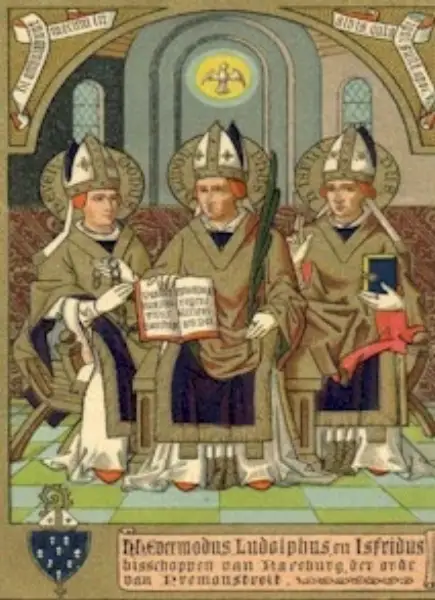
The cult of St. Ludolph of Ratzeburg preserved the memory of a bishop whose authority was vindicated not by power but by wounds. Alongside his historical record the tradition kept a legend that shows what the faithful believed his intercession could do: a soldier, struck so that an arrowhead had embedded itself in his head and left him in great pain, invoked St. Ludolph, and through the saint's help he was soon able to draw the arrow from the wound and was healed. Such stories, attached to the tombs and feast days of medieval bishops, kept Ludolph's name alive in the devotional life of the region long after the political quarrels of the thirteenth century were forgotten. He is pictured in the company of the other saints of his see, standing beside Sts. Evermode and Isfrid of Ratzeburg in the community of holy bishops who governed that church. His feast on 29 March keeps him among the bishops and martyrs whom the Catholic Church honors, and his story remains a plain witness: a pastor who chose prison over compliance and counted the cost of the Gospel in his own body.
§ Legacy
Timeline
- 1236
Appointed bishop of the newly formed Prince-Bishopric of Ratzeburg.
§ Religious life
- 1250
Died soon after taking refuge with Duke John of Mecklenburg, broken by the beatings received in prison.
§ Religious life
The Record
- Canonization
- Pre-congregation; venerated as a saint in the Catholic Church
Prayer
Bibliography
Show 2 sources
- St. Ludolph. Catholic Online.
- St. Ludolf. Catholic Online.
Profile text adapted from the Wikipedia article, licensed CC BY-SA 4.0.
Pray with this saint every day
Save St. Ludolph of Ratzeburg to your favorites, read the full profile, and get feast-day reminders in the Saints app.
Get the Saints AppFree on the App Store for iPhone and iPad