
1872 – 1940·Feast May 16
St. Luigi Orione
Apostle of the Poor and Founder of the Orionines
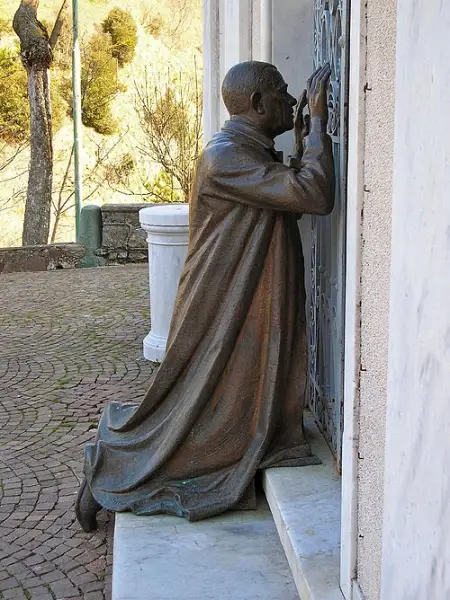
Overview
Luigi Giovanni Orione was an Italian priest who devoted his whole life to answering the social miseries of a nation convulsed by the upheavals of the late nineteenth and early twentieth centuries. Born poor at Pontecurone in Piedmont on 23 June 1872, he entered the Franciscans at thirteen, left for reasons of health, and was formed instead among the Salesians of Don Bosco at Turin, where John Bosco counted him among his favorite pupils and where, at Bosco's death in 1888, the boy's chronic ailments were suddenly cured. Ordained a priest on 13 April 1895, he opened an oratory for poor boys at twenty and a boarding school the next year. In 1903 his Little Work of Divine Providence received the bishop's authorization as the Sons of Divine Providence, joined in 1915 by the Little Missionary Sisters of Charity. Earthquake relief at Messina, Reggio Calabria, and Marsica, schools, farming colonies, and nursing homes followed, and after the First World War his foundations spread through Italy and the Americas. He died at Sanremo on 12 March 1940, was beatified in 1980 and canonized in 2004 by Pope John Paul II, and is now honored as patron of the abandoned.
The Complete Life
A Poor Boy from Pontecurone
Luigi Orione was born on 23 June 1872 at Pontecurone, in the province of Alessandria amid the Italian Piedmont, on the eve kept for the birth of St. John the Baptist, and was named after Aloysius Gonzaga and John the Baptist. The parish priest, Michele Cattaneo, baptized him the following day. Vittorio, the father, laid street pavement and spoke little; Carolina, the mother, kept the house with energy, piety, and thrift — a household of honest poverty in a country still assembling itself. At thirteen Luigi entered the Franciscan friary of Voghera in the diocese of Pavia, but frail health forced him out after a single year. From 1886 to 1889 he studied instead at the Valdocco Oratory in Turin, the school of the Salesians of Don Bosco, where the aged founder himself noticed the boy and numbered him among his favorite pupils. Illness pursued him still, until 1888, when he stood at the deathbed of John Bosco and found himself cured — an event he counted as a miracle and that bound his vocation forever to the Salesian spirit of cheerful, practical charity. He resolved on the priesthood and entered the seminary of the Archdiocese of Turin, joining the San Marziano Society for Mutual Help and the Society of Saint Vincent de Paul as a seminarian.
§ Early life
Priest of Turin's Poor
The education Don Bosco's followers gave him became the blueprint of Luigi's own priesthood. In 1892, still only a twenty-year-old seminarian, he opened his own oratory in Turin to educate the city's poor boys; and added a residential school for poor children the year after. On 13 April 1895 he was ordained a priest, and from that day the oratory, the school, and the streets of Turin formed his single field of labor. What marked him out was not novelty but continuity: he took the method he had watched at Valdocco — the young served by the young, kindness before reproach, work and prayer joined — and reproduced it wherever poverty gathered boys without a future. Turin in the 1890s was a city absorbing the shocks of industrialization, crowded with families displaced from the countryside, and Don Orione responded not with theory but with beds, classrooms, and trades. Even then he thought institutionally as well as personally: the oratory of 1892 and the boarding school of 1893 were the seedlings of a work that would one day span continents. He had learned from Bosco that Providence is not an excuse for passivity but a program for boldness.
§ Early life
Founder and Disaster Worker
Beginning in 1899, Don Orione gathered around himself a company of priests and clerics that took shape as the Piccola Opera della Divina Provvidenza, the Little Work of Divine Providence; in 1903 the bishop granted it full authorization as a religious congregation, the Sons of Divine Providence. Among the first companions was Lorenzo Perosi, who shared Orione's birth year and native region, would head the Sistine Chapel Choir as its perpetual director, and win fame among composers of church music; the two kept each other's friendship all their lives. Charity, in Orione's understanding, had to go where suffering was loudest. In 1908 he went to Messina in Sicily and Reggio Calabria, cities laid waste by earthquake, and gave three years to relief, above all the care of orphans. In 1915 he hurried to Marsica when another earthquake devastated that region, and in the same year he founded the Little Missionary Sisters of Charity, giving women a share in the work. After the First World War ended he expanded on every front: he planted schools and farm colonies, charitable bodies and homes for the aged, throughout Italy, always with orphans and the poor at the center, and over the following two decades he carried his foundations to the Americas as well.
§ Founder
Divine Providence and the Poor
The name Don Orione chose for his institute — Divine Providence — was the heart of his spirituality. He believed that God provides for the poor through those willing to be provided for in turn, and he acted on that belief with an audacity that made poverty itself a form of confidence. In 1931 he built the Shrine of the Madonna della Guardia at Tortona, raised with the help of his priests and acolytes in gratitude to the Madonna for the end of the First World War; it became the principal church of the Orionine family in the world and a center of annual music festivals honoring his friend Perosi. Marian devotion and service of the abandoned were one movement in him, not two. Those who worked beside him remembered a founder who counted no hardship, who treated every beggar as Christ and every orphan as a charge laid on him personally, and whose institutions existed for exactly one purpose: that no abandoned person should remain abandoned. The Church would later give that instinct its formal title, naming him patron saint of the abandoned — the summary of a life in which theology, charity, and sheer labor had become indistinguishable.
§ Shrine of the Madonna della Guardia
Among the Poor Who Are Jesus Christ
In the winter of 1940 Don Orione's heart and lungs began to fail seriously, and doctors ordered him to Sanremo to recuperate. He went with a tinge of regret that has become one of the most quoted moments of his life: on 8 March 1940, on the eve of his departure, he said it was not among the palm trees that he wished to die, but amongst the poor who are Jesus Christ. Four days later, on 12 March 1940, in the Ligurian resort town, he died surrounded by the priests of his own order, his last words the name of Jesus spoken three times: Jesus, Jesus! Jesus! I am going. His body was brought back to Tortona and buried on 19 March 1940 in the crypt of the Shrine of Nostra Signora della Guardia, the church he himself had built in thanksgiving for peace. There his mortal remains have rested ever since, exhumed once, in 1965, for examination in the course of his cause. The dying wish had been denied only in geography, not in substance: he was buried among his own poor, in a church built for them, in the city his work had made his own.
§ Final illness
From Cause to Canonization
The Church moved toward Don Orione's honors with unusual directness. The formal inquiry into his sanctity opened, remarkably, on 14 May 1937 — while its subject still lived, a rare and demanding vote of confidence in a founder's holiness. Twenty-six years after his death, on 26 October 1980, Pope John Paul II beatified him in Vatican City; nearly twenty-four years later, on 16 May 2004, the same pope canonized him in Vatican City, enrolling Luigi Orione among the saints of the Catholic Church. His feast is kept on 16 May, the anniversary of his canonization. The examination of his remains in 1965 and the testimony gathered through decades of process confirmed what his thousands of orphans, students, and nursing-home residents had always said: the founder's holiness lay in an extraordinary ordinariness, a lifetime of daily labor for the abandoned performed without pause or self-regard. In the liturgical calendar and in the memory of the Orionine family worldwide, the priest from Pontecurone' district stands as the Church's official witness that sanctity in the twentieth century could look like soup, schooling, shelter, and perseverance.
§ Veneration
A Work That Never Stopped
The charitable bodies Don Orione founded carry on today in strength across the globe, more than eight decades after his death. In the United States the national shrine and American headquarters of the Sons of Divine Providence occupy Orient Heights, the familiar hill in Boston's East Boston district of Massachusetts, while the Little Missionary Sisters of Charity carry the same charism on other continents. The Shrine of the Madonna della Guardia at Tortona remains the chief pilgrimage destination worldwide for Orione's followers and the principal church of the Orionine order, hosting annual music festivals in memory of Lorenzo Perosi. The institutions he founded — schools, farming colonies, nursing homes, orphanages — have outlived the wars and upheavals that interrupted them, and the congregation he began with a handful of clerics in 1899 now serves on multiple continents. Canonized in 2004 and honored as patron of the abandoned, Don Orione belongs to the great line of Italian apostles of charity, in the tradition of Don Bosco, who formed him, and Giuseppe Benedetto Cottolengo, whose spirit he continued. His last recorded thought — that he would have preferred to die among the poor — remains the charter of the work he left behind.
§ Veneration
Timeline
- 23 Jun 1872
Born to a poor household at Pontecurone, in Alessandria province, on the eve of the Nativity of St. John the Baptist.
§ Early life
- 1886
Became a student at the Valdocco Oratory in Turin, run by the Salesians of Don Bosco.
§ Early life
- 1888
Was present at the death of John Bosco in Turin, at which moment his long ailments were miraculously cured.
§ Early life
- 1892
Opened an oratory of his own at twenty, schooling the poor boys of Turin.
§ Early life
- 1893
Started a boarding school for the poor in Turin.
§ Early life
- 13 Apr 1895
Ordained a priest for the archdiocese of Turin.
§ Early life
- 1899
Began gathering the group of priests and clerics that became the Little Work of Divine Providence.
§ Founder
- 1903
Received the bishop's full authorization for his congregation, known as the Sons of Divine Providence.
§ Founder
- 1908
Went to earthquake-devastated Messina and Reggio Calabria, spending three years in relief work, especially the care of orphans.
§ Founder
- 1915
Aid to the earthquake-stricken Marsica region; founded the Little Missionary Sisters of Charity that same year.
§ Founder
- 1931
Founded the Shrine of the Madonna della Guardia at Tortona, now the principal church of the Orionine order.
§ Shrine of the Madonna della Guardia
- 14 May 1937
His cause was formally opened for beatification and canonization.
§ Veneration
- 12 Mar 1940
Died at Sanremo, surrounded by priests of his order, after uttering the name of Jesus.
§ Final illness
- 19 Mar 1940
Buried in the Shrine of Nostra Signora della Guardia at Tortona, the church he himself had built.
§ Veneration
- 1965
Body exhumed for examination in the course of his cause.
§ Veneration
- 26 Oct 1980
Beatified in Vatican City by Pope John Paul II.
§ Veneration
- 16 May 2004
Canonized in Vatican City by Pope John Paul II.
§ Veneration
In Their Own Words
It is not among the palm trees that I would like to die, but amongst the poor who are Jesus Christ.
Jesus, Jesus! Jesus! I am going...
The Record
- Major works
- Sons of Divine Providence (Little Work of Divine Providence)·Little Missionary Sisters of Charity·Shrine of the Madonna della Guardia, Tortona·Oratories, schools, farming colonies, charity organizations, and nursing homes across Italy and the Americas
- Patron of
- the abandoned
- Canonization
- Canonized 16 May 2004 in Vatican City by Pope John Paul II, having been beatified by him on 26 October 1980
Prayer
Bibliography
Show 5 sources
- Venturelli, D. G., The Blessed Don Louis Orione: A short Biography, 3rd Edition, Rome: Generalate House of the Work, 1981.
- "Luigi Orione (1872–1940)", Vatican.
- Clissold, Stephen (1980). Some Call It Providence. London: Darton.
- Index ac status causarum beatificationis servorum dei et canonizationis beatorum (in Latin). Typis polyglottis vaticanis. January 1953.
- Homily of John Paul II.
Profile text adapted from the Wikipedia article, licensed CC BY-SA 4.0.
Pray with this saint every day
Save St. Luigi Orione to your favorites, read the full profile, and get feast-day reminders in the Saints app.
Get the Saints AppFree on the App Store for iPhone and iPad