
died 1597·Feast February 6
St. Louis Ibaraki
Japanese Franciscan Tertiary Crucified at Nagasaki
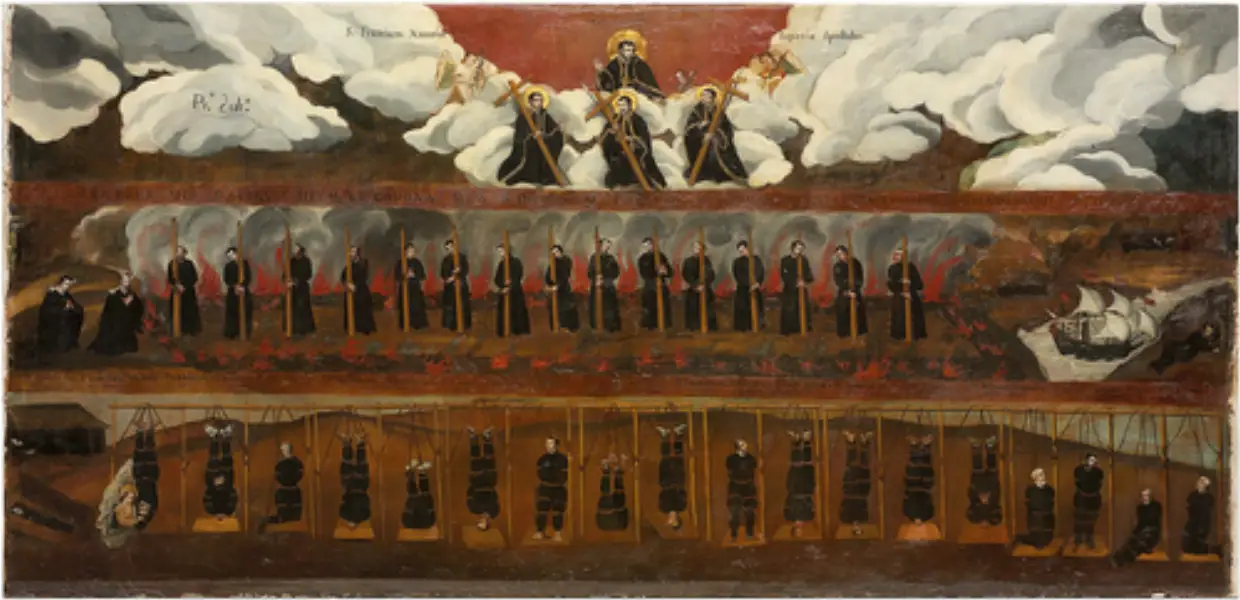
Overview
Louis Ibaraki was one of the twenty-six Catholics executed by crucifixion at Nagasaki on 5 February 1597, remembered with St. Paul Miki and his companions as the Martyrs of Japan. A Japanese layman of the Third Order of St. Francis, he belonged to the great company of native tertiaries who served the Franciscan missionaries in Kyoto — catechists, helpers, and altar boys drawn from the first generation of Japanese Christianity. After the San Felipe affair of 1596 inflamed official suspicion, Hideyoshi moved against the Church, and in January 1597 twenty-six believers were arrested at his order in Kyoto: four Spaniards, one Mexican, one Portuguese from India — all Franciscan missionaries — three Japanese Jesuits, and seventeen Japanese Franciscan tertiaries, among them Louis Ibaraki and three young boys who served the priests at the altar. Condemned for defying the regent's prohibition on preaching the faith, they were paraded behind carts through the towns, their left ears cut off, stoned and mocked along the road. On 5 February 1597 they were crucified and pierced with lances on a hill overlooking Nagasaki. Beatified in 1627 and canonized in 1862, Louis Ibaraki shares the feast of the Japanese martyrs on 6 February.
The Complete Life
A Tertiary of the First Japanese Generation
Louis Ibaraki belonged to the generation of Japanese Christians who received the faith within half a century of Francis Xavier's landing at Kagoshima on 15 August 1549. By the end of the sixteenth century the Catholic mission in Japan counted perhaps 300,000 believers, and among them a native corps of lay workers had grown up around the Franciscan friaries: the Third Order of St. Francis, whose members shared the friars' life of prayer and service without leaving their own people and language. Louis Ibaraki was one of these tertiaries — one of the seventeen Japanese members of the Third Order who served the Alcantarine missionaries of Kyoto, together with Anthony Dainan, Bonaventure of Miyako, Cosmas Takeya, and the rest. Some were mature men with families; others, as the record of the martyrdom notes, were merely boys, three of them so young that they served the priests as altar boys. In that company the lay faithful of Japan were not spectators of the mission but its sinews: they taught, they served at the altar, and when the persecution came they died beside the friars in numbers the friars never outnumbered.
§ List of martyrs
The Church Hideyoshi Turned Against
The mission that formed Louis Ibaraki's world had begun with extraordinary favor. The shogunate and the imperial court at first supported the missionaries, reckoning that Christianity would weaken the Buddhist monasteries and enrich trade with Spain and Portugal; the daimyō of Kagoshima granted Xavier permission for the first Catholic mission in the hope of commerce with Europe. But by the late 1500s the government had grown wary of foreign influence and fearful of colonialism, and rivalry between the missionary orders and between Portugal and Spain sharpened the suspicion. In 1587 Toyotomi Hideyoshi ordered every Christian expelled from Japan, his stated reasons being the danger he claimed foreigners posed to the Japanese state and the offence Buddhism had taken at the new faith. The order was not fully enforced at once, and the Church lived on precariously until the San Felipe incident of 1596 — a Spanish galleon wrecked on the Japanese coast — gave the persecution its pretext. Out of that affair came the arrest, in January 1597, of the twenty-six whose deaths would define Japanese Catholicism for centuries. Louis Ibaraki, a Kyoto tertiary, was caught in the net with the friars he served.
§ Early Christianity in Japan
The Road and the Hill
The sentence posted against the twenty-six charged them with a crime: the preaching of the Christian faith in defiance of the regent's command. Before execution they were tied together with rope and paraded behind carts through the towns of the road to Nagasaki, a herald going before them with a sign declaring their sentence. Along the way their left ears were cut off, and crowds abused them, stoning them and stuffing weeds into their mouths — a calvary of some weeks that the martyrs bore publicly and in Christ's own pattern. On 5 February 1597, on a hill that overlooks the city of Nagasaki, the sentence was carried out: all twenty-six were crucified and their bodies pierced with lances. Among them were four Spaniards, one Mexican, and one Portuguese from India — the Franciscan missionaries, led by Pedro Bautista — three Japanese Jesuits, James Kisai, John Soan de Goto, and the celebrated Paul Miki, and seventeen Japanese tertiaries of the Third Order, Louis Ibaraki with them. The most celebrated of the group was Paul Miki, but the church has never divided the twenty-six: crucified together on one hill, they are honored together on one feast.
§ Martyrdom
Beatified and Canonized
The Church's judgment on the Nagasaki executions came quickly and decisively. On 14 September 1627 Pope Urban VIII beatified the twenty-six — honored under two headings — Pedro Bautista Blasquez y Blasquez with twenty-two companions, and Paulus Miki with his two — setting the martyrs of 1597 on the path to the altars. Thirty-five years later, on 8 June 1862, Pope Pius IX canonized them, and the twenty-six Martyrs of Japan entered the calendar of the universal Church as Sts. Paul Miki and his Companions. Because 5 February, the day of their death, belongs to the feast of St. Agatha, their commemoration was assigned to 6 February. They were honored locally for centuries before receiving a proper Mass: not until the calendar reform of 1969 did the General Roman Calendar admit them at last. Elsewhere the commemoration spread the celebration — the Church of England commemorates them on 6 February, the Anglican Church in Japan added them to its calendar in 1959, and the Evangelical Lutheran Church in America keeps a commemoration on 5 February — a rare breadth of common veneration for martyrs of the sixteenth century.
§ Recognition
Seed of the Hidden Church
The crucifixion of Louis Ibaraki and his companions did not end Christianity in Japan; it began its hardest and strangest chapter. After the persecution of 1597 about seventy further martyrdoms are recorded in scattered incidents up to 1614, and on 10 September 1622 fifty-five Catholics were put to death at Nagasaki in the Great Genna Martyrdom, at which point the faith was officially outlawed. By 1630 Catholicism had been driven underground, and the Church in Japan was left without clergy or theological teaching for two centuries. Yet the seed the twenty-six watered with their blood did not die: missionaries coming back to Japan 250 years afterward found Catholic communities that had lived on in hiding, their faith intact through all the generations of prohibition, baptizing their children and keeping the faith without a single priest. The memory of the martyrs became a bond between Japan and the universal Church — marked by the Twenty-Six Martyrs Museum and Monument at Nagasaki, the Basilica of the Twenty-Six Holy Martyrs there, and the Church of the Holy Japanese Martyrs at Civitavecchia in Italy, decorated by the Japanese artist Luke Hasegawa. Louis Ibaraki shares in all of it, one of the native sons whose fidelity proved the faith was no foreign thing.
§ Martyrdom
Timeline
- 15 Aug 1549
Francis Xavier, Cosme de Torres, and Juan Fernández landed at Kagoshima, opening the Catholic mission in Japan.
§ Early Christianity in Japan
- 1587
Toyotomi Hideyoshi ordered all Christians expelled from Japan, declaring foreigners a threat to the state and Christianity hostile to Buddhism.
§ Early Christianity in Japan
- 1596
The San Felipe incident set off the persecution that would end at Nagasaki.
§ Martyrdom
- Jan 1597
Twenty-six Catholics, Louis Ibaraki among the seventeen Japanese Franciscan tertiaries, were arrested in Kyoto on Hideyoshi's orders.
§ Martyrdom
- 5 Feb 1597
Crucified with his twenty-five companions and impaled with lances on a hill overlooking Nagasaki.
§ Martyrdom
- 10 Sep 1622
Fifty-five more Catholics were martyred at Nagasaki in the Great Genna Martyrdom, and Catholicism was officially outlawed.
§ Martyrdom
- 14 Sep 1627
Beatified in Vatican City by Pope Urban VIII as one of Pedro Bautista and twenty-two companions and Paulus Miki and two companions.
§ Recognition
- 8 Jun 1862
Canonized by Pope Pius IX with the rest of the twenty-six Martyrs of Japan.
§ Recognition
- 1969
Admitted to the General Roman Calendar for the first time.
§ Recognition
The Record
- Patron of
- Japan·persecuted Christians
- Symbols
- Martyr's palm·Cross
- Canonization
- Beatified 14 September 1627 by Pope Urban VIII; canonized 8 June 1862 by Pope Pius IX with his twenty-five companions
Prayer
Bibliography
Show 5 sources
- Astrain, Antonio. "St. Francis Xavier." The Catholic Encyclopedia Vol. 6. New York: Robert Appleton Company, 1909.
- Kennedy, Thomas. "Nagasaki." The Catholic Encyclopedia Vol. 10. New York: Robert Appleton Company, 1911.
- Delplace, Louis. "Japanese Martyrs." The Catholic Encyclopedia Vol. 9. New York: Robert Appleton Company, 1910.
- Heckmann, Ferdinand. "Sts. Peter Baptist and Twenty-Five Companions." The Catholic Encyclopedia Vol. 11. New York: Robert Appleton Company, 1911.
- Solly, Meilan (September 10, 2024). "Why Japan's Shogun Executed Dozens of Christians During the Great Genna Martyrdom of 1622". Smithsonian Magazine.
Profile text adapted from the Wikipedia article, licensed CC BY-SA 4.0.
Pray with this saint every day
Save St. Louis Ibaraki to your favorites, read the full profile, and get feast-day reminders in the Saints app.
Get the Saints AppFree on the App Store for iPhone and iPad