
c. 1549 – 1582·Feast May 30
St. Luke Kirby
Yorkshire missionary priest and Tyburn martyr
Overview
Luke Kirby was an English Catholic priest who gave his life under the Elizabethan persecution of the late sixteenth century. Born around 1549 in Richmond, Yorkshire, he received a master's degree in England, probably at Cambridge, before his conversion to Catholicism drew him across the Channel to Louvain and then to Douai College, which he entered in 1576. Ordained a priest at Cambrai in September 1577, he prepared for the hazardous mission to his homeland, setting out from Rome in 1580 in the company of Edmund Campion and Ralph Sherwin. Arrested almost immediately upon landing at Dover, he spent his remaining months in prison, enduring the torture of the Scavenger's Daughter in the Tower of London and the indignity of irons. Tried alongside Campion on a charge of treason, he was condemned in November 1581 and hanged, drawn, and quartered at Tyburn on 30 May 1582, dying alongside three fellow priests. He was beatified by Pope Leo XIII in 1886 and canonized by Pope Paul VI in 1970 as one of the Forty Martyrs of England and Wales.
The Complete Life
A Scholar's Turning
Luke Kirby was born around 1549, probably near Richmond in the North Riding of Yorkshire, into an England that was being remade by the Reformation. In his youth he pursued learning with such success that he took his master's degree in England, most likely at Cambridge, an achievement that marked him as a man of considerable ability. Yet academic distinction did not satisfy him. At some point in his twenties his searching conscience led him to embrace the Catholic faith, and for that choice he crossed the Channel to Louvain, where his conversion took root. From Louvain the path led naturally to Douai College, the seminary founded to train missionaries for a homeland where Catholic priesthood had been outlawed. He entered the college in 1576, joining a stream of young Englishmen who accepted study, exile, and eventual danger as the price of fidelity. Within a year of arriving he had advanced to ordination, being raised to the priesthood at Cambrai in September 1577. The scholar from Yorkshire had become a Catholic priest, and the direction of his whole life was now set toward the persecuted Church at home.
§ Early life
Prepared for a Dangerous Harvest
Ordination committed Kirby to a mission that almost every observer understood to be a sentence of danger. In 1578 he made his first attempt to reach England, leaving Rheims on 3 May, but the journey was interrupted and he returned on 15 July before traveling on to Rome. There he enrolled himself more formally in the missionary enterprise, taking the college oath at the English College on 23 April 1579. Rome was full of eyes and ears, and it was there that he encountered Anthony Munday, a man who moved among the seminarians as a spy and informer and who would later give false testimony against him. In the spring of 1580 his moment came: he was chosen to accompany Edmund Campion and Ralph Sherwin, two of the most celebrated figures of the English mission, and the three left Rome on 14 April 1580 and arrived at Rheims on the last day of May. A fortnight later, on 16 June, Kirby departed Rheims in the company of William Hartley, and together the pair walked to the coast by way of Douai and Dunkirk, dressed and disguised for the passage into a country where discovery meant the gallows.
§ Mission
Captured at the Shore
The mission ended almost before it began. In June 1580, as he came ashore at Dover, Kirby was arrested and committed to the Gatehouse prison at Westminster. Months of confinement followed, and on 4 December he was moved to the Tower of London, the fortress that held and broke the crown's most dangerous enemies. There, on 9 December, he endured for more than an hour the compression of the Scavenger's Daughter, an engine that crushed the body into a knotted crouch. The purpose of such treatment was to extract evidence against the missionary network, and it was at this time that the informer Anthony Munday's testimony was marshaled against him. In November 1581 Kirby was brought to trial at the same sessions as Edmund Campion, facing the identical charge of treason against Queen Elizabeth I. The verdict was never in doubt. The sentence of death was pronounced on 17 November 1581, yet the carrying out of it was put off until the following May; from the beginning of April 1582 he lay in fetters until the day he died, a lingering cruelty that never shook him.
§ Arrest
Tyburn, 30 May 1582
On 30 May 1582, Luke Kirby was drawn on a hurdle to Tyburn, the triple-tree gallows at the edge of London where the Elizabethan regime staged its demonstrations against the old faith. He died immediately after William Filby, and with him at the gallows suffered three brother priests: Thomas Cottam, a Jesuit, and Lawrence Richardson and William Filby, both seminary priests of the English mission. The deaths were intended as a terror and a warning, but among Catholics they were received as martyrdom, and the memory of the four men was kept alive in recusant households and missionary colleges for generations. Nearly three centuries later the Church confirmed that judgment: on 29 December 1886, Pope Leo XIII beatified Kirby and his companions, recognizing their deaths as those of martyrs. The final vindication came on 25 October 1970, when Pope Paul VI canonized him among the Forty Martyrs of England and Wales, the group memorial that gathered the most celebrated victims of the Tudor and Stuart persecutions into one act of canonization.
§ Execution
Raised to the Altars
The road to sainthood for Luke Kirby ran through centuries of persistent memory. The cause of the Elizabethan martyrs was preserved by historians such as Richard Challoner, whose Memoirs of Missionary Priests kept the details of their arrests, trials, and executions in print, and by later compilers like Dom Bede Camm and Richard Stanton. On 29 December 1886, Pope Leo XIII beatified Kirby equipollently, together with the companions who died at Tyburn with him, confirming a veneration that had never ceased among English Catholics. The definitive act came in the twentieth century, when the Church in England and Wales sought the canonization of its most renowned martyrs as a body. On 25 October 1970, Pope Paul VI canonized Luke Kirby among the Forty Martyrs of England and Wales in Rome. His feast is kept on 30 May, the anniversary of his martyrdom with his three companions, on 25 October with the Forty Martyrs, and on 29 October among the Douai Martyrs, the seminary priests trained in France who died for exercising their priesthood at home.
§ Execution
Names Stitched in Cloth
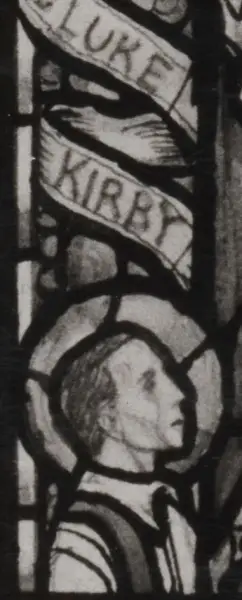
Kirby's memory endures in a handful of quiet and touching monuments. In the English College in Rome there is preserved a corporal, the linen cloth used at Mass, into which the names of five martyred priests have been stitched; Luke Kirby is one of the names embroidered in that cloth, a relic that ties the seminary where he took his oath to the martyr who kept it. At St. Edmund's College in Ware, the heir of the old English Catholic colleges, a portion of a stained glass window portrays him, so that generations of seminarians have studied and prayed beneath the face of a man who died for the priesthood they were preparing to receive. His story has also been told in print: a book entitled Blessed Luke Kirby: Priest and Martyr, written by Michael TH Banks, appeared nine months before his canonization, helping to introduce him to a wider public at the very moment the Church raised him to the altars. Together these memorials keep before the Church the figure of a Yorkshire scholar who traded a promising career for the gallows and found in that trade the glory of martyrdom.
§ Legacy and relic
Timeline
- 1549
Born around this year, probably near Richmond in Yorkshire, England.
§ Early life
- 1576
Entered Douai College in the Spanish Netherlands after converting to Catholicism at Louvain.
§ Early life
- Sep 1577
Ordained a priest at Cambrai.
§ Early life
- 3 May 1578
Departed Rheims for the English mission.
§ Early life
- 15 Jul 1578
Returned to Rheims and then traveled on to Rome.
§ Early life
- 23 Apr 1579
Took the college oath at the English College in Rome.
§ Early life
- 14 Apr 1580
Set out from Rome with Edmund Campion and Ralph Sherwin for the mission to England.
§ Mission
- Jun 1580
Seized by the authorities as he came ashore at Dover and sent to the Gatehouse prison.
§ Arrest
- 4 Dec 1580
Transferred from the Gatehouse to the Tower of London.
§ Arrest
- 9 Dec 1580
Subjected for over an hour to the torture of the Scavenger's Daughter in the Tower.
§ Arrest
- 17 Nov 1581
Condemned to death for treason at the trial held alongside Edmund Campion.
§ Execution
- 2 Apr 1582
Placed in irons, which he wore until his death.
§ Execution
- 30 May 1582
Executed at Tyburn alongside Thomas Cottam, Lawrence Richardson, and William Filby.
§ Execution
- 29 Dec 1886
Beatified by Pope Leo XIII.
§ Execution
- 25 Oct 1970
Canonized by Pope Paul VI as one of the Forty Martyrs of England and Wales.
§ Execution
The Record
- Symbols
- martyr's palm·book of hours
- Canonization
- Canonized 25 October 1970 by Pope Paul VI as one of the Forty Martyrs of England and Wales
Prayer
Bibliography
Show 7 sources
- Farmer, David. The Oxford Dictionary of Saints, 5th ed., OUP. 2011, ISBN 9780199596607
- Challoner, Richard. Memoirs of Missionary Priests, Thomas Richardson & son, 1843, p. 110
- Camm O.S.B., Dom Bede, Lives of the English Martyrs, Vol. II, pp. 500-522, Longmans, Green and Co., London, 1914
- Stanton, Richard, A Menology of England and Wales, p.243, Burns & Oates, Ltd., London, 1892
- Wainewright, John. "Filby Family." The Catholic Encyclopedia. Vol. 15. New York: Robert Appleton Company, 1912
- "Five Martyrs | Jesuit Collections". www.jesuitcollections.org.uk. Retrieved 21 July 2022
- Banks, Michael TH (1 January 1970). Blessed Luke Kirby. Office of the Vice-Postulation.
Profile text adapted from the Wikipedia article, licensed CC BY-SA 4.0.
Pray with this saint every day
Save St. Luke Kirby to your favorites, read the full profile, and get feast-day reminders in the Saints app.
Get the Saints AppFree on the App Store for iPhone and iPad