
c. 896 – c. 953·Feast February 7
St. Luke of Steiris
Byzantine wonder-worker and founder of Hosios Loukas
Overview
Luke of Steiris, also called Luke the Younger, Luke of Hellas, and Luke the Wonder-worker, was a Byzantine ascetic of the tenth century who became one of the most beloved saints of the Greek church. Born around 896 in the village of Kastorion in Phocis to a family of poor farmers, he tried twice as a boy to run away to the monastic life before receiving his mother's blessing at fourteen to withdraw to Mount Ioannitza, where he lived as a solitary for seven years. Driven out by the Bulgarian invasion of Symeon, he studied briefly at Corinth and then spent ten years serving a stylite at Zemena. After Symeon's death in 927 he returned to Ioannitza and gathered a community, only to be displaced again by a Magyar invasion, which he weathered on a desert island for three years. About 946 he founded his hermitage at Stiris in Boeotia, beneath the heights of Helicon in the hill country between Delphi and the Corinthian Gulf, where disciples gathered and a monastery grew up around him, its church dedicated to the Great Martyr Barbara. There he was celebrated as a healer of soul and body and was one of the earliest saints recorded as levitating in prayer. He died around 953, and his relics remain at his monastery of Hosios Loukas.
The Complete Life
The Child of Kastorion
Luke was born around 896 in the Greek village of Kastorion in Phocis, the third among the seven children whom Stephen and Euphrosyne, a poor farming couple, brought up. The account of his life, written by a monk of his own monastery who had been one of his followers, opens in the manner of the genre with signs of the child's closeness to God. Luke, his biographer records, did nothing in a childish fashion; and the most striking sign came when his mother came upon him at prayer and saw him levitating, an experience that convinced her that her son belonged to God in a singular way. As a boy he worked in the fields and tended the family's sheep, but the ordinary life of a farming household could not hold him. Twice he tried to slip away from home in hope of the solitary life of prayer. On the first attempt he made for Thessaly, but soldiers lying in wait for runaway slaves caught the boy and took him back. The second attempt succeeded: he fell in with two monks on the road from Rome toward Jerusalem; these brought him to a monastery at Athens and there clothed him with the small habit. Only his mother's prayer ended the adventure, for God brought the abbot a dream in which the mother stood before him and ordered that Luke be given back.
§ Childhood
Seven Years on Ioannitza
At the age of fourteen Luke at last received his mother's blessing, and he retreated to a lonely spot on the mountain called Ioannou, or Ioannitza, keeping there the ascetic life for seven years. His biographer notes a pleasing symmetry in the course of his formation: it was two monks traveling from Jerusalem to Rome, surely the same two men who had clothed him with the small habit on their eastward way, and who now bestowed on him the great and solemn habit of the desert. The fame of the young hermit began to spread abroad, and the record credits these years with a number of wonders, among them the disclosure to two brothers of the spot where their dead father had hidden a treasure. The Life also preserves the disciplines by which Luke trained his soul. He slept in a trench dug in the earth, so that the thought of death would never leave him. He was visited, so the account runs, by an angel in a dream who drew from his mouth, by means of a hook, a certain fleshy part, delivering him from the assaults of the flesh. Tales like these mark him in the hagiographic tradition as a wonder-worker from the beginning of his ascetic career.
§ Asceticism
Exile and Wandering
The wars of the tenth century broke in upon Luke's solitude. The Bulgarian emperor Symeon invaded the theme of Hellas — an invasion Luke himself had predicted — and the hermit was forced to leave his mountain. The villagers followed him, and the whole company fled to a nearby island, where they nearly perished when Bulgarians attacked them in a stolen ship. After the invaders withdrew, Luke, then about twenty-one, tried another path and enrolled in a school in Corinth, but he soon abandoned his studies, finding his fellow students insufficiently serious. Instead he spent the next ten years in the service of a stylite at Zemena, learning the discipline of holiness at the foot of a pillar ascetic. An errand stranded him in the Peloponnese when the harbor master, fearing raids, refused him passage back to Hellas; and when a rainstorm led to his being ejected from his oratory in the Peloponnese, his hagiographer saw providence in the misfortune, remarking that God perhaps arranged it lest he do an injustice to his fatherland by lingering overlong in the land of Pelops — a comment that hints at a rival cult in the Peloponnese and shows the patriotism of the theme.
§ Exodus
The Wonder-Worker of Two Invasions
Symeon died in 927, and his more pacific son Peter succeeded him; the Life cites this change as the reason Luke was able to return to Ioannitza and build a community of his own. So many disciples gathered around him that he found the company unbearable and withdrew deeper into the wilderness. Three years later he was displaced once more, this time by a Magyar invasion, and again he retreated with the villagers to a nearby island. There, on what proved a desert island, he discovered a place suited to the solitary life and remained three years, enduring terrible thirst. These trials shaped the spirituality that the monks of Hosios Loukas remembered: a life marked by flight from the world, by endurance of invasion and exile, and by the conviction that God was arranging each hardship for a beneficent end. The biography records that during these years proofs of his holiness multiplied, so that the hermit of Ioannitza became known throughout the themes of Hellas and the Peloponnese as a wonder-worker long before he founded the house that bears his name. Levitation in prayer, the healing of the sick, and the uncovering of hidden things made him, in the memory of his disciples, a bearer of the desert tradition in the Byzantine countryside.
§ Return
Stiris and the Monastery of Barbara
At length the companions of Luke prevailed on him to quit the island, and he took up his abode for good in far gentler surroundings: the region of Stiris in Boeotia, whose name may be a corruption of Soterion, the place of healing. There, about the year 946, high on the flank of Helicon in the country between Delphi and Levadia and not far above the waters of the Corinthian Gulf, he planted his hermitage. Once more disciples assembled about the elder, and out of their company arose a modest monastery whose church was given over to the Great Martyr Barbara. In this final dwelling the saint worked wonder upon wonder, curing ailments of soul and body alike, and the ceaseless flow of pilgrims that found its way up Helicon made the hermitage a place of resort for the whole region. Luke died around 953, not long after the founding, but the community he planted endured and grew into the great monastery of Hosios Loukas — Venerable Luke — that still stands on the site. There his relics are preserved to this day, and it was a monk of that house, one of Luke's own followers, who wrote the anonymous Life that preserves the memory of his childhood, his wanderings, and his miracles.
§ Return
Feast and Veneration
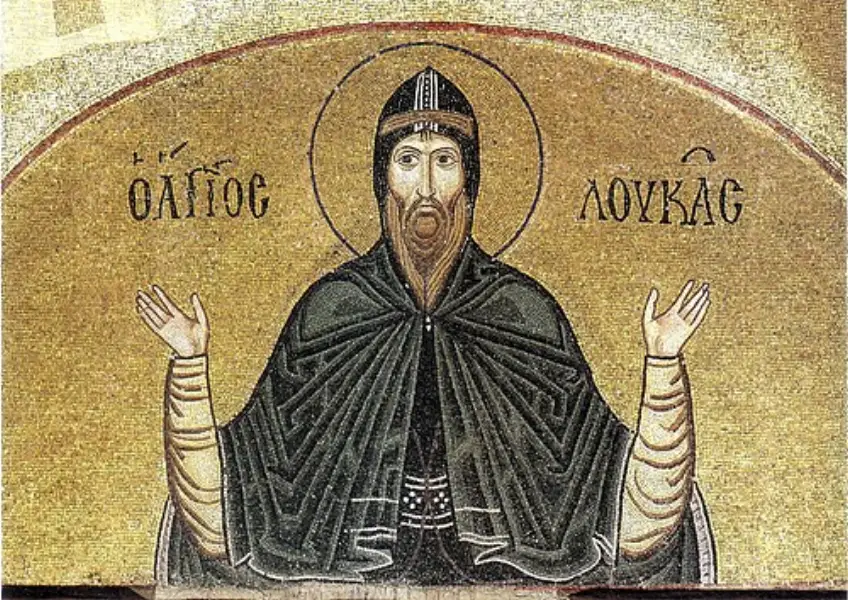
Luke was never canonized by a formal act, for he belongs to the company of pre-congregation saints whose cult arose among the people and was ratified by the practice of the church. The Eastern Orthodox Church honors him each year on 7 February, his principal feast, and keeps a second commemoration on 3 May, the feast of the translation of his relics. His veneration centered from the beginning at his own monastery of Hosios Loukas, where his body was laid and where his tomb became the heart of the pilgrimage. The fame of the site proved lasting: the monastery that grew from his hermitage became one of the celebrated monuments of middle Byzantine Greece, and its mosaics include a depiction of the saint himself, shown as Luke the Younger. His cult was not confined to Boeotia, for, as the comment of his hagiographer about the Peloponnese suggests, devotion to him flourished in more than one theme, and the calendars of the Orthodox church in Greece record his feast in the synaxaria. In the modern church he continues to be commemorated under his various names — Luke of Steiris, Luke of Hellas, Luke the Wonder-worker — and the Orthodox Church in America keeps his memory among the venerable fathers of the Greek lands.
§ Luke of Steiris
The House That Bears His Name
The enduring legacy of Luke of Steiris is the monastery of Hosios Loukas, the house that grew from the hermitage he founded at Stiris around 946. From a small band of brethren gathered around an aging ascetic, the site became one of the most famous monastic centers of Greece, and the church dedicated there first to the Great Martyr Barbara was followed by buildings whose mosaics preserve the image of the founder among the saints of the church. The monastery keeps his relics, and the translation of the relics is remembered with its own feast on 3 May. His life, written by an anonymous monk of the community who had followed him in the flesh, became the principal source for his story and a valued example of Byzantine hagiography, studied in modern editions such as the translation and commentary of the Conners. The Life preserves details of rare vividness — the levitating child, the trench in which the hermit slept, the providential storms of the Peloponnese — and shows how the wars of Symeon and the Magyar raids shaped the spiritual geography of tenth-century Greece. Luke stands in that record as the holy man of the countryside, drawing to Mount Helicon the poor farmers and villagers among whom he had been born, and leaving them a house of healing on the mountain above their fields.
§ Luke of Steiris
Timeline
- 896
Born around this year in the village of Kastorion in Phocis, the third of seven children of Stephen and Euphrosyne.
§ Childhood
- 927
After the death of the Bulgarian emperor Symeon, returned to Ioannitza and began building his own community.
§ Return
- 946
Founded his hermitage in the area of Stiris on the slopes of Mount Helicon, where a monastery soon grew up.
§ Return
- 953
Died around this year at Stiris; his remains are kept in veneration at the monastery that bears his name.
§ Luke of Steiris
In Their Own Words
God perhaps arranged these things beneficially, lest dwelling too long in the land of Pelops he do an injustice to his fatherland
The Record
- Major works
- Monastery of Hosios Loukas
- Symbols
- levitating in prayer·monastic habit of the desert fathers
- Canonization
- Pre-congregation saint, venerated in the Eastern Orthodox Church
Prayer
Bibliography
Show 6 sources
- Saint Patrick Catholic Church: Saints of February 7
- Ὁ Ὅσιος Λουκᾶς ὁ ἐν Στειρίῳ τῆς Ἑλλάδος. 7 Φεβρουαρίου. ΜΕΓΑΣ ΣΥΝΑΞΑΡΙΣΤΗΣ
- Ἀνακομιδὴ Τιμίων Λειψάνων Ὁσίου Λουκᾶ τοῦ ἐν Στειρίῳ. 3 Μαΐου. ΜΕΓΑΣ ΣΥΝΑΞΑΡΙΣΤΗΣ
- "Venerable Luke of Hellas". OCA - Lives of the Saints
- McInerney, Jeremy. The Folds of Parnassos: Land and Ethnicity in Ancient Phokis. University of Texas Press, 1999. p. 317
- Connor, Walter Robert; Connor, Carolyn Loessel (Eds.). The Life and Miracles of Saint Luke of Steiris: Text, Translation and Commentary. Archbishop Iakovos Library of Ecclesiastical and Historical Sources, Vol. 18. Hellenic College Press, 1994. ISBN 9780917653353
Profile text adapted from the Wikipedia article, licensed CC BY-SA 4.0.
Pray with this saint every day
Save St. Luke of Steiris to your favorites, read the full profile, and get feast-day reminders in the Saints app.
Get the Saints AppFree on the App Store for iPhone and iPad