
1st century AD (traditionally died at 84)·Feast October 18
St. Luke the Evangelist
Physician, companion of Paul, author of the third Gospel
Overview
Luke the Evangelist, remembered in Latin as Lucas and in Greek as Loukas, was one of the Four Evangelists, the traditionally ascribed authors of the canonical gospels, to whom Christian tradition assigns the third Gospel together with the Book of Acts; the New Testament speaks of him only in passing: the Epistle to Philemon names him among Paul's fellow workers, the Epistle to the Colossians calls him the beloved physician, and the Second Epistle to Timothy laments, at the end of Paul's life, that only Luke remains at his side. Many scholars believe he was a physician of the Hellenistic city of Antioch in ancient Syria, born of a Greek family, and among the most highly educated writers of the New Testament. The we-passages of Acts suggest he was a traveling companion of Paul, joining him at Troas, staying in Philippi, and sailing with him on the perilous voyage to Italy. Tradition holds that he died a martyr at the age of eighty-four in Boeotia, with his tomb at Thebes, whence his relics were taken to Constantinople in 357. Since the earliest years of the faith Christians have honored him as a saint; he is venerated across the major denominations as patron of artists, physicians, and many other trades, with his feast kept on 18 October.
The Complete Life
The Physician of Antioch
Luke emerges from the written record in brief but telling strokes. Many scholars believe he was a physician — the Colossians passage uses the Greek word for one who heals — who lived in the Hellenistic city of Antioch in ancient Syria, born of a Greek family, though some scholars and theologians judge him instead to have been a Hellenized Jew. Whatever his ancestry, the quality of the Greek of Luke–Acts shows an author among the most highly educated of the New Testament writers. His text consciously echoes and cites the classical and Hellenistic writers — Homer, Aesop, Epimenides, Euripides, Plato, Thucydides, Aratus — an acquaintance with the Greek literary tradition that most likely came from his youthful experience of the enkyklios paideia, the common Hellenistic curriculum of the eastern Mediterranean that had schooled generations before him and would school generations after. Later tradition added its own identifications: Epiphanius counted him among the Seventy Apostles, and John Chrysostom at one point suggested that the brother praised by Paul in Second Corinthians was either Luke or Barnabas. His earliest certain mention is in the Epistle to Philemon, where Paul numbers him among his fellow workers, and in Colossians he sends greetings as the beloved physician alongside Demas.
§ Life
Companion of Paul
If the Luke of tradition is the author of Acts, the book itself tells when he joined the mission. Though he excludes himself from the eyewitnesses of Jesus' ministry, he repeatedly slips into the first person in describing Paul's journeys, using the word we, which indicates that he stood at Paul's side at those moments. On that reading, the author met the apostle at Troas and crossed with him to Macedonia, was left behind for a time in Philippi, and around the year 52 rejoined Paul there on the return toward Syria and Jerusalem. He then stayed beside Paul on the perilous third journey and sailed with him to Italy, his presence in Rome at the end of the apostle's life being attested by Paul's own words in Second Timothy: only Luke is with me. The last chapter of Acts carries first-person accounts that likewise place him in the capital. A quiet detail in Colossians, where Luke is distinguished from the colleagues of the circumcision, led most commentators to conclude he was a gentile — which would make him the only New Testament writer plainly not Jewish — though others note the phrase may simply separate strict observers of Jewish ritual from those who did not keep it. Some accounts even credit him with a share in composing the Epistle to the Hebrews.
§ Life
The Two-Volume Work
The Gospel of Luke and the Acts of the Apostles together form a two-volume work that scholars call Luke–Acts, accounting for 27.5 percent of the New Testament — the largest single contribution of any one author. The Gospel never names its writer, in the manner of other Greco-Roman lives, and it claims dependence on eyewitnesses rather than direct sight. But Acts, from its sixteenth chapter onward, implies a traveling companion of Paul, and in most translations the author presents himself as an investigator of the events, writing to a certain Theophilus. The earliest witnesses assign the work to Luke: the Muratorian fragment, a seventh-century Latin manuscript thought to translate a Greek text as old as AD 170, ascribes it to him; Irenaeus did the same around AD 180; and Papyrus 75, the oldest manuscript of the Gospel, dated about AD 200, carries his name, as Jerome and Eusebius later reaffirmed. Most scholars read the work in the tradition of Greek historiography, for the preface of the Gospel identifies itself as the product of careful investigation. Assessments of its accuracy divide: William Mitchell Ramsay ranked Luke a historian of the first rank, while others, working with the methodological naturalism of post-Enlightenment scholarship, question a narrative filled with angels and demons, noting that Luke wrote to proclaim and persuade rather than to preserve records.
§ Authorship of Luke and Acts
Thebes and the Long Journey of the Relics
Tradition preserves few details of Luke's last years but a firm conviction of his end. A fairly early and widespread tradition holds that he died at the age of eighty-four in Boeotia, though the sources do not agree that he suffered martyrdom, and some doubt that his death was a martyr's at all; another tradition reports that he was hanged from an olive tree. By the testimony of the fourteenth-century Greek historian Nikephoros Kallistos Xanthopoulos and other writers, his burial place was at Thebes, and in the year 357 his remains were carried from there to Constantinople. The remains journeyed on in later ages: they were discovered about 960, in the days of Romanos Lakapenos, within a monastery of Saint Augusta, and Patriarch Polyeuctus brought them under Constantine Porphyrogenitus to the Church of the Holy Apostles. In the fifteenth century the Serbian despot George was reputed to have purchased the remains from Sultan Murad II at a price of 30,000 gold coins, and when the Ottomans overran Bosnia, that kingdom's final queen Mary — George's own granddaughter — parted with them to the Venetian Republic. In our own day the body lies in the Abbey of Santa Giustina at Padua, the head is enshrined at Saint Vitus Cathedral in Prague, and a single rib rests beside the tomb at Thebes.
§ Relics
Venerated Since the Beginning
Luke belongs to that first generation of Christians whose sanctity the church recognized without any process of canonization; from the church's first decades, believers have counted him among the saints, and he receives the veneration of every major denomination that honors the saints. His principal feast falls on 18 October, observed alike by the Roman Catholic Church and the Church of England; the Eastern churches that follow the Julian calendar keep the same feast on 31 October. The Orthodox tradition, which honors him as apostle of the Seventy, evangelist, companion of Paul, hieromartyr, physician, and first icon painter, keeps several additional fixed feasts: the Synaxis of the Seventy Apostles on 4 January, a joint commemoration with the apostles Nathaniel, Clement, and Apelles on 22 April and again on 10 September, and the translation of his relics and garments on 20 June. He is remembered also in the moveable synaxes of all the saints of Achaia and of Boeotia, the Greek lands of his mission and his tomb. The Coptic Orthodox Church marks his martyrdom on 22 Paopi. Even the Druze faith, which reveres certain biblical figures, numbers Luke among the personages whose lives it covers, a rare reach beyond the Christian churches.
§ Veneration
First of the Icon Painters
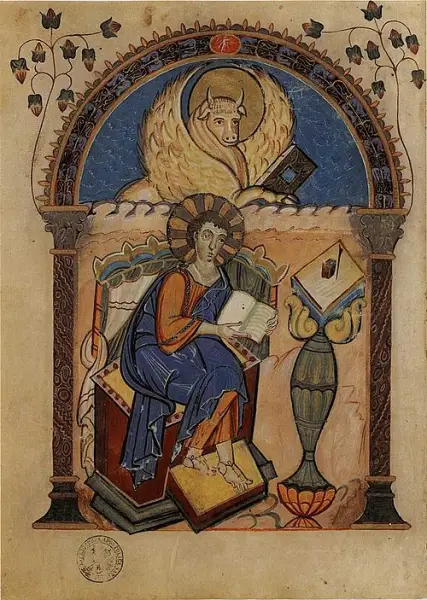
From the eighth century onward, Christian tradition has honored Luke as the earliest of the icon painters. Ancient accounts tell of his painting the Virgin Mary with her Child, above all the Hodegetria image of Constantinople, now lost, together with likenesses of the two apostles Peter and Paul, and even the adornment of a gospel book with an entire cycle of miniatures. Beginning in the eleventh century, a series of paintings came to be honored as works from his own hand — the Black Madonna of Częstochowa, Our Lady of Vladimir, and the Madonna del Rosario among them, and the Saint Thomas Christians of India claim still to possess a Theotokos icon that the apostle Thomas carried to their shores. The art critic A. I. Uspensky observed that the icons attributed to the Evangelist bear a wholly Byzantine character established only in the fifth and sixth centuries, and critical study of the legends has traced their growth with care; yet the tradition took deep institutional root. The late medieval Guilds of Saint Luke gathered and protected painters in cities across Europe, Flanders among them, and the Academy of Saint Luke in Rome was imitated in many other cities in the sixteenth century. In traditional depictions Luke is accompanied by a winged ox or calf, the sacrificial animal from Ezekiel and Revelation that marks a Gospel which stresses the sacrificial character of Christ's ministry and opens with Zechariah at his priestly duties.
§ As an artist
Timeline
- 52
Around this year, as inferred from the we-passages of Acts, rejoined Paul at Philippi on the return to Syria and Jerusalem.
§ Life
- 170
The Muratorian fragment, a Latin manuscript thought to be copied from a Greek text as old as this year, ascribes the Gospel to Luke.
§ Authorship of Luke and Acts
- 180
Irenaeus, writing around this year, affirmed Luke's authorship of the Gospel and Acts.
§ Authorship of Luke and Acts
- 200
Papyrus 75, the earliest manuscript of the Gospel, dated around this year, ascribes the work to Luke.
§ Authorship of Luke and Acts
- 357
According to Nikephoros Kallistos Xanthopoulos and others, Luke's relics were transferred from his tomb at Thebes to Constantinople.
§ Life
- 960
Relics and garments of Luke were found in a monastery of Saint Augusta and translated to the Church of the Holy Apostles in Constantinople by Patriarch Polyeuctus.
§ Veneration
- 1992
Greek Orthodox Metropolitan Ieronymos of Thebes and Livadeia requested the return of a fragment of the relics from the Bishop of Padua.
§ Relics
- 2001
A genetic study of the Padua remains matched them to a man of Syrian origin whose death fell somewhere between AD 72 and AD 416.
§ Relics
In Their Own Words
Luke is a historian of the first rank; not merely are his statements of fact trustworthy. ...[He] should be placed along with the very greatest of historians.
For accuracy of detail, and for evocation of atmosphere, Luke stands, in fact, with Thucydides. The Acts of the Apostles is not shoddy product of pious imagining, but a trustworthy record. ...It was the spadework of archaeology which first revealed the truth.
The Record
- Major works
- Gospel of Luke·Acts of the Apostles
- Patron of
- patron of artists·patron of physicians·patron of notaries·patron of bachelors·patron of goldsmiths·patron of butchers·patron of brewers·patron of glass workers
- Symbols
- winged ox or calf·book or pen·painting an icon of the Blessed Virgin Mary·brush and palette
- Canonization
- Pre-congregation saint, venerated since the earliest years of the Christian faith
Prayer
Bibliography
Show 11 sources
- Brown, Raymond E. (1997). An Introduction to the New Testament. New York: Doubleday. ISBN 978-0-385-24767-2
- Ramsay, Sir William Mitchell (1915). The Bearing of Recent Discovery on the Trustworthiness of the New Testament. Hodder and Stoughton
- Blaiklock, E. M. (1970). The Archaeology of the New Testament. Zondervan
- Hemer, Colin J. (1989). The Book of Acts in the Setting of Hellenistic History. Mohr. ISBN 978-3-16-145451-6
- Johnson, Luke Timothy (1991). The Gospel of Luke. Sacra Pagina. Liturgical Press. ISBN 978-0-8146-5805-5
- Butler, Alban (1991). Walsh, Michael (ed.). Butler's Lives of the Saints. New York: HarperCollins Publishers. ISBN 978-0-06-069299-5
- Aherne, Cornelius (1910). "Gospel of Saint Luke". In Herbermann, Charles (ed.). Catholic Encyclopedia. Vol. 9. New York: Robert Appleton Company
- Reece, Steve (2022). The Formal Education of the Author of Luke-Acts. London: T&T Clark. ISBN 978-0-567-70588-4
- Vernesi, Cristiano; et al. (6 November 2001). "Genetic characterization of the body attributed to the evangelist Luke". Proceedings of the National Academy of Sciences of the United States of America. 98 (23): 13460–63
- Wade, Nicholas (16 October 2001). "Body of St. Luke Gains Credibility". The New York Times
- Fine, John van Antwerp (1975). The Bosnian Church: A New Interpretation. East European Quarterly. ISBN 978-0-914710-03-5
Profile text adapted from the Wikipedia article, licensed CC BY-SA 4.0.
Pray with this saint every day
Save St. Luke the Evangelist to your favorites, read the full profile, and get feast-day reminders in the Saints app.
Get the Saints AppFree on the App Store for iPhone and iPad