
c. 879 – c. 970·Feast December 11
St. Luke the Stylite
Soldier-turned-pillar-hermit of Chalcedon
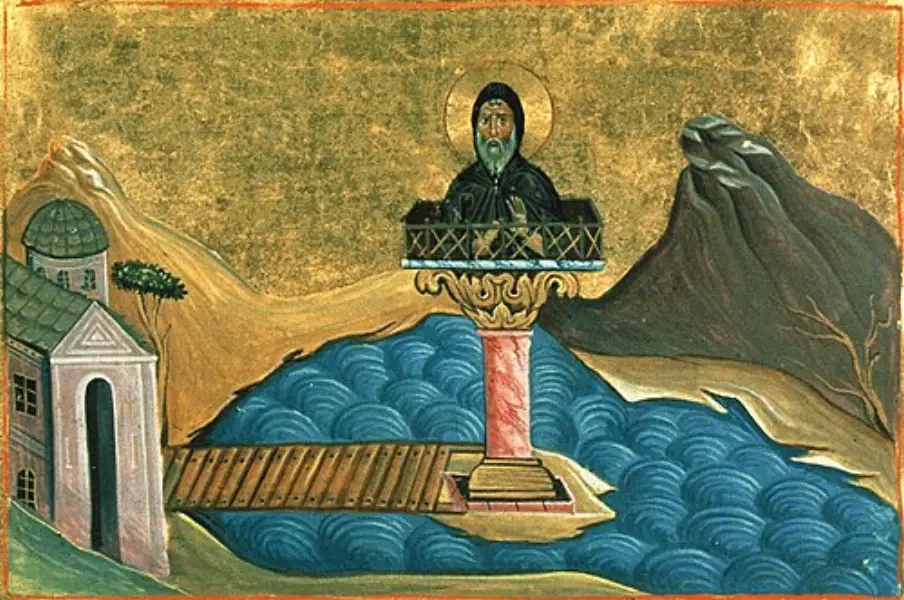
Overview
Luke the Stylite was a tenth-century Byzantine ascetic who abandoned the military life for an extraordinary career of penance and prayer atop a pillar. Born around 879, he bore arms under the emperor Constantine Porphyrogenitus. In battle against the Bulgarians he witnessed the slaughter of many thousands of men, and he came to believe that God had preserved his own life for a different purpose. He became a monk, was ordained a presbyter, and then embraced the eremitic discipline of the stylites, the pillar saints who carried out their asceticism on high platforms open to the sky. After three years standing on a pillar he withdrew to Mount Olympos in Bithynia, and from there made his way back to Constantinople and finally to Chalcedon. For the last forty-five years of his life he lived atop a pillar near that city, praying and counseling those who came to him, until his death around the year 970. He is venerated as a saint in the Eastern Orthodox Church and the Eastern Catholic churches of the Byzantine rite, which commemorate him on 11 December.
The Complete Life
A Soldier Who Saw Too Much
Luke was born around the year 879, and his youth was spent in the world of Byzantium, whose capital, Constantinople, was then the greatest city of Christendom. As a young man he took service as a soldier, and his military career fell during the reign of the emperor Constantine Porphyrogenitus, the learned ruler of the tenth century. In that capacity Luke marched against the Bulgarians, the formidable northern adversaries with whom the empire fought repeated and brutal wars. What he witnessed on campaign changed him forever: in the course of battle he saw several thousands of people put to death around him. The experience of standing amid such slaughter while his own life was spared struck him as a sign of divine providence. He came to believe that God had preserved him deliberately, that his survival was not an accident of the battlefield but a summons. Many men of his generation carried the memory of such carnage into civilian life; Luke resolved to carry it to a different destination altogether, laying down the sword and turning the remainder of his years toward the pursuit of holiness.
§ Luke the Stylite
From Monastery to Pillar
Fleeing the military life, Luke entered the monastic state, receiving the habit and in time ordination as a presbyter. Yet the ordinary disciplines of the monastery did not contain his aspiration. He resolved to embrace the vocation of the pillar hermits, joining the line begun by Simeon Stylites and carried on by figures such as Daniel, in which the ascetic made his dwelling atop a column, exposed to weather and to the gaze of the world, devoting himself to unceasing prayer. Luke stood upon a pillar for three years, long enough to test both body and resolve. He then withdrew to Mount Olympos in Bithynia, the celebrated haven of Byzantine monasticism where many holy men had sought deeper solitude, and lived there before the pull of the capital and the straits drew him onward. His wanderings brought him back to Constantinople, and at last to Chalcedon on the Asiatic shore of the Bosporus, where he would fix his dwelling for good. Each stage of the journey marked a progression in renunciation, from the regiment to the cloister, from the cloister to the column, and from the column to a permanence of consecration.
§ Luke the Stylite
Forty-Five Years in the Air
Near the city of Chalcedon, Luke mounted the pillar on which he was to spend the rest of his life, and there he remained for forty-five years in pursuit of sanctity in Christ. The feat places him among the most enduring of the pillar ascetics, whose elevated dwellings made them at once a spectacle, an intercessor, and a living sermon for the surrounding population. From his platform he endured the heat of the Anatolian summer and the cold of the winter winds off the Propontis, sustaining himself through the ministry of those who served the pillar saints from below. Such men attracted the sick, the troubled, and the curious, and their counsel was sought by high and low alike. Luke persevered in this extraordinary vocation until extreme old age; he is believed to have died around the year 970, having lived some ninety years, most of them in penance and prayer. His memory was cherished by the churches of Constantinople and Chalcedon, and he came to be honored as Venerable Luke the Stylite. The Eastern Orthodox Church and the Byzantine-rite Eastern Catholic churches commemorate him each year on 11 December, and his likeness was preserved in the Menologion of Basil II, the great illuminated register of the saints of the capital.
§ Luke the Stylite
Timeline
- 879
Born around this year; he would live through nearly the whole of the tenth century.
§ Luke the Stylite
- 970
Died around this year after some forty-five years living atop a pillar near Chalcedon.
§ Luke the Stylite
The Record
- Symbols
- pillar·monastic habit
- Canonization
- Pre-congregation saint, venerated since antiquity in the Eastern Christian churches
Prayer
Bibliography
Show 2 sources
- "Venerable Luke the New Stylite of Chalcedon", Orthodox Church in America
- Thurston, Herbert. "Stylites (Pillar Saints)." The Catholic Encyclopedia Vol. 14. New York: Robert Appleton Company, 1912
Profile text adapted from the Wikipedia article, licensed CC BY-SA 4.0.
Pray with this saint every day
Save St. Luke the Stylite to your favorites, read the full profile, and get feast-day reminders in the Saints app.
Get the Saints AppFree on the App Store for iPhone and iPad