
c. 710 – 786·Feast October 16
St. Lullus
First archbishop of Mainz and abbot of Hersfeld
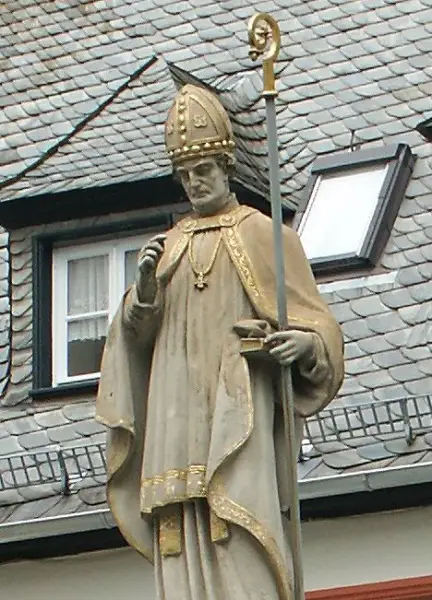
Overview
Lullus, also called Lull or Lul, was an Anglo-Saxon monk who became the first permanent archbishop of Mainz and the first abbot of Hersfeld Abbey. Born in Wessex around 710, he was a monk at Malmesbury before a pilgrimage to Rome in 737 brought him into the company of St. Boniface, the great apostle of Germany, whose closest assistant he was to become. After formation at the monastery of Fritzlar under Abbot Wigbert, he advanced through the orders of the church — attested as deacon in 745-46, archdeacon in 746-47, and priest by 751 — while serving as Boniface's trusted messenger, traveling twice to Rome on his behalf. When Boniface resigned the see of Mainz and named Lullus his successor, King Pippin confirmed him as bishop in 753, and he became archbishop in 754. He received the pallium from Pope Adrian I around 781 and enlarged his diocese by absorbing the sees of Büraburg and Erfurt. His chief achievement was the completion of Boniface's reform of the Frankish church and the consolidation of Christianity among the peoples of Hesse and Thuringia. He founded the Carolingian monastery of Hersfeld, where he died on 16 October 786 and was buried in its church.
The Complete Life
From Malmesbury to Rome
Lullus was born in the Anglo-Saxon kingdom of Wessex around the year 710, and his early name may have been Rehdgerus, a name handed down in many varying forms, Ratkar, Hredgar, and Raedgar among them. He embraced the monastic life at Malmesbury Abbey in Wiltshire, one of the venerable houses of the West Saxon church. His life took its decisive turn in 737, when he undertook a pilgrimage to Rome. On that journey, or in connection with it, he met St. Boniface, the West Country monk who had already won renown as the reformer of the Frankish church and the missionary of Germany. The encounter persuaded Lullus to abandon the security of his English monastery and attach himself to Boniface's perilous enterprise among the German tribes. In 738 he entered the Benedictine monastery of Fritzlar, which Boniface had founded in 732 as a base for the German mission. There his teacher was Abbot Wigbert, an Englishman like himself, and under this compatriot of Boniface the young monk received the formation that would fit him for the highest offices of the missionary church.
§ Monk to archbishop
Boniface's Closest Assistant
Lullus's rise among Boniface's collaborators was the rise of a man trusted with everything. The documents of the Boniface Correspondence show him as a deacon in 745-46, as the archdeacon of Mainz in 746-47, and as a priest by 751, though his ordination probably came earlier. As the youngest man in Boniface's circle, and tied as yet to no fixed place, he rose to become the aging apostle's nearest and most trusted helper. He carried Boniface's letters as his messenger and twice traveled to Rome on his business, even the delicate, secret talks over who should follow Boniface in the see of Mainz. Michael Tangl, in a study quoted by Theodor Schieffer, has proposed that the failing eyesight that troubled Boniface from the early 740s onward may have led him to lean on Lullus for the reading and drafting of his letters, and that the young monk had a hand in some of the mission's most important correspondence. The young monk also kept up an exchange of letters and gifts with Anglo-Saxon correspondents such as Edburga of Minster-in-Thanet and St. Leoba, evidence of the learned network of English religious that sustained the German mission across the Channel.
§ Monk to archbishop
Archbishop of Mainz
The death of Charles Martel in 741 opened the most important phase of Boniface's career, and Lullus was at his side throughout it. When the end approached, Boniface resigned the archbishopric of Mainz and appointed Lullus his successor; King Pippin confirmed him as bishop in 753, and he became archbishop in 754, the year of Boniface's martyrdom. The succession marked a change of orientation as well as of men: where Boniface had looked constantly to Rome, Lullus sought a closer and more practical understanding with the Frankish kings, binding the German church to the Carolingian state that would protect it. Around 781 Pope Adrian I granted him the pallium, making him the first regular archbishop of Mainz, and he expanded his province by absorbing the neighboring bishoprics of Büraburg near Fritzlar and Erfurt. Historians consider him the first official sovereign of what became the Electorate of Mainz, the ecclesiastical principality that would rank among the greatest powers of the empire. His chief accomplishment, in the judgment of history, was the finishing of Boniface's reform of the church across the Frankish empire of the Carolingians, and the bringing to completion of the conversion of the German peoples in Hesse and Thuringia.
§ Monk to archbishop
Hersfeld and the Quiet End
From 769 onward Lullus devoted himself to a foundation of his own: the monastery of Hersfeld, built in the new Carolingian style and destined to become one of the great abbeys of Germany. In 775 he succeeded in placing the abbey under the protection of Charlemagne's dynasty, the imperial patronage that secured its future. Hersfeld was the fitting counterpart to his episcopal work, a house of prayer and learning planted in the newly Christianized lands of Hesse that his archdiocese governed. There, at Bad Hersfeld, Lullus spent his last years, and there he died on 16 October 786, after more than three decades as archbishop of Mainz. He was buried in the abbey church he had founded, and his tomb made Hersfeld the center of his cult. The city of Bad Hersfeld grew up around his abbey and still honors the West Saxon monk who went out from Malmesbury in the 730s to bring the Christian faith to the tribes of Germany; its Lullusfest, celebrated in his honor as the festival of the city's founding, is counted the oldest folk festival in Germany and marked its 1,160th year in 2012.
§ Carolingian era
Honored at the Altar
The memory of Lullus was kept above all at Hersfeld, where he was buried. The Vita Lulli, a life of the saint written by the monk Lampert of Hersfeld, probably between 1063 and 1073, gave his story its lasting literary form and led to his widespread veneration as a saint; he became, along with his old teacher Wigbert, one of the two chief patrons of the abbey. His cult spread to the universal church, and he is venerated in both the Roman Catholic and the Eastern Orthodox churches. The date of 7 April 852 is traditionally given for his canonization, and he is commemorated with a feast on 16 October, the day of his death. It should be noted, however, that scholars have pointed out that no formal act of canonization ever took place: the ceremony of 852 was the translatio, the solemn removal of his relics, which has variously been misread as a papal canonization. Whatever the precise juridical character of his elevation, the devotion of the church of Mainz and Hersfeld to their first archbishop has never wavered since the ninth century, and he stands in the calendar among the missionary saints of the Catholic Church.
§ Veneration
The First Sovereign of Mainz
Lullus's significance reaches beyond sanctity into the constitutional history of Germany. As the first permanent archbishop of Mainz, he established the see that would become the premier church of the German lands, and historiography regards him as the first official sovereign of the Electorate of Mainz, the prince-archbishopric whose holder would later preside over the election of emperors. In the church, his completion of Boniface's reform fixed the structures of the hierarchy in Hesse and Thuringia that endured for a thousand years. His abbey of Hersfeld became a center of the Carolingian renaissance, its chroniclers and its school carrying the learning of the empire into the Saxon lands; the Vita Lulli written there in the eleventh century is itself a monument of medieval historiography. His adoption of a Frankish rather than a Roman political orientation set the course of the Mainz church for the centuries that followed. And in Bad Hersfeld his name still lives in the ordinary life of the people: the Lullusfest that celebrates the founding of the city, said to be more than 1,275 years old, keeps alive the memory of the Wessex monk who made the valleys of Hesse his home and his harvest.
§ Veneration
Timeline
- 710
Born in Wessex around this year.
§ Monk to archbishop
- 737
Met St. Boniface during a pilgrimage to Rome and resolved to join his missionary work in northern Germany.
§ Monk to archbishop
- 738
Entered the Benedictine monastery of Fritzlar, founded by Boniface, where Abbot Wigbert became his teacher.
§ Monk to archbishop
- 741
On the death of Charles Martel, became the closest assistant of Boniface at the height of his career.
§ Monk to archbishop
- 745
Attested as a deacon in 745-46, according to the Boniface Correspondence.
§ Monk to archbishop
- 746
Served as Boniface's archdeacon in 746-47.
§ Monk to archbishop
- 751
Attested as a priest, though his ordination probably preceded this date.
§ Monk to archbishop
- 753
Confirmed by King Pippin as bishop of Mainz.
§ Monk to archbishop
- 754
Became archbishop of Mainz when Boniface resigned the see and appointed him successor.
§ Monk to archbishop
- 769
Set in motion the founding of Hersfeld Abbey, a monastery built in the new Carolingian manner.
§ Carolingian era
- 775
Secured the placement of Hersfeld Abbey under the protection of Charlemagne's dynasty.
§ Carolingian era
- 781
Received the pallium from Pope Adrian I, becoming the first regular archbishop of Mainz.
§ Monk to archbishop
- 16 Oct 786
Died at Hersfeld Abbey at Bad Hersfeld and was buried in the abbey church.
§ Carolingian era
- 7 Apr 852
Date given for his canonization; the translation of his relics that year is sometimes mistaken for it.
§ Veneration
The Record
- Major works
- Hersfeld Abbey·Completion of Boniface's reform of the Frankish church
- Patron of
- main patron of Hersfeld Abbey, with St. Wigbert
- Canonization
- Canonized 7 April 852 (the formal canonization is doubted; the 852 translatio of his relics is sometimes mistaken for it)
Prayer
Bibliography
Show 9 sources
- "Saint Lullus", Athelstan Museum
- Böhmer, Johann Friedrich (1877). "2. Lullus. 754 or 755-786". In Will, C. (ed.). Regesta archiepiscoporum Maguntinensium. Innsbruck. pp. xiv–xv
- Schieffer, Theodor (1950). "Angelsachsen und Franken: II. Erzbischof Lul und die Anfänge des Mainzer Sprengels". Abhandlungen der Geistes- und Sozialwissenschaftlichen Klasse. 20: 1431–1539
- Mershman, Francis. "St. Boniface." The Catholic Encyclopedia. Vol. 2. New York: Robert Appleton Company, 1907
- "St. Boniface, Archbishop of Mentz, Apostle of Germany and Martyr", Butler's Lives of the Saints
- "Latin Saints of the Orthodox Patriarchate of Rome". www.orthodoxengland.org.uk. Retrieved 2025-01-17
- "Eine förmliche Kanonisation von Lullus fand nie statt. Die Umbettung (translatio) von 852 wird verschiedentlich falsch als Heiligsprechung interpretiert.
- Robins, Tina, "Malmesbury monk celebrated in Germany's oldest folk festival", Wilts and Gloucestershire Standard, 2 November 2012
- Fleck, Michael (ed.). Lampert von Hersfeld. Das Leben des heiligen Lullus. N. G. Elwert, Marburg, 2007. ISBN 978-3-7708-1308-7
Profile text adapted from the Wikipedia article, licensed CC BY-SA 4.0.
Pray with this saint every day
Save St. Lullus to your favorites, read the full profile, and get feast-day reminders in the Saints app.
Get the Saints AppFree on the App Store for iPhone and iPad