
died c. 307·Feast August 23
St. Lupus of Novae
Martyr and Servant of St. Demetrius
Overview
Lupus of Novae, honored in Romanian as Sfântul Lup, is a Dacian or Roman saint of the age of the last persecutions, remembered as the servant of Demetrius of Thessaloniki. He lived at the transition between the third and fourth centuries in Novae, a legionary fortress on the Danube that corresponds to the Bulgarian town of Svishtov, and his lifetime overlapped with the martyrs Montanus and Anastasia of Sirmium. The story told of him makes him a devoted attendant of Demetrius: he stood by his master at the martyr's death, soaked his own garments in the blood that fell, and took a ring from the dying man's hand. Returning to Thessaloniki with these relics, he became a wonder-worker and a provocateur of the pagan establishment, smashing idols and remaining untouched under persecution until he gave himself up voluntarily. By the order of the emperor Galerius he was beheaded with the sword on August 23, probably in the year 307, soon after his master's own passion. A medieval scholar's caution notes the tale may be apocryphal in its details, yet the cult at Novae itself is ancient and well attested.
The Complete Life
A Dacian of the Danube Frontier
Lupus belonged to the Christian community that took root in the Danube valley as the Roman empire entered its final century of persecutions. His home, Novae, was a fortress of the legionary army on the lower Danube, guarding the frontier of the province that corresponds today to Bulgaria; the modern town of Svishtov occupies the site. He was born in the closing period of the third century, and the world of his youth was one in which the old gods of the army camp and the new faith of the martyrs competed openly for men's allegiance. His people were Dacian or Roman by stock, and his cult was carried eastward into Romanian memory as well, where he is still called Sfântul Lup. The chronology of his life links him with the martyrs Montanus and Anastasia at Sirmium, a pairing that places his adulthood in the years of the great persecutions under the tetrarchy, when professing Christianity on the Danube frontier carried a real and frequently enforced penalty of death.
§ Life
Servant of Demetrius
The defining bond of Lupus' life was his service to Demetrius of Thessaloniki, the great martyr of the eastern church. He was, in the language of the tradition, a faithful servant of the saint, attending him in the final period before his passion. When the arrest and execution of Demetrius came, Lupus did not save himself by distance: he was present at his master's death, and in the moments after it he performed two acts that the hagiographers never tire of retelling. He dipped his own clothing in the blood of the martyr, making of his garments a relic of the passion he had witnessed, and he drew the ring from the dead man's hand, carrying off with it a token of his office and affection. These two objects became the treasuries of his later life. The act was risky to the point of folly, for possession of a martyr's relics was itself a crime under the persecution, and from that moment the servant of Demetrius carried the mark of the persecuted church on his very body.
§ Life
Wonder-Worker and Destroyer of Idols
With the bloodstained cloth and the ring of his master, Lupus went to Thessaloniki and there began the public career that made him a saint. The tradition credits him with many miracles worked through these relics, wonders that gathered the Christian community and advertised the power of the newly glorified Demetrius through the hands of his servant. But Lupus was not content with signs among the faithful. He attacked the pagan cults directly, assailing the idols themselves, an act of provocation that in the charged atmosphere of the persecutions amounted to a public profession of defiance. The pagan authorities responded with persecution, and the tradition insists that he passed through their hands unharmed, preserved by God as Daniel in the den or the three youths in the furnace. The pattern is a familiar one in martyr lore, and its purpose is clear: the saint's invulnerability demonstrated that the power of the idols was nothing, so that the final act of his life, when God at last allowed the sword to fall, would be seen as a free gift and not a defeat.
§ Life
Martyrdom
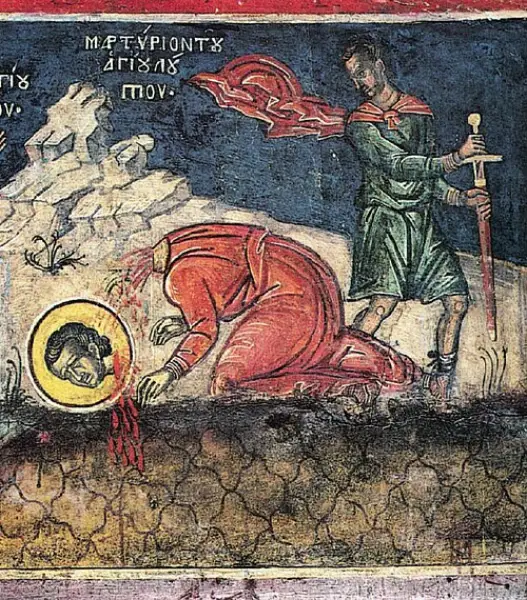
The end came when Lupus ended it, by choice. Rather than wait for the persecutors to seize him, he walked voluntarily into the hands of the torturers, an act the tradition records without surprise, for voluntary martyrdom was counted among the highest expressions of Christian freedom. He was brought before the imperial power, and by the order of the emperor Galerius — one of the chief architects of the final persecution — he was condemned to the sword. The execution took place on August 23, the date his feast still keeps, and fell probably in the year 307, a short time after the death of Demetrius whose servant he had been. Master and servant thus stand paired in the calendar, the great martyr of Thessaloniki and the Dacian who loved him, dying within seasons of one another in the same cause. Modern scholarship counsels reserve about the narrative's details, but the fact of his commemoration as a martyr, and the day assigned to it, belong to the church's oldest memory.
§ Life
Legacy at Novae
Whatever the historians say of his story, Lupus left a permanent mark on the place of his origin. When the old legionary fortress of Novae was transformed into a Roman-Byzantine town in the fifth and sixth centuries, the heart of the new city was an episcopal complex whose remains have been uncovered by archaeologists: a great basilica, residential buildings with remarkable baths, and a baptistery of striking design west of the basilica entrance. Beside these stood a large building plainly intended to lodge the pilgrims who came to honor the local martyr St. Lupus, evidence that his shrine drew travelers from afar and anchored the town's Christian identity. The cult was alive enough in the late sixth century that when Peter, brother of the emperor Maurice, marched his army through Novae on campaign in the Dacian lands, a chronicler thought the celebrations of St. Lupus' day worth recording. His memory also crossed into sacred art: in 1547 the monks of Dionysiou on Mount Athos painted his martyrdom in fresco, fixing the image of the servant of Demetrius in the visual tradition of the Orthodox world.
§ Novae
Timeline
- 23 Aug 307
Delivers himself to the torturers and is beheaded by order of Emperor Galerius, probably in this year
§ Life
- 1547
His martyrdom is painted in a fresco at the Dionysiou Monastery on Mount Athos
§ Introduction
In Their Own Words
his story is apocryphal
The Record
- Patron of
- Pilgrims to Novae, where a reception building served visitors to his shrine
- Symbols
- Fresco of his martyrdom·Ring of St. Demetrius
- Canonization
- Pre-congregation; venerated in the Eastern Orthodox and Catholic Churches
Prayer
Bibliography
Show 4 sources
- "Roman Martyrology August, in English".
- Walsh, Michael J., A New Dictionary of Saints, Liturgical Press, 2007, p. 375. ISBN 9780814631867
- Holweck, F.G., A Biographical Dictionary of the Saints, B. Herder, 1924, p. 628
- Teofilact Simocatta, în Historiae, VII, 2, 17, ed. Boor, Leipzig, 1887, p. 249.
Profile text adapted from the Wikipedia article, licensed CC BY-SA 4.0.
Pray with this saint every day
Save St. Lupus of Novae to your favorites, read the full profile, and get feast-day reminders in the Saints app.
Get the Saints AppFree on the App Store for iPhone and iPad