
c. 383 – c. 479·Feast July 29
St. Lupus of Troyes
Bishop Who Faced Attila at Troyes
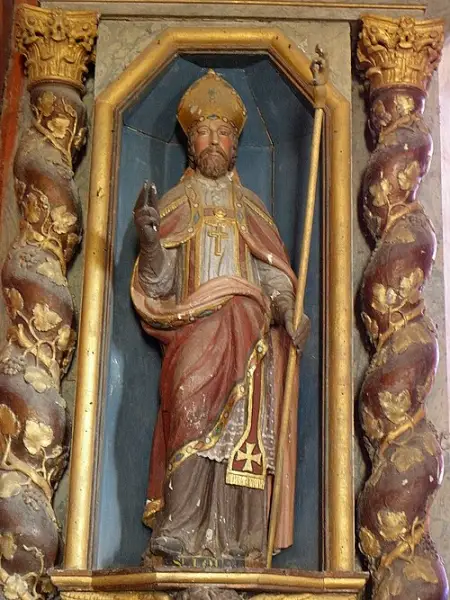
Overview
Lupus of Troyes, called Loup or Leu in French and Bleiddian in Welsh, was an early bishop of Troyes who lived from about 383 to about 478. Born at Toul, the son of the wealthy nobleman Epirocus, he was orphaned in infancy, raised by his uncle Alistocus, married to Pimeniola the sister of Hilary of Arles, and employed as a lawyer while holding estates in Maxima Sequanorum. After six years of wedlock, the two parted with one consent, and Lupus divested himself of his property for the poor before entering Lérins Abbey, then led by Honoratus. Forced by circumstance toward the episcopate, he resisted the appointment to Troyes at first, then yielded, and governed the see for fifty-two years. In 429 the Council of Arles dispatched him with Germanus of Auxerre to Britain to combat Pelagianism, a mission that bound his name to Welsh tradition. He is best remembered for the account in which his prayer and his bold procession saved Troyes from Attila's Huns in 451, and for the praise of Sidonius Apollinaris, who ranked him the first of the Gallic prelates.
The Complete Life
A Noble Orphan of Toul
Lupus was born around 383 at Toul, into the wealth of the Gallo-Roman aristocracy in the waning years of the Western Roman Empire. His father, Epirocus of Toul, was a rich nobleman, but he and Lupus' mother died while their son was still an infant, and the boy was taken in and brought up by an uncle named Alistocus. The family's connections reached to the highest circles of the Gallic church: Lupus has been called the brother of Vincent of Lérins, and by his marriage to Pimeniola he became brother-in-law to Hilary of Arles, one of the towering figures of fifth-century Gaul. As a young man he managed a number of estates in Maxima Sequanorum, the province of the Sequani, and practiced law, a profession that sharpened the skills of argument and administration he would later use as a bishop. His first life, in short, was entirely of this world — property, family alliance, professional standing — and the story of his sanctity is the story of how deliberately he dismantled it, piece by piece, in favor of the one he came to serve.
§ Life
From Marriage to Lérins
The turning of Lupus' life came through two renunciations, freely agreed. After six years of marriage, he and Pimeniola parted by mutual consent, a separation that both Christian tradition and Roman law recognized, and which in the lives of the Gallic saints often opened the way to the cloister or the episcopate. Lupus then sold his estate and distributed the proceeds to the poor, cutting himself off from the wealth that had defined his family for generations. He entered Lérins Abbey, the island monastery off the southern coast that had become the nursery of Gallican sanctity, then governed by Honoratus, and spent about a year within its discipline. The stay proved decisive even in its brevity. In 427 Honoratus was elevated to the bishopric of Arles and Hilary, Lupus' brother-in-law, went with him to assist at the new see, drawing the network of Lérins men into the church's government. Lupus withdrew to Macon, where his reputation brought him to the attention of Germanus of Auxerre — and Germanus, seeing the monk in the retired nobleman, determined to make him a bishop.
§ Life
Bishop of Troyes and Missionary to Britain
Lupus did not want the office Germanus had marked out for him. Named bishop of Troyes, he declined at first, and only under pressure did he relent and accept a charge he would carry for half a century. Within a few years that charge was extended far beyond his own diocese. British bishops, contending with the teaching of Pelagius spreading among their people, appealed to their counterparts in Gaul for help — an appeal first voiced around 426 — and in the autumn of 429 the Council of Arles answered it, sending Lupus and Germanus of Auxerre across the Channel to combat Pelagianism in person. The two Gallic bishops preached against the heresy in Britain through the following months and were back on Gallic soil shortly after Easter of the next spring. The expedition left permanent traces. In Wales, Lupus was remembered under the name Bleiddian, his story entered the early Welsh literature such as the Bonedd y Saint, and at Llanblethian in the Vale of Glamorgan he was venerated for centuries. Few Gallican bishops left their names so deeply printed on another nation's memory.
§ Life
Attila, Exile, and a Long Episcopate
The most famous story of Lupus belongs to the year 451, when the army of Attila swept into Gaul. The accounts relate that after praying for many days, the bishop went out to meet the Hunnish king dressed in full episcopal regalia at the head of a procession of his clergy, and that Attila, impressed by the sight, spared the city before going on to defeat at the Battle of Châlons. The tale then takes a bitter turn: Attila, persuaded that Lupus' presence would preserve his own army from destruction, asked the bishop to accompany him, and the Romans afterward accused Lupus of helping the Huns escape. Driven from his see by the slander, he withdrew to the mountains and lived as a hermit. Modern historians treat the episode with caution — a parallel story is told of Genevieve of Paris, and Donald Attwater judges the whole hagiographical rather than historical, though perhaps resting on the fact that Troyes escaped sacking and its people saw miraculous deliverance in it. What is beyond dispute is the length of his service: fifty-two years as bishop, ending with his death at Troyes in 479, and the tribute of Sidonius Apollinaris, who called him the friend of God and the first of the Gallican prelates. He numbered among his friendships Euphronius, bishop of Autun.
§ Lupus and Attila
Veneration
Lupus was numbered among the saints by the practice of the ancient church long before any process of canonization existed, and he is venerated today in both the Roman Catholic Church and the Eastern Orthodox Church. His feast falls on July 29, the date under which the old martyrologies and the collections of the lives of the saints commemorate him. The devotion that grew around him attached itself to the places of his life and mission: at Llanblethian in the Vale of Glamorgan he was honored for his part in the conversion-era mission to Britain, and in the diocese of his birth and burial his name was carried by parish churches, one of which, at Le Lou-du-Lac in Brittany, preserves his memory in its very name and building. His iconography is among the most distinctive in the Gallican calendar. Artists show a gemstone descending from the sky while he stands at the altar, or a chalice in his hand with a gem set in it, or the bishop presenting such a stone to a king — images that gather his priesthood, his heavenly favor, and his commerce with the powerful into a single emblem.
§ Life
Legacy
The legacy of Lupus rests on three foundations. The first is institutional: a fifty-two year episcopate at Troyes that made his see a fixed point of Christian life in northern Gaul through the catastrophic middle decades of the fifth century, when invasions, usurpers, and the fall of the Western Empire remade the world around it. The second is literary and linguistic: his mission to Britain against Pelagianism carried his name into Wales as Bleiddian and into the oldest strata of Welsh genealogical literature, the Bonedd y Saint, making him one of the few Gallic bishops whom the Celtic peoples claimed as their own. The third is the judgment of his contemporaries, above all Sidonius Apollinaris, whose description of him as the rule of manners and pillar of truth fixed his reputation for posterity. Historians have sifted the legend of Attila and the bishop carefully, distinguishing hagiography from history, yet even the sifting preserves the essential fact that Troyes stood unpillaged in a year when cities burned. A saint remembered as an intercessor for men — in the phrase of the poet-bishop who knew him — needs no better monument than a city that survived.
§ Lupus and Attila
Timeline
- 383
Is born at Toul, son of the nobleman Epirocus
§ Life
- 427
Honoratus is named Bishop of Arles, and Hilary accompanies him to the new see
§ Life
- 429
The Council of Arles sends Lupus and Germanus of Auxerre to Britain against Pelagianism
§ Life
- 430
Comes home to Gaul shortly after Easter of the following spring, the British mission accomplished
§ Life
- 451
Tradition honors him for sparing Troyes from Attila's Huns; the invader goes on to lose the Battle of Châlons
§ Lupus and Attila
- 479
Dies at Troyes after fifty-two years as bishop
§ Life
In Their Own Words
The father of fathers and bishop of bishops, the chief of the Gallican prelates, the rule of manners, the pillar of truth, the friend of God, and the intercessor to him for men
many scholars doubt the veracity of the account of the Attila incident
The Record
- Patron of
- Venerated at Llanblethian in the Vale of Glamorgan, Wales
- Symbols
- A diamond falling from heaven as he celebrates Mass·A chalice with a diamond in it, or a diamond at the altar·Giving a diamond to a king
- Canonization
- Pre-congregation; venerated in the Roman Catholic and Eastern Orthodox Churches
Prayer
Bibliography
Show 8 sources
- Holmes, T. Scott. The Origin and Development of the Christian Church in Gaul During the First Six Centuries of the Christian Era, Mac Millan, 1911, p. 480
- "Saint of the Day, July 29". Archived from the original on 2017-11-13. Retrieved 2012-02-22.
- Goyau, Georges. "Fréjus." The Catholic Encyclopedia Vol. 6. New York: Robert Appleton Company, 1909. 9 February 2019
- Hughes, John (1819). Horae Britannicae: Or, Studies in Ancient British History Containing Various Disquisitions on the National and Religious Antiquities of Great Britain. Volume 2. The Horæ Britannicæ translation of Archau y Saint. Vol. II. London. p. 161.
- Butler, Alban. "St. Lupus, Bishop of Troyes, Confessor", The Lives of the Saints, vol. vii, 1866
- Watkins OSB, Basil. "Euphronius of Autun", The Book of Saints: A Comprehensive Biographical Dictionary, Bloomsbury Publishing, 2015, p. 220. ISBN 9780567664150
- St. Lupus - Saints & Angels - Catholic Online
- Attwater, Donald. The Penguin Dictionary of Saints, (1945) Reprint: 1981, p. 223.
Profile text adapted from the Wikipedia article, licensed CC BY-SA 4.0.
Pray with this saint every day
Save St. Lupus of Troyes to your favorites, read the full profile, and get feast-day reminders in the Saints app.
Get the Saints AppFree on the App Store for iPhone and iPad