
1182 – 1246·Feast June 16
St. Lutgardis
Mystic of the Exchange of Hearts
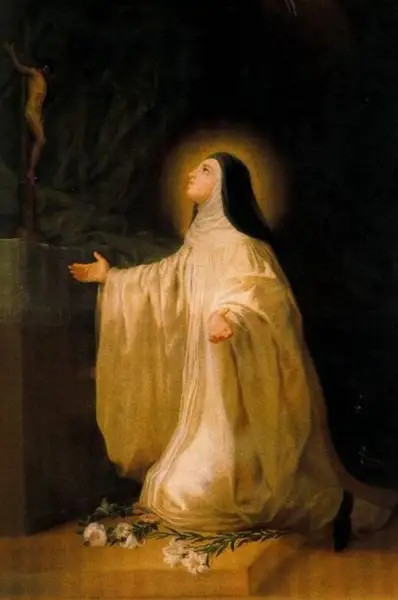
Overview
Lutgardis of Aywières, also spelled Lutgarde and known in Dutch as Sint-Ludgardis, was a Benedictine and later Cistercian nun of the medieval Low Countries who became one of the leading mystics of the thirteenth century. Born at Tongeren in 1182, she was placed at twelve in the Benedictine house of St. Catherine by Sint-Truiden, sent there because her dowry had been lost rather than because she felt a call. A vision of Christ showing his wounds changed her at twenty, when she made solemn vows, and in the years that followed Christ, his Mother, and St. John the Evangelist came to her sight again and again, along with ecstasies and other extraordinary favors. In 1208 she transferred to the stricter Cistercians at Aywières near Liège, where she deliberately refused to learn the French of her sisters so as to live in deeper silence. There she received the mystical grace for which she is best remembered: an exchange of her own heart with the Heart of Christ. A friend and spiritual mother to the early Dominicans and Franciscans, she spent her final eleven years in darkness and died at Aywières on 16 June 1246.
The Complete Life
A Girl of Tongeren
Lutgardis was born at Tongeren in 1182, in the Prince-Bishopric of Liège within the Holy Roman Empire — a town the French call Tongres, which is why she is also styled Lutgardis of Tongres or Luitgard of Tongeren. Her entry into religious life owed nothing to a girlish piety. Her dowry had been swallowed by a failed business venture, and the monastery of St. Catherine near Sint-Truiden, a Benedictine house, received her at the age of twelve in the way the age understood: a daughter without a marriage portion could be placed under a rule. The accounts of her youth are unusually frank. She was attractive, fond of fine clothes, and fond of enjoying herself, and she regarded the cloister as a socially respectable shelter from the disgrace that waited on unmarried women of the world. For years she drifted through convent observance with little interest in it, enjoying liberties that surprise the modern reader: she came and went and received visitors as she pleased. Nothing in the outward circumstances of her childhood suggested the interior edifice her life would become.
§ Life
Conversion in the Parlour
The change came in the most worldly corner of the monastery. The parlour, where visitors were received and the tedium of observance briefly lifted, was the place where Lutgardis was visited by a vision of Christ showing her his wounds. The sight converted her on the spot. At twenty she pronounced her solemn profession as a Benedictine nun, and the sisters who had wagered that her fervor would not last watched it deepen instead. Across the next dozen years she was granted many visions of Christ, of Mary, and of St. John the Evangelist, and the accounts of her life describe ecstasies, levitation, and blood dripping from her forehead and hair when she was entranced. Her reputation for holiness brought honors, which she declined: she refused the office of abbess, though in 1205 her community chose her as prioress. Even the dead sought her prayers, if Robert Bellarmine's story is true, for he relates that Pope Innocent III appeared to her in the monastery soon after his death, grateful for the intercession and mortifications she had raised to God on his behalf throughout his pontificate.
§ Life
Mother of Preachers
In 1208 Lutgardis left the Benedictines for the Cistercians, the stricter order, at Aywières near Liège, following the advice of her friend Christina. The move placed her among nuns who spoke French, not her native Flemish, and she made a decision that has fascinated her readers ever since: she deliberately declined to learn French, so that the constraint of living among sisters whose speech she could not share would keep her in greater silence. The solitude she had sought pursued her into community itself, and she came to know a loneliness unlike any she had experienced before. Yet out of that silence she gave the church something public and lasting, for her writings contributed powerful images to the Christocentric mysticism then taking shape. The multiplication of Cistercian houses of women in the Low Countries had obliged the White Nuns to seek sacramental help from the newly founded friars rather than from their own brother monks, and Lutgardis took the first Dominicans and Franciscans to her heart as friend and mother — upholding their preaching with her fasts and intercession, offering hospitality, and hungering for news of their missions, until the friars themselves gave her the title of mater praedicatorum, a preacher's own mother.
§ Life
The Exchange of Hearts
Lutgardis stands among the great precursors of devotion to the Sacred Heart of Jesus, and the first recorded mystical revelation of the heart of Christ belongs to her. Thomas Merton, her modern biographer, describes a woman whose entrance into mysticism came through a sight of the Saviour's wounded Heart, and whose mystic betrothal to the Incarnate Word was consummated when the two hearts were exchanged. The story the tradition tells of that exchange is among the most intimate in hagiography. In a visitation Christ offered Lutgarde whatever grace she desired, and she begged for a surer command of Latin, wanting to fathom the sense of Scripture and sing his praise in choir. The request was granted; her mind was flooded with the wealth of psalmody, antiphons, readings, and responsories. Yet an aching emptiness remained, and with disarming candor she came back to ask whether she might return the gift and trade it for another. When Christ asked what she would take instead, she answered that she would exchange it for his Heart. He then reached into her, drew out her heart, replaced it with his own, and hid hers within his breast. To the end of her life she showed gifts of healing and prophecy, and taught the Gospels with an adept's hand.
§ Life
Blindness and Death
The last eleven years of Lutgardis' life were passed in blindness, a deprivation that her iconography would later transfigure into the image of a nun blinded by the Heart of Jesus. The mystic who had received so many sights of Christ now saw nothing of the world, and died as she had asked to live, in dependence on him alone. She was at Aywières when death approached, and the tradition records that Christ himself informed her of its coming in a vision. She died quietly, without violence, on 16 June 1246 — the morrow of Trinity Sunday — when she was sixty-four years old. The date has a fitting harmony: the nun whose whole spirituality centered on the inner life of God — Father, Word, and the Heart that bound them to her — passed from this life immediately after the church had celebrated that mystery. Her body was buried in the community she had served, and the veneration that began at her tomb at Aywières would continue there for centuries and follow her relics even into exile.
§ Life
Veneration
Lutgardis was never subjected to the formal processes of canonization that later centuries would require; her sanctity was received and celebrated by the church through the immediate and unbroken devotion that followed her death. Her feast is kept on 16 June, the day of her birth into heaven, in the Roman Catholic Church, and she is numbered among the virgin saints of that tradition. The anchor of her cult was Aywières itself, where she was venerated for centuries and where her relics were exhumed in the sixteenth century to be kept with honor. When the French Revolution shattered religious life in the Low Countries, the relics were carried to safety at Ittre on 4 December 1796, and they remain there still. Her memory has been renewed by the popes as well as the people: Pope Francis counts her among the holy women who have taught the church to rest in the Lord's own heart, the wellspring of life and of peace deep within, placing her in the direct lineage of the Sacred Heart devotion she helped to found eight centuries before.
§ Veneration
Legacy
Lutgardis' legacy travelled through books, stone, and art. Within two years of her death the Dominican friar Thomas of Cantimpré, a theologian of real ability, composed the Vita Lutgardis, and in the second half of the thirteenth century that life was rendered into Middle Dutch verse as the Leven van Lutgart, a work now regarded as canonical in the literature of the Dutch language — a rare case of a mystic's biography becoming a monument of a national literature. Artists kept her memory before the eyes of Europe: Matthias Braun sculpted her in baroque marble for Charles Bridge in Prague in 1710, commissioned by Evžen Tyttl, abbot of the Cistercian house at Plasy, and Goya painted her as Santa Lutgarda in 1787. In the Low Countries she remains a patroness of Flanders and of the Flemish National Movement, and throughout the church she is invoked by the blind and the disabled, by mothers in childbirth, and for birth itself — patronages that reflect both her eleven years of darkness and the mystery of the Heart she received. Among the leading mystics of her century, she endures as the saint who asked for nothing less than the Heart of Christ, and received it.
§ Veneration
Timeline
- 1182
Is born at Tongeren in the Prince-Bishopric of Liège
§ Life
- 1205
Is chosen prioress of her community, having refused the honor of serving as abbess
§ Life
- 1208
Joins the Cistercians at Aywières near Liège on the advice of her friend Christina
§ Life
- 16 Jun 1246
Dies at Aywières, aged 64, on the morrow of Trinity Sunday, having been told of her coming death in a vision
§ Life
- 1710
Matthias Braun sculpts the baroque statue of Lutgardis for Charles Bridge in Prague, commissioned by Abbot Evžen Tyttl
§ Veneration
- 4 Dec 1796
Her relics are sheltered at Ittre as the French Revolution sweeps the Low Countries
§ Veneration
In Their Own Words
entered upon the mystical life with a vision of the pierced Heart of the Saviour, and had concluded her mystical espousals with the Incarnate Word by an exchange of hearts with Him
Lord, I would exchange it for your Heart
The Record
- Major works
- Vita Lutgardis (life by Thomas of Cantimpré, composed soon after her death)
- Patron of
- Birth·Blind people·Childbirth·Disabled people·Flanders·The Flemish National Movement
- Symbols
- Christ showing her his wounded side·Habit and attributes of a Cistercian abbess·Being blinded by the Heart of Jesus·A nun to whom Christ extends his hand from the cross·In attendance when Christ shows his Heart to the Father
- Canonization
- Pre-congregation; venerated at Aywières for centuries after her death
Prayer
Bibliography
Show 9 sources
- Kirby, Dom Mark Daniel. "Draw Me to Thy Piercèd Side", June 15, 2008, Silverstream Priory, Stamullen, County Meath, Ireland
- Staley, Tony. "From fancy clothes to visions and levitation", The Compass News, 11 June 2004, Diocese of Green Bay Wisconsin
- "St. Lutgardis", Catholic News Agency
- "St. Lutgardis", Christ in the Desert Monastery
- Wiethaus, Ulrike. "Luitgard of Aywieres", Key Figures in Medieval Europe: An Encyclopedia, ed. Richard K. Emmerson. Routledge, 2013. ISBN 9781136775185
- Grassi, Joseph A., Healing the Heart: The Transformational Power of Biblical Heart Imagery, Wipf and Stock Publishers, 2010. ISBN 9781608993802
- Merton, Thomas. What are These Wounds?: The Life of a Cistercian Mystic, Saint Lutgarde of Aywières, Clonmore and Reynolds Ltd., Dublin, 1948
- Farmer, David. "Lutgardis", Oxford Dictionary of Saints, 5th ed., Oxford University Press, 2011. ISBN 9780199596607
- Pope Francis, Dilexit nos, paragraph 110, published on 24 October 2024, accessed on 25 January 2025
Profile text adapted from the Wikipedia article, licensed CC BY-SA 4.0.
Pray with this saint every day
Save St. Lutgardis to your favorites, read the full profile, and get feast-day reminders in the Saints app.
Get the Saints AppFree on the App Store for iPhone and iPad