
died c. 304·Feast August 21
St. Luxorius
Martyr of Forum Traiani in Sardinia
Overview
Luxorius, known in Italian as Lussorio and in the Pisan dialect as Rossore, was a Roman official on Sardinia in the late third and early fourth centuries who died as a martyr in the Diocletian persecution. He served as apparitor, or assistant, to Delphius, the praeses who governed the island, and was brought to the Christian faith by an unlikely path: when his superior came into possession of the Holy Scriptures, Luxorius read the Psalms and was converted. Denouncing the idols and giving himself to prayer and the study of the sacred text, he was arrested on a complaint and brought in chains before the very magistrate he had served. His refusal to sacrifice to the gods, argued with a courage the Passio preserves in the form of a judicial dispute, cost him his life: he was beheaded outside Forum Traiani, present-day Fordongianus, on 21 August, probably in the year 304, and buried in a crypt. His cult is among the oldest attested in Sardinia, honored by a sixth-century inscription, noticed by Gregory the Great, and alive today at Pisa, where he is patron under the name San Rossore.
The Complete Life
An Official of Roman Sardinia
Luxorius spent the first part of his life entirely within the machinery of the Roman state. He was an apparitor — an assistant and executive officer — to Delphius, the praeses or provincial governor of Sardinia, in the closing decades of the third century, when the island formed part of an empire straining under administrative reform and, soon after, under the last great assault on Christianity. Nothing is recorded of his birth, family, or native town; the sources know him only through his office, which made him a close collaborator of the governor himself. That position matters for understanding the story that follows. An apparitor's career depended entirely on the favor of his magistrate and on conformity with imperial policy, and the edicts of Diocletian and Maximian were about to make conformity a religious act, demanding sacrifice to the gods of the state. Luxorius stood, therefore, at the intersection of patronage and power, with everything to lose and nothing in his background to suggest he would throw it away. His conversion, when it came, did not come from preachers or persecution, but from a book lying in the governor's own custody.
§ Narrative
Converted by the Psalms
In the course of his official duties, the story goes, Delphius came into possession of the Holy Scriptures, and Luxorius, driven by the desire to know their contents, began to leaf through them. The Psalms held him. Their effect was such that he gave himself to Christ, and the conversion expressed itself at once in practice: he began to pray, to deny the idols he had officially served, and to pore over the Scriptures day after day. The narrative thus presents one of the most attractive conversions in early hagiography — a pagan bureaucrate evangelized by Hebrew poetry, without a missionary in sight. It was also, inevitably, a dangerous one. A complaint was lodged against him, and he was arrested and brought in chains before the praeses, the very magistrate under whom he had served. Delphius accused him of betraying a trust, of despising the emperors' orders, and of blasphemy against the sacrifices offered to the gods. The account dwells on the personal dimension of the confrontation: until the arrest, the two men had worked side by side, and the judge did everything he could to avoid applying the imperial decree to his former collaborator.
§ Narrative
Martyrdom at Forum Traiani
The hearing became a dispute of the kind the hagiographic genre loved, in which the accused attempts to convert the judge. Luxorius answered every question firmly, arguing against idolatry with a boldness the Passio admires, while Delphius, for his part, made every effort to avoid the extreme consequences of the law. The magistrate finally presented the choice he could not avoid offering: sacrifice to the gods, or death. Luxorius refused to sacrifice, and Delphius condemned him to a dungeon in heavy chains. A few days on, the magistrates had him led out a second time, and a fresh dispute ended in the magistrate's conviction that no torment would move him; the death sentence followed. Luxorius was led by the governor's bodyguards to a pagan temple near the city of Forum Traiani, present-day Fordongianus, and there faced death by decapitation on 21 August, reckoned in the ancient fashion as twelve days before the calends of September, probably in the year 304, in the course of Diocletian's fourth persecution. He was buried in a crypt, and the place of his passion became the place of his cult. The sober tone of the Passio, free of the fantastic elements that mark other martyr tales, has commended it to modern readers.
§ Narrative
Veneration
The veneration of Luxorius as a martyr and saint is documented earlier than that of most martyrs of the West. The basic elements of his passio are contained in the Martyrologium Hieronymianum, whose earliest text belongs to the fifth century's first decades, and his blood was remembered where it was shed: a sixth-century marble Latin inscription, built into the south side of the church of San Lussorio about a mile and a half from Fordongianus, records where the blood of the most blessed martyr Luxurius was poured out and notes the renewal of the celebration of his natalis in the days of Bishop Elias. In 599 Gregory the Great, writing to Januarius, bishop of Cagliari, referred to a monastery in that city dedicated to Saints Gavinus and Luxurius, evidence that by the turn of the seventh century the martyr's cult had spread across the whole of Sardinia. No formal canonization ever took place, for the cult was older than the process; the inscription, the martyrology, and the pope's letter stand in place of a decree, and the church of Rome has honored him ever since with his feast on 21 August, the day of his passion.
§ Veneration
Legacy and Relics
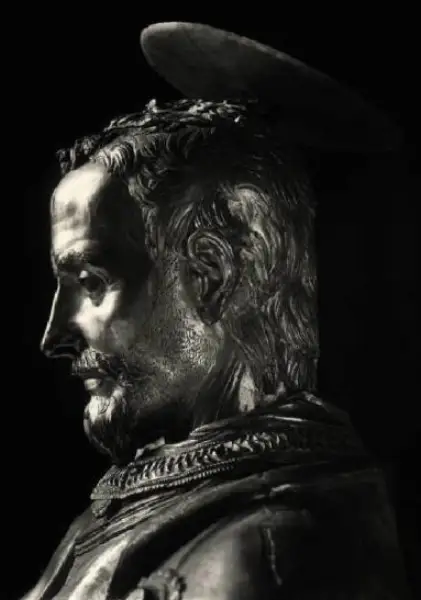
The cult of Luxorius outlived the empire that killed him and spread far beyond the island that bore him. Churches dedicated to San Lussorio stand at Oliena, Romana, Selargius, and elsewhere, and at Borore, a small town in central Sardinia, he is the patron, and his memory keeps two feasts each year — one in April that is almost entirely devotional, and one in August with three days of religious and civil festivities from the twentieth to the twenty-second, followed by novenas at the rural sanctuary in his name. His largest patronage, however, is Pisa, where under the Pisan form of his name, Rossore — a corruption of Luxorius through Ruxorius — he became the city's patron. His relics followed the political currents of the early Middle Ages: one tradition sends them to Pavia in 722 under King Liutprand of the Lombards, in Augustine's own company, while another carries them to Pisa's cathedral in 1088, and it is possible that parts of the martyr rest in both cities. In 1422 the Humiliati friars of Florence secured the relics for the church of Ognissanti, and five years later they commissioned Donatello to model a gilded bronze reliquary bust for the saint's head, a masterpiece now in the Museo Nazionale di San Matteo at Pisa, which the friars kept until their order was suppressed in 1571. A marble ark, brought to light when Pisa's archbishopric was restored in 1796, holding bones and three inscribed lead sheets, closed the long record of a martyr whose memory never ceased to grow.
§ Relics
Timeline
- 21 Aug 304
Is beheaded near Forum Traiani after refusing to sacrifice to idols, twelve days before the calends of September, probably in this year
§ Narrative
- 599
Gregory the Great writes to Januarius, bishop of Cagliari, about a monastery dedicated to saints Gavinus and Luxurius in Cagliari
§ Veneration
- 722
His relics are said to leave Sardinia for Pavia in the company of St. Augustine's remains, sent by the Lombard king Liutprand
§ Relics
- 1088
By a second tradition, his relics are carried from Sardinia to the cathedral of Pisa, where he is called San Rossore
§ Relics
- 1181
The Passio sancti Luxorii martyris is written in the years immediately after this date
§ Sources
- 1422
The Humiliati friars of Florence obtain the transfer of his relics from Pisa to their city, preserved at the church of Ognissanti
§ Relics
- 1427
The friars commission Donatello to model a gilded bronze bust to serve as the reliquary of the saint's head
§ Relics
- 1571
The Donatello reliquary remains with the Florentine friars until the suppression of their order in this year
§ Relics
- 1796
During restoration of the archbishopric of Pisa, a marble ark is found containing bones and three inscribed sheets of lead
§ Relics
In Their Own Words
(H)ic effusus est sangu(is) beatissimi martyris Luxuri. Celebratur natale eius XII c(a)l(enda)s S(e)p(tem)b(re)s renobatu(r) sup temporibus Helia(e) ep(is)c(o)p(i)
The Record
- Patron of
- Pisa, where he is honored as San Rossore·Borore in central Sardinia·Several other Italian cities
- Symbols
- Palm branch
- Canonization
- Pre-congregation; venerated as a martyr since the early centuries
Prayer
Bibliography
Show 1 sources
- Zucca, Raimondo (1988). Le Iscrizioni latine del martyrium di Luxurius: (Forum Traiani, Sardinia). Oristano, Editrice S'Alvure, p. 7.
Profile text adapted from the Wikipedia article, licensed CC BY-SA 4.0.
Pray with this saint every day
Save St. Luxorius to your favorites, read the full profile, and get feast-day reminders in the Saints app.
Get the Saints AppFree on the App Store for iPhone and iPad