
died 548·Feast August 27
St. Lycerius
Bishop of Couserans in the Pyrenees
Overview
Lycerius, also called Glycerius and known in French as Saint Lizier, was bishop of Couserans in south-western France during the late fifth and early sixth centuries. Tradition, though it cannot be verified, traces him to Civitas Bigorra — today's Saint-Lézer, close to Tarbes — where he began his studies under the local bishop before completing them at Rodez under Quintí, by whom he was raised to the priesthood. His reputation for holiness led to his election as bishop of Couserans, and during a vacancy he also administered the neighboring diocese of Tarbes from 506 to 541. At the Council of Agde in 506 his name appears in the acts as Glycerius, placing him among the bishops at one of the formative assemblies of the Frankish church. He was credited with many miracles of healing, and the town of Saint-Lizier is said to have been saved from the Vandals through him. He died at Couserans in 548, and his burial in the cathedral now known as Saint-Lizier made his tomb a center of devotion. He is the patron of Saint-Lizier, Saint-Lizier-d'Ustou in Ariège, and Saint-Lizier-du-Planté in Gers, and is venerated secondarily at Lleida in Catalonia.
The Complete Life
Origins and Formation
The record of Lycerius's beginnings rests entirely on tradition, and the tradition itself is honest about its uncertainty. It places his birth at Civitas Bigorra, the settlement that survives today as Saint-Lézer near Tarbes, in the foothills where the Pyrenees open toward the plains of Gascony. The same account describes a course of studies under the bishop of Tarbes, an apprenticeship in scripture and church order of the kind a future bishop of the region would have received. From Tarbes he moved on to Rodez, where he continued his formation under Quintí, the bishop of that see, and it was Quintí who ordained him to the priesthood. The sequence of a provincial education, first at home and then under a neighboring prelate, fits what is known of how the church of southern Gaul prepared its clergy in the generations after Roman administration faded. Nothing is recorded of his family, his youth, or the date of his birth; what the tradition preserves is a young priest formed by two episcopal households, marked by a sanctity of life that his contemporaries noticed.
§ Introduction
Call to the Episcopate
Lycerius's rise to the episcopate is attributed directly to the holiness of his life: on account of it, the sources say, he was elected bishop of Couserans. The see sat in the Pyrenean valley of the Salat, a mountain diocese whose cathedral town, Saint-Lizier, guarded the approaches to the high passes into Spain. Election by acclamation of clergy and people was the normal route to a bishop's throne in sixth-century Gaul, and a candidate known first for sanctity rather than family rank was not unusual in that generation. His responsibilities soon exceeded the bounds of a single diocese. When the bishopric of Tarbes, in the country of his birth, fell vacant, Lycerius took over its administration as well, holding both charges from 506 until 541, a period of thirty-five years during which one man shepherded two folds. This double stewardship argues for the confidence he commanded across the region: his fellow bishops and his flocks alike were willing to see a distant mountain valley and his own homeland governed by the same pastoral hand.
§ Introduction
Bishop of the Councils
The one firmly dated event of Lycerius's career is his attendance at the Council of Agde in 506, where the episcopal acts record him under the name Glycerius. Agde gathered the bishops of the Visigothic-ruled south to legislate on discipline, the governance of parishes, the obligations of clergy, and the reception of converts, and a bishop's presence there placed him among the working leadership of the Gallic church. For Couserans, a poor and remote mountain see, such a voice at the council table mattered: decisions about tithes, asylum, and clerical conduct made on that coast reached the Pyrenean valleys through bishops like him. His administration of Tarbes ran parallel to these years and covered the same period of upheaval, as the old senatorial order of Aquitaine gave way to new rulers. Popular memory attached a dramatic episode to him as well, crediting him with saving Saint-Lizier from the Vandals, a deliverance the town never forgot and repaid by taking his name. Whatever the historical core of that story, it preserves the image of a bishop who stood between his people and violence.
§ Introduction
A Ministry of Healing
The tradition that grew around Lycerius credits him with many miracles of healing, and this is the aspect of his sanctity that his cult most consistently recalls. In the devotional imagination of the early medieval Pyrenees, a healing bishop was a patron of daily need: farmers, shepherds and townsfolk who came to his shrine sought relief from sickness more urgently than doctrine. The holiness of life that won him election, and the thaumaturgic reputation that followed his death, belong to a single pattern in which the bishop's intercession continued after the grave the work of his hands had begun while he lived. His iconography reflects a sturdy local piety rather than courtly grandeur: he is shown in bishop's robes standing between two bulls, an image that ties him directly to the agricultural world of the Couserans and has been interpreted as recalling the patient strength of the beasts that pulled the ploughs of his flock. A fifteenth-century holy card pairs him with Saints Roch and Sebastian, the great intercessors against plague, a company that confirms how his devotees understood his power.
§ Introduction
Death and Burial
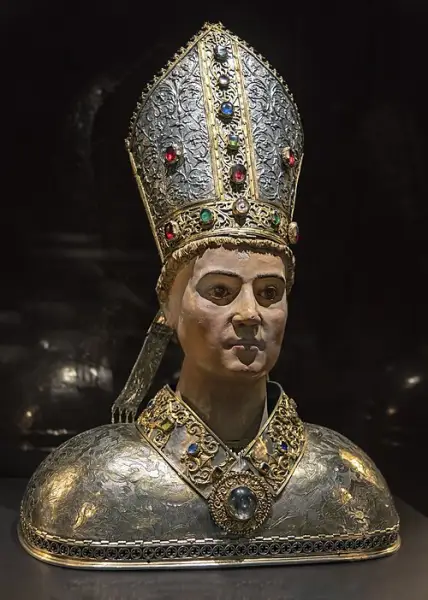
Lycerius died in 548 at Couserans, closing an episcopate that had spanned at least four decades and two dioceses. His body was laid to rest in the cathedral of Saint-Lizier, the church that remains the monumental heart of the old see, and the place of his burial became at once the proof and the center of his sanctity. Devotion at a bishop's tomb ordinarily followed a familiar course: the faithful came to pray where the body lay, favors were asked and granted, and the memory of the man passed into the memory of the place. At Saint-Lizier that process ran so deep that the town itself took his name, and centuries later his cult found expression in a reliquary bust carved by Antoine Favier in 1518, which still identifies the cathedral as his. The sequence of his last years, release of the Tarbes charge in 541, death in the mountain see in 548, and burial beside the altar he had served, gave the church of Couserans a founder-figure whose grave its faithful could visit without crossing any frontier.
§ Introduction
Recognition as a Saint
Lycerius was never formally canonized by a pope, for his cult belongs to the era before centralized canonization existed. He was honored as a saint by the community that buried him, and the acknowledgment of the universal church followed from the endurance of that local veneration rather than from any decree. The signs of an established cult are numerous and old: his name in the martyrologies and calendars with a feast on 27 August, the cathedral dedicated around his tomb, the medieval holy cards pairing him with celebrated plague-saints, and the Renaissance reliquary that displayed his relics to pilgrims. In Catalonia a parallel devotion arose at Lleida, where a tradition, undocumented and perhaps confused with an earlier bishop of the same name, honored Lycerius with a feast on 1 September and ranked him as secondary patron of the city. The doubling of his feast between France and Catalonia, and the variety of his names, Liceri, Lleïr, Llisér among them, show a saint remembered across linguistic frontiers by communities that each kept the memory in their own tongue.
§ Introduction
Legacy
Lycerius left his name on the map of two countries. Saint-Lizier, the former cathedral town of the Couserans, bears him directly, and two other communes, Saint-Lizier-d'Ustou in Ariège and Saint-Lizier-du-Planté in Gers, carry the same dedication, marking the reach of his cult across south-western France. In Catalonia he is remembered at Lleida as secondary patron and at Sant Antoni de Vilamajor as principal patron, under the forms Sant Lliceri and Lleïr. The scholarly question of whether the Catalan and French traditions concern one saint or two, a third-century bishop of Lleida as well as the sixth-century bishop of Couserans, remains open, and the sources themselves admit the confusion. What is not in doubt is the endurance of the devotion: the cathedral of Saint-Lizier preserves the memory of the bishop buried there in 548, the annual feast of 27 August keeps his day in the calendar of south-western France, and the image of the bishop standing between two bulls remains one of the most distinctive saintly portraits of the Pyrenean region.
§ Introduction
Timeline
- 506
Attends the Council of Agde as bishop, recorded in the acts under the name Glycerius
§ Introduction
- 506
Begins administering the diocese of Tarbes during its vacancy, a charge he holds for thirty-five years
§ Introduction
- 541
Ends his administration of the vacant see of Tarbes
§ Introduction
- 548
Dies at Couserans and is buried in what is now Saint-Lizier Cathedral
§ Introduction
The Record
- Patron of
- Saint-Lizier, Ariège, France·Saint-Lizier-d'Ustou, Ariège, France·Saint-Lizier-du-Planté, Gers, France·Secondary patron of Lleida, Catalonia·Patron of Sant Antoni de Vilamajor, Catalonia
- Symbols
- Bishop's robes·Standing between two bulls·Reliquary bust
- Canonization
- Pre-congregation; honored as a saint immediately after his burial
Prayer
Bibliography
Show 2 sources
- Jacques Sirmond (1789). Conciliorum Galliae tam editorum quam ineditorum collectio, temporum ordine digesta, ab anno Christi 177 ad ann. 1563 (in Latin and French). Vol. Tomus primus. Paris: P. Didot. p. 797.
- "St-Lizier-de-Couserans", The Encyclopaedia Britannica, the University Press, 1911, vol. XXIV, p. 24
Profile text adapted from the Wikipedia article, licensed CC BY-SA 4.0.
Pray with this saint every day
Save St. Lycerius to your favorites, read the full profile, and get feast-day reminders in the Saints app.
Get the Saints AppFree on the App Store for iPhone and iPad