
1st century·Feast May 20 (August 3 in the Extraordinary Form; January 27 among Anglicans and Lutherans)
St. Lydia of Thyatira
First Christian Convert in Europe
Overview
Lydia of Thyatira is the woman of the New Testament whom Christian tradition honors as the first documented convert to Christianity in Europe. Her very name is an ethnicon meaning 'the Lydian woman,' pointing to her origin in Thyatira, a city in Asia Minor famous for its red-purple dye, and she carried several titles: Purpuraria, from the Latin for purple, and 'of Philippi,' for the Macedonian city where she lived and worked. Acts presents her as a dealer in purple, plainly a prosperous representative of a Thyatiran dye house and a worshiper of God — one of the Gentile sympathizers with Judaism known as God-fearers. When Paul, Silas and Timothy preached at Philippi, the Lord opened her heart to the message, and she and her household were baptized. She then insisted on hosting the missionaries in her home, exercising the authority of a free woman and probably a widow. The Eastern Churches style her 'Equal to the Apostles,' and a modern baptistry stands at Krynides, near Philippi, on the traditional site of her baptism. Her feast is kept on May 20 in the Roman Rite and by most Orthodox jurisdictions, with other dates across the confessions that venerate her.
The Complete Life
A Woman of Thyatira
The names by which Lydia was known map her life with unusual precision. 'Lydia' itself is an ethnicon rather than a personal name, marking her as a woman from Lydia, the ancient region of western Asia Minor, and specifically from its city of Thyatira, the modern Akhisar, lying southeast of Pergamum some forty miles inland. Her title 'of Thyatira' preserved her birthplace, 'Purpuraria' proclaimed her trade, and 'of Philippi,' or Philippisia in Greek, recorded the Macedonian city where she settled. Scholars judge her most likely an ethnic Greek, but a romanized one, since Thyatira was a Roman settlement and she herself lived and traded in a Roman colony. Thyatira enjoyed a special fame: it was renowned for the red variety of purple dye extracted from the murex and other shells, a commodity worth more than gold in the luxury markets of the Mediterranean world. That a woman of this city appears in the Acts of the Apostles as the agent who carried its most celebrated product to the edge of Europe is a small piece of economic history preserved within a religious narrative, and it explains both her wealth and her independence.
§ Lydia of Thyatira and Philippi
God-Fearer at Philippi
When Paul, Silas and Timothy came to Philippi, they found Lydia among a class of seekers the New Testament calls God-fearers: righteous Gentiles attracted to Judaism, believers in the one God who had sympathized with the synagogue but had not become full proselytes. She was a reputable businesswoman, possibly a widow, praying by the river with other women when the missionaries spoke. Acts records the turning of her life in a single sentence: her heart was opened by the Lord to listen to the things spoken by Paul, and she with all the members of her household was baptized. Theologians have read the scene in different keys. Wayne Grudem treats it as an example of effectual calling, the divine initiative that makes the preached word effective. The narrative also shows a woman of standing exercising her own judgment, for she persuaded her whole household to receive baptism and then pressed hospitality on the apostles, appealing to their own verdict on her faith. Her conversion thus joined the mercantile networks of the Aegean to the young Christian movement, and the church at Philippi, the first on European soil, appears to have had her house for one of its earliest homes.
§ Background
Hostess of the Apostles
Lydia's principal work in the Christian story was the hospitality she forced upon Paul and his companions. Her appeal, recorded in Acts, was made as a wager on her own sincerity: if they judged her faithful to the Lord, they must come into her house and stay. They accepted, and remained with her until their departure from Philippi, traveling on through Amphipolis and Apollonia toward Thessalonica. In that interval her home became the base of the apostolic mission in Macedonia, and she became, in the church's memory, the first European Christian: because these events took place in what is now Europe, she is counted the continent's first convert. Her standing has attracted continuing discussion. Some speculated she might have been a freedwoman or even a slave, since her name is a place-name rather than a personal name, but scholars point to noblewomen named Lydia in the first and second centuries and to the authority she wielded over her household, which a servant could hardly have exercised. Most conclude she was free, well-to-do, probably a widow, and accustomed to directing her own affairs — precisely the person whose house could shelter a persecuted mission.
§ Social status
Veneration Across the Churches
No formal canonization process lies behind Lydia's cult, for she belongs to the apostolic age, and the churches that honor her do so by immemorial tradition. The breadth of that honor is striking. The Roman Rite of the Catholic Church keeps her feast on May 20 in the Ordinary Form and on August 3 in the Extraordinary Form, and the Greek Catholic Churches likewise commemorate her on May 20. The Eastern Orthodox Churches remember her on various days, some jurisdictions keeping her twice in a single liturgical year: many, including the Antiochian Archdiocese of North America, observe May 20, while some parts of the Russian tradition keep both June 25 and March 27. In the Anglican world the Episcopal Church has inscribed her in its calendar on May 21, and the Anglican Church in North America on January 27. Lutheranism is divided between the ELCA, which commemorates Lydia, Dorcas and Phoebe together on January 27, and the Lutheran Church–Missouri Synod, which keeps the three women on October 25. The Orthodox Churches have granted her the title 'Equal to the Apostles,' the rank reserved for those whose conversion bore apostolic fruit.
§ Feast day
Memory and Devotion
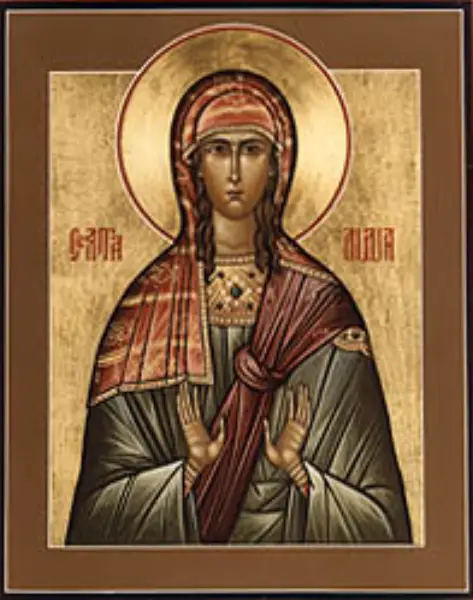
Lydia's memory remains rooted in the landscape of Philippi. A church stands there which many judge to have been raised in her memory, while at Krynides — the traditional riverside scene of her baptism — a modern Greek Orthodox outdoor chapel and baptistry welcome pilgrims to the place where Europe's first conversion is recalled. In art she is inseparable from her trade: her icons invariably show her with purple cloth of one kind or another, most often a shawl or veil in that color, a detail that has led historians to see her as a merchant of purple textiles specifically rather than of raw dye. The Catholic Church has named her patroness of dyers, extending her protection to the craft that gave her wealth and her title. Her story has also carried a second life in modern reflection on the women of the New Testament, standing alongside figures such as Phoebe, Dorcas and Junia as evidence of the responsibility and initiative women exercised in the earliest Christian communities. As seller of purple, hostess of apostles and first believer of the West, she unites in one person the worlds of commerce, household and church.
§ Devotion
In Their Own Words
If you have judged me to be faithful to the Lord, come into my house, and stay.
The Record
- Patron of
- Dyers·Purple-cloth merchants
- Symbols
- Purple cloth·Purple shawl or veil
- Canonization
- Pre-congregation; honored as a saint since antiquity by the Catholic, Eastern Orthodox, Anglican and Lutheran traditions
Prayer
Bibliography
Show 6 sources
- Cumming, John (1998). Butler's Lives of the Saints. Collegeville, MN: The Liturgical Press. p. 24.
- Grudem, Wayne (1994). Systematic Theology. IVP. p. 693.
- Ascough, Richard S. (2009). Lydia: Paul's Cosmopolitan Hostess. Collegeville, MN: The Liturgical Press. p. 27.
- Hahn, Scott (2002). The Acts of the Apostles Revised Standard Version (Second Catholic ed.). San Francisco, California: Ignatius Press. p. 45.
- Martyrologium Romanum. Libreria Editrice Vaticana. 2004. p. 290.
- Lesser Feasts and Fasts 2018. Church Publishing, Inc. 17 December 2019. ISBN 978-1-64065-235-4.
Profile text adapted from the Wikipedia article, licensed CC BY-SA 4.0.
Pray with this saint every day
Save St. Lydia of Thyatira to your favorites, read the full profile, and get feast-day reminders in the Saints app.
Get the Saints AppFree on the App Store for iPhone and iPad