
5th century (traditional)·Feast November 18
St. Mabyn
Cornish Saint of Brychan's Family
Overview
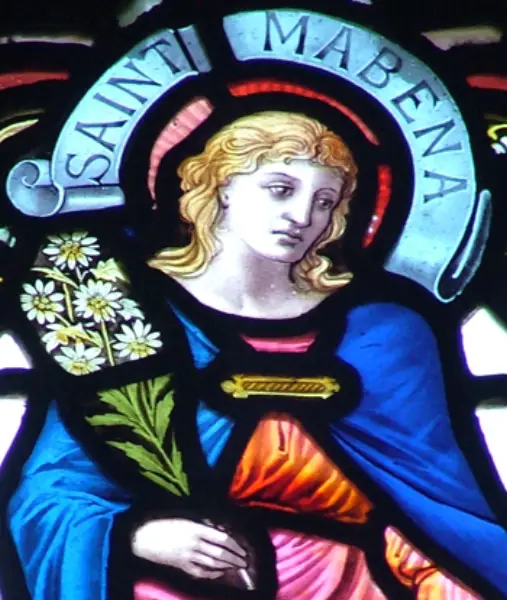
Mabyn, also known as Mabena or Mabon, was a medieval Cornish saint whom local tradition numbers among the many saintly children of Brychan, king of Brycheiniog in fifth-century Wales. Her cult is first attested in the twelfth-century Cornish Latin Life of Saint Nectan, which lists her among the children of Brychan together with Nectan himself and a host of other saints; the presence there of saints with West Country churches suggests that the parish church of St Mabyn already stood when the list was compiled. Later medieval references add little biographical detail, and a pair of them even took her for a man — a confusion that led Sabine Baring-Gould to propose that the church's founder was really the male Welsh saint Mabon, reputed brother of Saint Teilo. Cornish attachment to Mabyn as daughter of Brychan nonetheless proved durable, surviving at least into the sixteenth century, when Nicholas Roscarrock recorded a hymn sung in her honor at the rebuilding of her church and fixed her feast at November 18. She is portrayed in the remarkable 1520s stained glass of St Neot church, crowned and robed, holding book and palm, and a credence table at St Mabyn may preserve the panel of a medieval tomb raised in her memory.
The Complete Life
A Daughter of Brychan
Everything told of Mabyn's origins rests on the great Welsh dynastic legend of Brychan Brycheiniog, the fifth-century king whose enormous family became one of the chief nurseries of Celtic sanctity. Local Cornish tradition makes her one of his many children, brothers and sisters who included Saint Nectan of Hartland and numerous other figures honored across Wales, Cornwall, Ireland and Brittany. Brychan and his holy offspring appear in Welsh sources older than any that mention Mabyn by name, but those earlier witnesses are silent about her; her first recorded appearance comes only in the twelfth century, in the appended list of children in the Cornish Latin Life of Saint Nectan. The compiler of that list grouped her with several saints who had churches dedicated to them in the West Country, a detail that has convinced historians the parish church of St Mabyn already existed and was already hers when the Life was written. Whether the genealogical tradition that made her a princess of Brycheiniog was history or a habit of attaching stray saints to Brychan's famous family can no longer be determined, but in Cornwall the connection took firm root.
§ History
A Cult of Uncertain Face
Mabyn's cult displays the tangled evidence typical of the early Cornish saints. The medieval sources that mention her and her church offer almost no information about the saint herself, and two of them describe her as a man. This confusion prompted Sabine Baring-Gould's influential conjecture that the true founder of St Mabyn's Church was the male Welsh saint Mabon, supposedly a brother of Saint Teilo and founder of Llanvabon, and that a female Mabyn was invented after the real history had been forgotten. Against such skepticism stands the persistence of popular memory: the association with Brychan's family that appears in the Life of Saint Nectan survived in Cornish tradition until at least the sixteenth century. Nicholas Roscarrock learned from people still alive at the time of the church's rebuilding around 1500 that a song or hymn to Mabyn had been sung on that occasion, matching the list of Brychan's children in the Life, and he recorded her feast day as November 18. However scholars resolve the question of her identity, the cult itself, with its church, feast and hymn, is centuries older than any doubt about it.
§ History
Glass, Stone and Village
The visible memorials of Mabyn belong to the late medieval flowering of Cornish devotion. In the north aisle of the church at St Neot, a stained glass window of 1523 or 1528 portrays her in robes and crown, carrying a book and the palm branch of martyrdom, one of six local Cornish saints shown in the north-aisle windows while the south aisle was reserved for saints of international fame. The married women of the parish's western side paid for that window; they formed one of three associations restricted to a single sex — with the 'sisters,' probably unmarried women, and the young men — which between them gave five of the six local saints their panels, and Mabyn's also features Saint Meubred of Cardinham. At St Mabyn itself a credence table still survives which may once have formed the panel of a tomb set up in her memory; possibly her sisters of Brychan's line were given tombs of their own in the several churches that honored them. Above all, her name remains on the land: the village and civil parish of St Mabyn in Cornwall bear it, and their parish church still stands dedicated to the saint it was founded to honor.
§ History
The Record
- Patron of
- The village and parish of St Mabyn, Cornwall
- Symbols
- Robes and crown·Book·Palm branch
- Canonization
- Pre-congregation; venerated by immemorial local cult in Cornwall
Prayer
Bibliography
Show 4 sources
- Orme, Nicholas (2000). The Saints of Cornwall. Oxford University Press. ISBN 0-19-820765-4. Retrieved 15 January 2010.
- Baring-Gould, Sabine (2000). The Lives of the Saints. Oxford University Press. ISBN 0-19-820765-4. Retrieved 15 January 2010.
- Mattingly, Joanna (2003). "Pre-Reformation Saints' Cults in Cornwall – with particular reference to the St Neot windows". In Jane Cartwright (ed.). Celtic Hagiography and Saints' Cults. Cardiff: University of Wales Press. pp. 249–70.
- Olson, B.L. and O.J. Padel, "A tenth-century list of Cornish parochial saints". Cambridge Medieval Celtic Studies 12 (1986). pp. 33–71.
Profile text adapted from the Wikipedia article, licensed CC BY-SA 4.0.
Pray with this saint every day
Save St. Mabyn to your favorites, read the full profile, and get feast-day reminders in the Saints app.
Get the Saints AppFree on the App Store for iPhone and iPad