
died 506·Feast March 24
St. Macartan of Clogher
Patrick's Strong Man, First Bishop of Clogher
Overview
Saint Mac Cairthinn, known in English as Macartan or McCartan, died in 506 and is honored as the first presiding Bishop of Clogher, holding that see from 454 until his death. Counted among the earliest saints of the Irish Church, he carried the title of Saint Patrick's 'Threin Fhir,' or 'Strong Man,' a name earned through his dedication and faithfulness to the fledgling Irish Church. Tradition says he grew up in Munster under the name Aidus or Aedh, son of Caerthen, and traveled north to hear Patrick preach, leaving behind his wife and child. Baptized at Drumlease in County Leitrim, he joined Patrick's missionary staff, was ordained presbyter, and became famous for carrying the aging apostle over rough roads, marshes and rivers. Weary of travel, he asked for a church of his own, and Patrick established him at Clogher, near the royal fort of Rathmore, founding one of Ireland's oldest bishoprics and giving him his staff and the relic-shrine called the Domnach Airgid. Macartan died at Clogher in 506. His feast is kept on 24 March, and he remains patron of the diocese whose church he founded.
The Complete Life
Aidus of Munster
Before he was Macartan, the future bishop of Clogher was known as Aidus or Aedh, son of Caerthen, a name meaning son of the Rowan Tree, while his upbringing, so far as tradition locates it, lay in the south of the island, in Munster. The identity of his father remains uncertain: tradition sometimes associates him with a Dalcassian prince of Thomond and sometimes with the Uí Maine of Connacht, and from the father's name came the Anglicized form that has lasted, Macartan. Some sources claim that he was an uncle of Saint Brigid, which would place him within the web of kindred that linked Ireland's earliest saints. Nothing is recorded of his youth, his occupation, or the date of his birth, and even his homeland is fixed only as widely as the south of the island. What the tradition preserves is a married man, settled in his own country, who in maturity heard reports of a new preacher whose teaching was transforming the island, and who resolved to leave his home to seek him out — the decisive act from which all the rest of his story follows.
§ Legend
Conversion and the Missionary Band
Hearing of Patrick's teaching, Aidus traveled from his home all the way to Armagh to hear the apostle preach, though it cost him his wife and child. The meeting came at Drumlease, by Dromahair in County Leitrim, and there Patrick baptized him. Commitment followed at once: he joined the apostle's official band of missionaries, the traveling company that bore the Gospel from royal forts to rural settlements across the island, and received ordination as presbyter. His standing within the mission is captured by the titles his companions gave him — Patrick's 'champion' or 'strong man,' the 'Threin Fhir' remembered by the Irish Church. The tradition paints that fidelity in a physical image: when exhaustion overtook the apostle at his work, Macartan carried him, bearing his unsteady steps across bad roads, bogs and fords. Behind the picture lies the reality of Patrick's old age and the dependence of the mission on a circle of trusted, ordained companions who could be sent where the founder could no longer go.
§ Legend
The Church at Clogher
The hinge of Macartan's career came, the story says, beside yet another river. Having carried Patrick across it, he confessed his weariness and asked to be released from the road — to be given a church of his own near the master he loved, where his last years might pass in quiet. Patrick, moved by affection for so loyal a companion, consented and directed him to Clogher. There, beside the old royal stronghold of Rathmore on the town's edge, a monastery was planted, and from it developed a bishopric numbered among the oldest in Ireland, with Mac Cairthinn as its first presiding bishop from 454 to his death in 506. Clogher, a seat of the kings of Airgialla, gave the new church a platform whose influence ran deep into Ulster. For the founding, Patrick made over to Macartan his own staff together with precious relics kept in a shrine that tradition calls the Domnach Airgid — gifts which bound the young see to the memory of the apostle himself.
§ Legend
The Evening of His Life
Macartan governed Clogher for more than half a century, from 454 until his death in 506, years that spanned the consolidation of the Irish Church from a missionary enterprise into a settled order of bishoprics. The man who had once begged for rest now had a monastery, a cathedral charge and the care of a wide territory, yet the tradition preserves him above all as the companion of Patrick's declining years, the 'staff of Patrick' on whom the apostle leaned. At Clogher he kept the treasures Patrick had given him: the staff and the reliquary shrine, together with a Gospel book that tradition claimed came from Patrick's own hand. There he died in 506, and there his church endured, becoming one of the ancient episcopal seats of Ireland. The evening of life he had asked for turned into an institution that outlasted him by fifteen centuries, a reminder that the wish he voiced by the riverside — to settle down close by his master and serve a single church in peace — was granted in a form far larger than he had imagined.
§ Legend
The Domnach Airgid and After
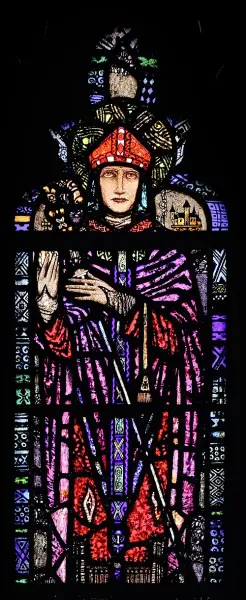
Macartan's memory is bound inseparably to the Domnach Airgid, the Silver Shrine he received from Patrick. The shrine was made to enclose a manuscript of Gospel leaves — thirty-nine fragments in the characteristically Irish script of the eighth or ninth century — which tradition asserted to be the very book Patrick had handed his companion, an attribution that made it an object of profound reverence. On its cover appears one of the earliest metalwork likenesses of Saint Patrick to survive, at the lower right, while at the lower left the apostle may be seen passing the shrine to Macartan. In about 1350 John O Carbry, abbot of Clones, had the shrine substantially remade; today it is numbered among A History of Ireland in 100 Objects in the National Museum of Ireland. The saint's cult has flourished in art as well: Harry Clarke depicted him in stained glass at Saint Joseph's Church in Carrickmacross, and a statue pairs him with the local prince Cairbre. He is venerated by Roman Catholics, the Eastern Orthodox and the Church of Ireland alike, and the diocese of Clogher, one of Ireland's oldest bishoprics, keeps him as its patron and first bishop.
§ Domnach Airgid
Timeline
- 454
Becomes the first presiding Bishop of Clogher
§ Introduction
- 506
Dies at Clogher after more than fifty years as its bishop
§ Introduction
- 1350
John O Carbry, abbot of Clones, commissions a substantial remodelling of the Domnach Airgid, the shrine associated with Macartan
§ Domnach Airgid
The Record
- Major works
- Foundation of the monastery and bishopric of Clogher
- Patron of
- The diocese of Clogher
- Symbols
- Bishop's vestments·Patrick's staff·The Domnach Airgid shrine
- Canonization
- Pre-congregation; venerated from earliest times in Ireland
Prayer
Bibliography
Show 6 sources
- Breen, Aidan. "Mac-Caírthinn", Dictionary of Irish Biography, 2009.
- "Saint Macartan: Our Patron Saint", Saint Macartan's College.
- "Domnach Airgid". Royal Irish Academy. Retrieved 20 June 2021.
- Bourke, Cormac. "The Domnach Airgid in 2006". Clogher Record, volume 19, nr 1, 2006.
- O'Toole, Fintan. A History of Ireland in 100 Objects. Dublin: Royal Irish Academy, 2013. ISBN 978-1-9089-9615-2.
- Farmer, David. "Macartan", Oxford Dictionary of Saints, 5th ed., Oxford University Press, 2011. ISBN 9780199596607.
Profile text adapted from the Wikipedia article, licensed CC BY-SA 4.0.
Pray with this saint every day
Save St. Macartan of Clogher to your favorites, read the full profile, and get feast-day reminders in the Saints app.
Get the Saints AppFree on the App Store for iPhone and iPad