
1482 – 1563·Feast December 30
St. Macarius of Moscow
Metropolitan, chronicler, and maker of Russian sanctity
Overview
Macarius, Metropolitan of Moscow and all Russia, presided over the Russian Orthodox Church from 1542 to 1563, the decisive decades of Ivan the Terrible's rise and the consolidation of the Muscovite state. Born in 1482 in the region around Moscow, he took monastic vows at the St. Paphnutius Monastery in Borovsk, where he served in every clerical rank and mastered the art of icon painting. Made archmandrite in 1523 and appointed archbishop of Novgorod in 1526, he combined firm pro-Muscovite policies with energetic missionary work among the Finno-Ugric peoples of the north. His literary monument is vast: the twelve-volume Great Menaion Reader, completed in its first edition in 1541, gathered the lives of the Russian saints month by month, and he began the Book of Royal Degrees tracing the tsar's lineage. As metropolitan he arranged Ivan IV's coronation in 1547, guided the great church councils, carried out the canonization of thirty-nine all-Russian saints, and served as the tsar's indispensable adviser and temporary head of state during his absence at war. He died on January 12, 1563, and his body was laid to rest in the Dormition Cathedral within the Moscow Kremlin.
The Complete Life
From Borovsk to the Cloister
Macarius was born in 1482 in the region around Moscow; in the world he was presumably named Mikhail, and his parents' names survive because he dedicated the Great Menaion Reader to them, including his mother's monastic name. In the late fifteenth century he became a monk at the St. Paphnutius Monastery in Borovsk, a house steeped in the tradition of Joseph Volotsky, whose cause and whose disciples the young monk supported firmly all his life. At Borovsk he progressed through the offices of reader, subdeacon, deacon, and priest, and there he mastered the art of icon painting, a craft that would make him one of the notable Russian clerics, writers, and icon painters of his century. His talents marked him out for responsibility: in 1523 Metropolitan Daniel set him over a Mozhaisk monastery as its archmandrite, and it was there that he came to the attention of Grand Prince Vasili III of Moscow. Among the few clerics who supported the prince's controversial divorce from the barren Solomonia Saburova, Macarius blessed the ruler's second marriage with Elena Glinskaya, a position that bound him closely to the dynasty from which Ivan the Terrible would be born.
§ Early life and work on the Menaion
Archbishop of Novgorod
In 1526 Macarius was appointed archbishop of Novgorod, the ancient second see of the Russian Church, and he conducted its affairs in firm alignment with Moscow's interests. His sixteen years in Novgorod joined pastoral administration to cultural patronage and missionary zeal. Twice, in 1533 and again in 1535, he dispatched the monk Ilya with other companions to evangelize the Finno-Ugric peoples along the Neva and about Lakes Ladoga and Onega, penetrating as far as the Kola Peninsula, extending the Church's reach across the pagan and sparsely evangelized north; his successor Feodosii would send missionaries into the same regions a decade later. Novgorod was also where his great literary labor matured: in 1541 Macarius and his companions completed the first edition of the Great Menaion Reader, a compilation of the lives of the Russian saints in twelve great volumes arranged on a monthly basis, the most ambitious hagiographical project Russia had yet seen. To the same period belong his other works of memory and image — the beginning of the Book of Royal Degrees, and, tradition says, the icons of the little iconostasis of the Cathedral of Holy Wisdom, painted by the archbishop's own trained hand.
§ Early life and work on the Menaion
Metropolitan of Moscow and All Russia
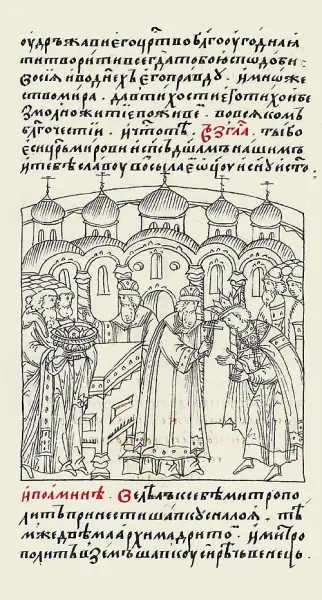
Backed by the powerful Prince Andrey Shuisky, Macarius attained election as Metropolitan of Moscow and all Russia on March 16, 1542, the tenth metropolitan of Moscow appointed without the approval of the Ecumenical Patriarch of Constantinople. His tenure was no easy alliance with the throne. During Ivan IV's childhood and the Shuisky regency his relations with the Boyar Duma soured over his constant grief at the disgraces suffered by courtiers and church dignitaries; his independence provoked repeated attempts to dislodge him, and in the summer of 1544 he narrowly escaped death in the fire that swept the Moscow Kremlin. Yet from the wreckage of the regency he emerged as one of the tsar's closest advisers. He arranged Ivan's coronation on January 16, 1547, blessed the tsar's marriage to Anastasia Zakharyina-Yuriyeva that same year, and took an active part in the national assemblies of 1547, 1549, and 1550, where he urged conciliation among the warring boyar factions. He blessed the army before its march on Kazan in 1552, managed diplomacy and state correspondence whenever the tsar was absent, and in 1559 was left to protect the tsardom as temporary head of state during the Kazan campaign.
§ Metropolitan of Moscow
Theology, Councils, and the Making of Saints
Macarius's spiritual program was the glorification of Russian holiness and the defense of Orthodox teaching. Through the councils traditionally known in Russian historiography as Macarius's synods, he carried out the canonization of thirty-nine all-Russian saints, giving the young autocracy a native cloud of witnesses and binding the Church's memory to the Muscovite state. In 1551 he and the tsar convened the Stoglav Sobor, the great council on church order and discipline. He pursued the Church's internal struggles with the same firmness: at the synod of 1542 he secured the excommunication of Isaac Sobaka, archmandrite of the Chudov Monastery and associate of Maximus the Greek, though he would later correspond with the exiled Maximus and include some of his essays in the Great Menaion Reader while refusing his appeals for pardon. In the councils of 1553 to 1555 he supported the heresy accusations brought against the boyar son Matvei Bashkin, the starets Artemiy, and the monk Feodosiy Kosoy, yet he defended the monk Sylvester against the charge of uncanonical wall-painting in the Cathedral of the Annunciation. His devotional life found expression too in art: he oversaw the painting of Saint Basil's Cathedral and the Kremlin's Golden Chamber.
§ Metropolitan of Moscow
Later Years and Death
In his declining years Macarius withdrew gradually from the affairs of state and turned to the works of memory that crowned his career. He supervised the completion of the Stepennaya Kniga, the Book of Generations that traced the tsar's lineage in stately degrees, supported Ivan Fyodorov's pioneering book-printing, and renovated icons. His pen did not retire with him: he helped compile the Chronicle of the Beginning of Tsardom, the official account of Ivan the Terrible's reign, together with the Regal Book, an illuminated telling of his policies. He died on January 12, 1563, and his body was laid to rest in the Dormition Cathedral within the Moscow Kremlin, the burial place of Russia's primates. The esteem in which he was held showed itself at once in letters: after his death his disciples wrote his life and composed A Tale of the Last Days of Metropolitan Macarius, and his memory passed into the calendars of the devout — indeed, his name is found in lists of saints reaching back to the eighteenth century, long before the Church's formal act of glorification.
§ Later years
Glorification
Macarius's formal canonization came at a moment of national spiritual renewal. On June 6, 1988, the 1988 Local Council of the Russian Orthodox Church, meeting at the Trinity Lavra of St. Sergius under Patriarch Pimen I of Moscow, enrolled him among the saints of the Church, in the same jubilee year that marked the millennium of the Baptism of Rus. The act, though formally new, confirmed a devotion centuries old: his name already figured in saints' lists reaching back to the eighteenth century. The Church keeps his memory on October 5 and December 30. He is depicted in icons vested as a bishop and holding a Gospel Book, and a modern icon of the saint hangs in a niche above the arched entrance of the Russian State Archive of Ancient Documents in Moscow — a fitting honor for the metropolitan whose life's work was the preservation of the nation's written and sanctified memory.
§ Later years
Legacy
Macarius shaped Russian church life more lastingly than perhaps any primate of the sixteenth century. The Great Menaion Reader fixed the written memory of Russian sanctity, gathering the lives of the nation's saints into a single authoritative order; the canonizations of his synods gave the Muscovite Church its all-Russian calendar of saints; and the Book of Royal Degrees helped articulate the ideology of the tsardom in which church and state rose together. His patronage reached into every corner of culture — he assisted the painting of Saint Basil's Cathedral and the Kremlin's Golden Chamber, supported the first Russian book-printing of Ivan Fyodorov, and contributed to the official chronicles and illuminated books of Ivan's reign. As a statesman he taught the Church to stand beside the throne without dissolving into it, grieving openly when court factions destroyed the innocent and refusing the demands of those who tried to dislodge him. The historian's judgment of his century has often turned on the contradictions of his career — the defender of Maximus the Greek who would not pardon him, the advocate of conciliation who pressed heresy cases hard — but the Church remembers him as the maker of its memory and glorifies him among the saints it was his life's work to honor.
§ Later years
Timeline
- 1482
Born in the region around Moscow; in the world he was presumably named Mikhail.
§ Early life and work on the Menaion
- 1523
Metropolitan Daniel sets him over a Mozhaisk monastery as its archmandrite.
§ Early life and work on the Menaion
- 1526
Appointed archbishop of Novgorod, where he conducts pro-Muscovite policies.
§ Early life and work on the Menaion
- 1533
Dispatches Ilya, a monk, with other laborers to evangelize the Finno-Ugric peoples dwelling by the Neva and the northern lakes.
§ Early life and work on the Menaion
- 1535
Dispatches a second missionary expedition to the region of Lakes Ladoga and Onega and the Kola Peninsula.
§ Early life and work on the Menaion
- 1541
Completes the first edition of the Great Menaion Reader, twelve volumes of saints' lives arranged by month.
§ Early life and work on the Menaion
- 16 Mar 1542
Elected Metropolitan of Moscow and all Russia with the support of Prince Andrey Shuisky.
§ Metropolitan of Moscow
- 1544
Narrowly escapes death when fire sweeps through the Moscow Kremlin.
§ Metropolitan of Moscow
- 16 Jan 1547
Arranges the coronation of Ivan IV and later blesses the tsar's marriage with Anastasia Zakharyina-Yuriyeva.
§ Metropolitan of Moscow
- 1551
Convenes the Stoglav Sobor with the tsar; through his synods he carries out the canonization of thirty-nine all-Russian saints.
§ Metropolitan of Moscow
- 1552
Blesses the Russian army before its departure to Kazan and completes the second edition of the Grand Menaion.
§ Metropolitan of Moscow
- 1554
Completes the third edition of the Grand Menaion.
§ Metropolitan of Moscow
- 1559
During the tsar's Kazan campaign he is left in Moscow to protect the tsardom, making him temporary head of state.
§ Metropolitan of Moscow
- 12 Jan 1563
Dies; his body is laid to rest in the Dormition Cathedral within the Moscow Kremlin.
§ Later years
- 6 Jun 1988
Canonized by the 1988 Local Council of the Russian Orthodox Church at the Trinity Lavra of St. Sergius.
§ Later years
The Record
- Major works
- Great Menaion Reader (Velikie Minei Chetii), twelve volumes of Russian saints' lives·Stepennaya Kniga (Book of Royal Degrees)·Contribution to the Chronicle of the Beginning of Tsardom and the Regal Book·Icons of the iconostasis of the Cathedral of Holy Wisdom in Novgorod (attributed)
- Patron of
- Moscow·Russian church historians and hagiographers
- Symbols
- Vested as a bishop, holding a Gospel Book
- Canonization
- Canonized 6 June 1988 by the 1988 Local Council of the Russian Orthodox Church at the Trinity Lavra of St. Sergius, under Patriarch Pimen I of Moscow
Prayer
Bibliography
Show 5 sources
- Makarii (Petr Ivanovich Veretennikov, Archimandrite), Zhizn' i trudy Makariia, Mitropolita Moskovskogo i vseia Rusi, Sergiev Posad: Ves' Sergiev Posad, 2002
- Michael C. Paul, "Continuity and Change in the Novgorodian Archiepiscopal Office, 1478-1591", Orientalia Christiana Periodica, Vol. 5, No. 2 (2009), pp. 273-317
- David B. Miller, "The Velikie Minei Chetii and the Stepennaia Kniga of Metropolitan Makarii and the Origins of Russian National Consciousness", Forschungen zur Osteuropäischen Geschichte 26 (1979): 263-382
- T. Iu. Tsarevskaia, St. Sofia's Cathedral in Novgorod, D. G. Fedosov, trans., Moscow: Severnyi Palomnik, 2005
- "Макарий, митрополит Всероссийский", Brockhaus and Efron Encyclopedic Dictionary, 1906
Profile text adapted from the Wikipedia article, licensed CC BY-SA 4.0.
Pray with this saint every day
Save St. Macarius of Moscow to your favorites, read the full profile, and get feast-day reminders in the Saints app.
Get the Saints AppFree on the App Store for iPhone and iPad