
c. 300 – 395·Feast January 19 (May 1 in the Coptic Orthodox Church)
St. Macarius of Alexandria
Desert Monk and Prior of the Cells
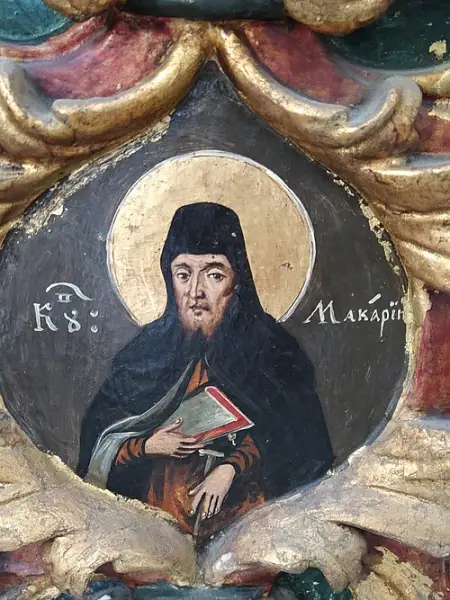
Overview
Macarius of Alexandria — Macarius the Younger, a little junior to his namesake Macarius of Egypt — served God as a monk of the Nitrian Desert until his death in 395. Alexandria saw his birth around the year 300, and for forty years he peddled confections there before baptism set him on the desert road. Years of ascetic training followed, then priestly ordination and appointment as prior over the Kellii, the 'cells,' a monastery lying between the Nitria mountain and a skete of the Egyptian desert, where hermits kept silence, one to a cell. Around 335 he withdrew yet deeper, living shut away as a recluse in the el-Natroun desert. Wonder-working powers were credited to him, and five thousand Nitric monks looked to him as their head. A famous tale recounts how he disguised himself in secular clothing to spend a Great Lent at Pachomius's monastery of Tabennesis, eating no bread and drinking no water, until divine inspiration revealed his identity. At the age of seventy-three the Emperor Valens exiled him, together with Macarius of Egypt, to an island which the two monks then Christianized. Eastern tradition places his death on 2 January 395, the Coptic tradition on 1 May of the same year.
The Complete Life
The Confectioner of Alexandria
Macarius began life not as a monk but as a tradesman of one of the great cities of the ancient world. He was born in Alexandria about the year 300, in the generations when Christianity was emerging from persecution into favor in Egypt, and until the age of forty he earned his living as a merchant selling confections. The detail is a small window into the economy of fourth-century Alexandria, where sweetmeats found buyers among the crowds of a cosmopolitan port, and it marks Macarius as a man of the market rather than the academy. Nothing is recorded of his family, his marriage or the circumstances of his daily life during those decades. What mattered to his biographers was the turn that came in middle age: at forty he was baptized, and with baptism came departure, for he went off into the desert. The pattern — a commercial career abandoned, a city left behind, a novice beginning late in the ascetic life — would become one of the classic stories of the Desert Fathers, and in Macarius it found one of its earliest embodiments.
§ Life
Into the Desert and the Cells
After his baptism Macarius withdrew into the desert of Egypt, the cradle of Christian monasticism, where Anthony the Great and Macarius of Egypt had already drawn thousands to the ascetic life. He spent several years in the ordinary disciplines of the novice — prayer, fasting and labor — before his abilities were recognized: priestly ordination came, and with it charge of the Kellii, the 'cells,' a monastery set between the Nitria mountain and a skete — hermits of the Egyptian desert keeping silence, one to a cell. The place-name says exactly what the settlement was — scattered dwellings where monks pursued the solitary combat within reach of a brotherhood. As prior, Macarius stood midway between the communal discipline of Nitria and the eremitical silence of the skete, governing men whose whole ambition was to be governed by God alone. About the year 335 the desert offered its strongest son a further step, and he took it: withdrawal into the el-Natroun desert as a recluse, trading office for solitude without surrendering the authority his holiness had won.
§ Life
Austerity in Disguise
Macarius's spirituality joined ferocious fasting to hidden humility, and miracles were credited to him in plenty. One tale displays both. Report had reached him of the surpassingly severe discipline kept at the Tabbenesiot Monastery under its prior, Pachomios the Great; so, dressed in secular clothes to hide his identity, he entered the house as an unknown layman. Through the whole of the Quadragesima, the forty-day Great Lent, he neither ate bread nor drank water; no one saw him eating, and no one saw him sitting down, for he made baskets of palm leaves while standing. At last the monks begged Pachomius to expel the stranger, protesting that no mere man could endure such things. Then a divine inspiration unmasked the visitor to the prior, and the community hurried — not to drive him out, but to ask his blessing. His demonstration of humility complete, its lesson delivered to all, Macarius went home to his own monastery. Beyond this anecdote, tradition credits him with the headship of five thousand Nitric monks, a vast spiritual fatherhood exercised from a recluse's cell.
§ Life
Exile and Death
The last public act of Macarius's life was imposed rather than chosen. At the age of seventy-three he was exiled by the Emperor Valens, the Arian ruler whose persecution of orthodox churchmen reached even the monks of the Egyptian desert, and he was sent away together with Macarius of Egypt, the great elder of Nitria. The two old ascetics were deported to an island, where their presence bore unexpected fruit: the exiles Christianized the island that had become their prison, converting their punishment into one final mission. The episode belongs to the wider story of the desert's resistance to imperial heresy, in which monks who had renounced the world found themselves punished by it for holding the faith of Nicaea. Macarius did not return to die in his own desert. According to Eastern Orthodox tradition he died on 2 January 395; the Coptic Orthodox tradition keeps his falling asleep on 1 May of the same year, the 6th of Pashons in the Coptic calendar. Both churches have kept their respective dates as his feast, a double memory of a single holy death.
§ Life
Writings and Memory
A small body of writing travels under Macarius's name: a monastic rule, three brief apothegms among the sayings of the Desert Fathers, and a homily on the end of the souls of the just and of sinners — though the finest Vienna manuscripts credit that homily to a monk called Alexander, a warning about how loosely the desert's literature clings to its authors. The ancient historians add a further puzzle, for Palladius and Sozomen speak of a Macarius the Younger of Lower Egypt who kept his cell for upwards of twenty-three years in expiation of a murder; whether that penitent was this Macarius, another monk sharing his name, or a story that migrated between the two, cannot be settled. The confusions have never obscured the essentials. He is venerated in the Eastern Orthodox, Roman Catholic and Oriental Orthodox churches; his feast is kept on 19 January in the Eastern and Roman traditions and on 1 May, 6 Pashons, in the Coptic calendar; and he stands in the memory of monasticism as Macarius the Younger, second only to the elder Macarius of Egypt among the fathers of Nitria.
§ Life
Timeline
- 300
Is born in Alexandria, Egypt, in about this year
§ Life
- 335
Retires to live alone as a recluse in the el-Natroun desert
§ Life
- 395
Dies in Egypt; Eastern tradition gives 2 January, Coptic tradition 1 May
§ Life
The Record
- Major works
- A monastic rule·Three brief apothegms·Homily "On the End of the Souls of the Righteous and of Sinners" (ascribed; excellent Vienna manuscripts assign it to a monk named Alexander)
- Symbols
- Monk's habit·Baskets woven of palm leaves
- Canonization
- Pre-congregation; venerated from antiquity in the Eastern Orthodox, Roman Catholic and Oriental Orthodox churches
Prayer
Bibliography
Show 6 sources
- Butler, Alban. "St. Macarius, of Alexandria, Anchoret", The Lives of the Saints. 1866.
- Jackson, Samuel Macauley, ed. (1914). "Macarius the Younger". New Schaff–Herzog Encyclopedia of Religious Knowledge (third ed.). London and New York: Funk and Wagnalls.
- Healy, Patrick. "Macarius." The Catholic Encyclopedia. Vol. 16 (Index). New York: The Encyclopedia Press, 1914.
- "St. Macarius of Alexandria". www.stabanoub-dallas.org. Archived from the original on 17 March 2018. Retrieved 17 March 2018.
- "St. Macarius of Alexandria", St. John's Orthodox Church.
- Lives of Saints :: Bashons 6, CopticChurch.net.
Profile text adapted from the Wikipedia article, licensed CC BY-SA 4.0.
Pray with this saint every day
Save St. Macarius of Alexandria to your favorites, read the full profile, and get feast-day reminders in the Saints app.
Get the Saints AppFree on the App Store for iPhone and iPad