
1731 – 1805·Feast April 17
St. Macarius of Corinth
Metropolitan, mystic, and compiler of the Philokalia
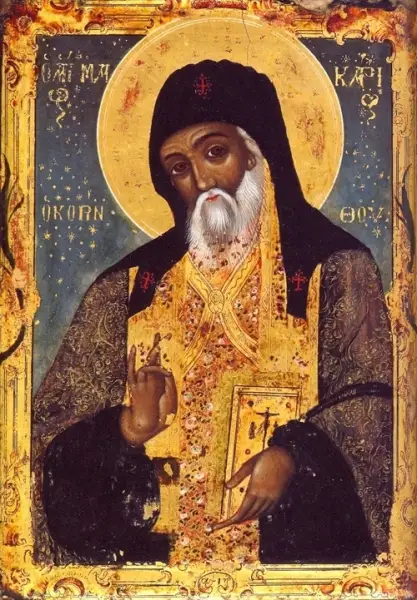
Overview
Macarius of Corinth, born Michael Notaras in 1731, served as Metropolitan bishop of Corinth at a time when the Orthodox Church of Greece labored under Ottoman rule. Remembered both as a mystic and as a spiritual writer, he devoted his episcopal ministry to reviving and sustaining the Church's inner life among a people governed by a foreign power. His lasting monument is literary: together with his friend Nicodemus of the Holy Mountain he gathered and edited the ascetic texts that became the Philokalia, the great anthology of Orthodox mystical teaching first printed in Venice in 1782. The appearance of these five volumes rekindled the hesychast tradition of inner prayer across the Orthodox world and placed Macarius among the principal architects of the eighteenth-century spiritual renewal. He spent his final years in retreat at the hermitage of St. Peter on the island of Chios, where he died on April 17, 1805. The Eastern Orthodox Church venerates him on that date.
The Complete Life
Origins in Corinth
The future metropolitan entered the world in 1731 in the Greek city of Corinth, receiving the baptismal name Michael Notaras. The Notaras name belonged to a lineage long woven into the history of Byzantine Orthodoxy, and the boy grew up in a Greece that had lived for generations under Turkish rule, its Church stripped of political patronage yet sustained by monasteries, liturgy, and popular devotion. Details of his childhood and schooling are scant, but the direction of his life was evident early: he pursued the ascetic and mystical tradition that had shaped Orthodox monasticism on the Holy Mountain and beyond, and he was marked out for service at the altar. In time he took the monastic name Macarius, a name shared with some of the desert fathers whose writings he would one day help carry to a wider Church. From Corinth he would rise to the episcopate, carrying with him the memory of a city ancient in the faith and a people whose spiritual survival had become a sacred charge.
§ Introduction
A Bishop for a Church Under Occupation
Macarius was elevated to the metropolitan throne of Corinth, becoming chief shepherd of a see whose cathedral and countryside had endured centuries of Ottoman dominion. The episcopal office in those circumstances bore little resemblance to temporal power; a bishop's work was to keep parishes alive, ordain clergy, comfort the afflicted, and preserve the transmission of Orthodox teaching from one generation to the next. Contemporaries remembered Macarius above all as a mystic, a man whose leadership flowed from inner prayer rather than from administrative ambition. He labored, as later writers have summarized it, to revive and sustain the Eastern Orthodox Church under Turkish rule — a task of quiet, patient endurance as much as of visible achievement. Alongside his episcopal duties he cultivated the company of the Athonite monk Nicodemus of the Holy Mountain, and the friendship of the two men, both steeped in the Fathers and in the practice of unceasing prayer, would soon bear fruit in the most influential publishing venture of Orthodox spirituality in the modern age.
§ Introduction
The Philokalia and the Renewal of the Heart
The work for which Macarius is most famous grew out of his collaboration with Nicodemus of the Holy Mountain. Together the two men collected ascetic and mystical texts reaching back across a millennium — writings on watchfulness, inner prayer, and the union of the soul with God — and arranged them in five volumes, printed at Venice in 1782 as the Philokalia, 'love of the beautiful.' Macarius had gathered much of the material from manuscripts available to him, and Nicodemus shaped it for the press; neither lived to see the full measure of the book's influence. When these sacred and spiritual texts appeared in print, they rekindled the hesychast movement across Eastern Orthodoxy, stirring monks and laypeople alike to take up the prayer of the heart. Through translators in the Slavic and later the Greek-reading worlds, the Philokalia circulated far beyond its original audience, becoming for many the single most important anthology of Orthodox mystical teaching and securing Macarius's place among the great restorers of the inner tradition.
§ Prayer of the Heart
Mystic of the Prayer of the Heart
Macarius's spiritual vision centered on the hesychast heritage: the conviction that the aim of the Christian life is the purification of the heart and the unceasing remembrance of God, practiced through vigilance, repetition of the Jesus Prayer, and obedience to the Fathers' teaching. As a mystic he did not treat such prayer as the monopoly of cloistered elites; his editorial work with the Philokalia shows a deliberate desire to place the ascetic classics in the hands of ordinary believers and to arm a persecuted Church with its own interior strength. The texts he and Nicodemus chose — from the Desert Fathers through Maximus the Confessor, Symeon the New Theologian, and Gregory Palamas — map the journey from attentiveness to dispassion and finally to the vision of divine light, the classical architecture of Orthodox mysticism. In this sense Macarius's spirituality was both deeply traditional and quietly revolutionary: rather than inventing new methods, he recovered the oldest ones, trusting that a Church deprived of outward freedom could be renewed from within by the ancient science of prayer.
§ Prayer of the Heart
Retreat on Chios
Macarius did not end his days on his metropolitan throne. In his later years he withdrew from public office to the hermitage of St. Peter on the island of Chios, embracing the eremitical retirement that his mystical inclinations had long foreshadowed. There, in the company of the island's monastic tradition, he closed his life in the peace he had spent a lifetime commending to others. He died on April 17, 1805, and the Orthodox Church fixed his commemoration to that same day. The movement from bishop's palace to hermit's cell gave quiet testimony to the ordering of his loves: the renewal he sought for the Church was, at root, the renewal of the heart, and he wished to meet death in the very practice he had spent himself promoting. His departure from Corinth's throne also allowed his literary legacy to travel freely — no longer tied to one see, the Philokalia passed into the hands of monks, translators, and seekers across the entire Orthodox world.
§ Introduction
Legacy
Macarius of Corinth endures in the Church's memory principally as the co-compiler of the Philokalia, the five-volume anthology whose 1782 appearance in Venice set in motion a renewal of hesychast prayer throughout Eastern Orthodoxy. The book carried the voices of Isaiah the Solitary, Evagrius, the Desert Fathers, Maximus the Confessor, Symeon the New Theologian, Gregory of Sinai, and Gregory Palamas into the modern era, and its subsequent translations — by Paisius Velichkovsky in the Slavic world, Theophan the Recluse in Russia, and modern Greek and English editors — show how far its reach eventually extended. Every revival of inner prayer in the Orthodox Church since the eighteenth century has been conducted, knowingly or not, in Macarius's debt. He is honored as a saint of the Eastern Orthodox Church, with his feast kept on April 17, the day of his repose at the hermitage of St. Peter on Chios. For a bishop whose public career unfolded under occupation, his greatest conquest was won not on any battlefield but in the printed page and the praying heart.
§ Prayer of the Heart
Timeline
- 1731
Born in Corinth as Michael Notaras, later known as Macarius.
§ Introduction
- 1782
The five volumes of the Philokalia, compiled with Nicodemus of the Holy Mountain, are first published in Venice.
§ Prayer of the Heart
- 17 Apr 1805
Dies at the hermitage of St. Peter on Chios; his feast is kept on the same date.
§ Introduction
The Record
- Major works
- Philokalia (co-compiled with Nicodemus of the Holy Mountain, published Venice, 1782)
- Patron of
- The renewal of hesychast prayer·The Orthodox Church under Ottoman rule
- Symbols
- Bishop's omophorion·A copy of the Philokalia·Prayer rope
- Canonization
- Pre-congregation; venerated in the Eastern Orthodox Church
Prayer
Bibliography
Show 1 sources
- Michael Walsh, A New Dictionary of Saints: East and West, p. 378, Liturgical Press, 2007, ISBN 0-8146-3186-X, 9780814631867
Profile text adapted from the Wikipedia article, licensed CC BY-SA 4.0.
Pray with this saint every day
Save St. Macarius of Corinth to your favorites, read the full profile, and get feast-day reminders in the Saints app.
Get the Saints AppFree on the App Store for iPhone and iPad