
c. 300 – 391·Feast January 19
St. Macarius of Egypt
Desert Father and founder of Scetis monasticism
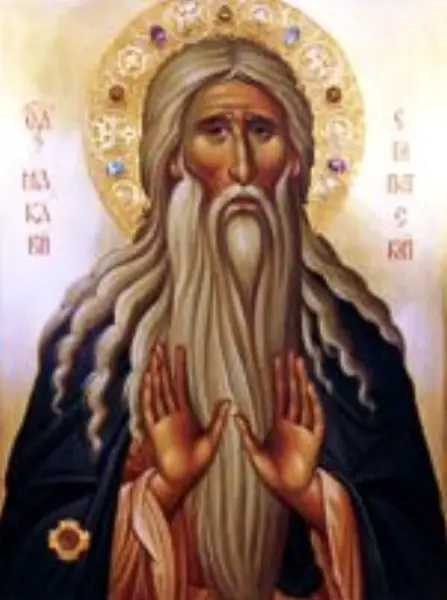
Overview
Macarius of Egypt, honored as Macarius the Great and Macarius the Elder, stands among the founding figures of Egyptian desert monasticism. Born around 300 in the village of Shabsheer in Lower Egypt, he tended cattle as a boy and, after the early deaths that emptied his household, gave away everything he owned and withdrew to a solitary cell near his home, where he prayed continually and wove mats for a living. Trained by an experienced elder in watchfulness, fasting, and prayer, he later sought out Anthony the Great, learned from him the laws of monastic life, and returned to the Scetic Desert, where he was ordained a priest at about the age of forty. His wisdom and austerity drew a community of disciples around him; banished briefly to a Nile island by Emperor Valens during the disputes over the Nicene Creed, he converted the island's pagan inhabitants and returned in triumph to the desert. He presided over the Scetis community until his death in 391, and his monastery remains inhabited to this day.
The Complete Life
The Old Young Man of Shabsheer
Macarius was born in Lower Egypt, in a village tradition places at Shabsheer, or Shanshour, around the year 300. He spent his boyhood tending cattle, an occupation that gave him an early familiarity with solitude and open country. His neighbors noticed that the young herdsman possessed a wisdom beyond his years; his friends and kinsmen nicknamed him Paidarion Geron, the 'old young man,' a title that passed into Coptic as Pidar Yougiron and described the boy who carried an elder's discernment in a youth's body. Even before he committed himself to the ascetic life he had tasted the desert: he earned money smuggling saltpeter in the region around Nitria, work that taught him how to survive and find his way across the wastes he would one day make his home. At his parents' wish he entered marriage, but his wife died young, and his parents followed her soon after. Stripped of every human attachment, Macarius distributed the family's money among the poor and needy and turned wholly toward God.
§ Life
Formation in the Desert
As a young man, feeling a strong call to solitude even before his bereavements, Macarius had built a small cell near his home, where he prayed continually and supported himself by weaving mats. After giving away his possessions, he sought out an experienced Elder living in the desert not far from his village, who accepted him as a disciple and trained him in the inner discipline of watchfulness, fasting, and prayer, teaching him as well the handicraft of weaving baskets. His reputation for holiness grew quickly, and not always to his advantage. When a pregnant woman falsely accused him of defiling her, Macarius offered no defense but accepted the accusation in silence, shouldering the shame until her difficult delivery forced her to confess his innocence. When crowds came seeking his forgiveness, he fled to the Nitrian Desert to escape their veneration. There he undertook extraordinary fasts — seven years on little more than raw herbs and pulse, followed by three years on a few ounces of bread a day and a single vessel of oil a year — and made a decisive visit to Anthony the Great, from whom he learned the laws and rules of monasticism.
§ Life
Father of Scetis
At the age of forty Macarius returned to the Scetic Desert and was ordained a priest, beginning the work for which he is remembered as the pioneer monk of the region. The fame of his sanctity gathered followers around his cell, and the community that formed in the desert took a semi-eremitical shape unlike the organized communities of Lower Egypt's coenobia: the monks were bound by no fixed rule, each lived in his own cell, and the brothers met for Divine worship only on Saturdays and Sundays. Macarius presided over this loose federation of solitaries for the rest of his life, guiding them by example and counsel rather than by legislation. Under his leadership Scetis became one of the great nurseries of Egyptian monasticism; later generations gave his name to the whole Nitrian Desert, and local tradition claimed that the number of cloisters there equaled the days of the year. Among the monks who looked to him were figures such as Pishoy and John the Dwarf, whose own reputations would carry the desert's fame across the Christian world.
§ Life
Wisdom of the Desert
The spirituality Macarius embodied was one of silence, watchfulness, and interior combat. From his Elder he had learned the science of watchfulness — the disciplined guarding of the heart's thoughts — joined to fasting and unceasing prayer, and he practiced these with a severity that became proverbial: years sustained on herbs, then on a few ounces of bread a day. Yet his austerity was joined to a striking gentleness. Faced with a slanderous accusation, he refused to defend himself, accepting humiliation in silence as a form of prayer; when his innocence emerged, he fled the ensuing praise rather than drink from it. His wisdom was recognized early — the nickname 'old young man' marked him out as one who possessed an elder's discernment while still a youth — and disciples gathered around him precisely because his counsel proved trustworthy. He directed a community of solitaries without imposing a common rule, trusting each monk's interior discipline under the shared rhythm of weekly worship. Later tradition remembered his face as mysteriously alight in the darkness of his cell, so that monks called him 'the glowing lantern,' an image his monastery inherited as the glowing lantern of the wilderness.
§ Life
Exile and Repose
Macarius's final decades were not without turmoil. For a brief period Emperor Valens banished him to an island in the Nile, together with Macarius of Alexandria, as part of the persecution of Orthodox Christians conducted by the followers of Bishop Lucius of Alexandria in the disputes over the Nicene Creed. The exile became an unexpected mission: when the daughter of the island's pagan priest fell ill, believed possessed by an evil spirit, the two saints prayed over her and she recovered. Impressed and grateful, the islanders forsook their old gods and raised a church. When word of the miracle reached Valens and Bishop Lucius, the two monks were permitted to return home; on their arrival they were met by a multitude of fifty thousand monks of the Nitrian Desert, among them Pishoy and John the Dwarf. Macarius died in the year 391. The natives of his home village of Shabsheer seized his body and built a great church over it, but Pope Michael V of Alexandria later translated the relics to the Nitrian Desert, where they rest today in the Monastery of Saint Macarius the Great in Scetes.
§ Death and relics
Veneration
The Church recognized Macarius as a saint from the earliest generations of monasticism, long before formal canonization processes existed; he is venerated across the divided traditions of Christianity as one of the classic Desert Fathers. The Eastern Orthodox, Oriental Orthodox, and Roman Catholic Churches all keep his memory, with feasts on January 15 in the West, January 19 in the Eastern Orthodox calendar, and 27 Paremhat, corresponding to April 5, among the Oriental Orthodox. His principal shrine is the monastery he founded in Scetes, which has never lacked a monastic community since its fourth-century founding and belongs today to the Coptic Orthodox Church. Coptic tradition keeps alive the image behind this veneration: the abba whose face glowed with grace in the dark, the lantern of the wilderness, whose name the monastery itself took as its own designation — the glowing monastery, a place of high wisdom and constant prayer.
§ Legacy
Legacy
Macarius of Egypt left a twofold inheritance. The first is institutional: the Monastery of Saint Macarius the Great, founded in the fourth century, has housed an unbroken succession of monks for some sixteen centuries, and the whole Nitrian Desert came to be called the Desert of Macarius in honor of its pioneer. Tradition credited him with cloisters as numerous as the days of the year, and the ruins scattered across the region still support that memory. The second inheritance is literary and spiritual. Writings associated with his name, above all the body of spiritual homilies transmitted under it, made his interior doctrine of the heart and its purification available far beyond Egypt; the Methodist Churches honor him particularly for his teaching on entire sanctification, an unusual tribute from a tradition so distant from the fourth-century desert. His figure also entered art: in the Triumph of Death fresco at Pisa, Macarius stands unmoved among horrified aristocrats, reading from a scroll above their skulls, a depiction that later inspired Benvenuto Cellini. In East and West alike, his name remains shorthand for the purest ideals of desert spirituality.
§ Legacy
Timeline
- 300
Born around this year in the village of Shabsheer (Shanshour) in Lower Egypt, Roman Egypt.
§ Life
- 391
Dies in the Scetes desert; his body is later claimed by his native village of Shabsheer.
§ Death and relics
The Record
- Major works
- Founding and leadership of the semi-eremitical monastic community of Scetis·The Monastery of Saint Macarius the Great·Spiritual homilies and ascetic teachings traditionally associated with his name
- Patron of
- The Monastery of Saint Macarius the Great·Desert monasticism and the Nitrian Desert
- Symbols
- Monk's habit of the Egyptian desert·Weaver's baskets·Glowing lantern
- Canonization
- Pre-congregation; venerated in the Oriental Orthodox, Eastern Orthodox, and Catholic Churches
Prayer
Bibliography
Show 8 sources
- "Bonus Episode: Macarius and the Mare", The Dark Ages Podcast, 2024-02-02, retrieved 2026-04-16
- Harmless, William, Desert Christians: An Introduction to the Literature of Early Monasticism, p. 174, Oxford University Press, 2004
- Butler, Alban (1866), The Lives of the Fathers, Martyrs, and Other Principal Saints, Dublin, p. 35
- Herbermann, Charles, ed. (1913), "Macarius", Catholic Encyclopedia, New York: Robert Appleton Company
- Kaufman, Paul L. (June 2018), "Did Holiness Begin with John Wesley?", The Allegheny Wesleyan Methodist, 80 (6): 4–5, Allegheny Wesleyan Methodist Connection
- "Venerable Macarius the Great of Egypt", oca.org, retrieved 2018-03-17
- Maloney, GA, SJ (trans.), 1992, Pseudo-Macarius. The Fifty Spiritual Homilies and the Great Letter, CWS, New York: Paulist Press
- Plested, Marcus, 2004, The Macarian Legacy: The Place of Macarius-Symeon in the Eastern Christian Tradition, Oxford: OUP
Profile text adapted from the Wikipedia article, licensed CC BY-SA 4.0.
Pray with this saint every day
Save St. Macarius of Egypt to your favorites, read the full profile, and get feast-day reminders in the Saints app.
Get the Saints AppFree on the App Store for iPhone and iPad