
died c. 335·Feast March 10
St. Macarius of Jerusalem
Bishop of the Holy City and Nicaean defender
Overview
Macarius I led the Church of Jerusalem through the pivotal decades that followed the end of persecution, serving as its bishop from 312 until shortly before his death around 335. He guided a see still emerging from obscurity into imperial favor, and his tenure coincided with the most consequential transformation in the holy city's Christian history: the rediscovery of the sites of the Passion and the erection of the Basilica of the Holy Sepulchre. He took part in the Council of Nicaea in 325, where his name stands first among the subscribing bishops of Palestine, and his vigorous opposition to Arianism drew abuse from Arius himself. Tradition remembers him as a man of apostolic simplicity — Athanasius cited him as an example of the honest style of the apostolic generation — and as a probable hand in the drafting of the Nicene Creed. He accompanied Helena Augusta in her search for the True Cross, received Constantine's orders for the great churches of Jerusalem, and died before the Council of Tyre in 335, leaving an episcopate that fixed Jerusalem's place in the universal Church.
The Complete Life
Bishop of the Ancient See
Nothing certain survives of Macarius's origins; he enters history in 312, when, according to the date preserved in Jerome's version of Eusebius of Caesarea's Chronicle, he acceded to the episcopate of Jerusalem. His consecration fell in the very years in which the Emperor Constantine's favor was opening a new era for Christians across the empire, and no see stood to gain more from that transformation than the one Macarius inherited. The bishop of Ælia, as Jerusalem was long officially known, presided over a Church whose mother-city memory gave it unique honor but whose actual standing among the metropolitan sees remained contested, not least by Eusebius of Caesarea, its senior neighbor. The later chronicler Sozomen records that near the end of his life Macarius tried to appoint his eventual successor, Maximus, to the see of Lydda; the people of Jerusalem refused to surrender their distinguished priest, or — in a second version of the story — Macarius himself changed his mind, fearing that an unorthodox man might otherwise succeed to his own throne. Whatever the truth, the episode shows a bishop thinking anxiously about the future of his flock.
§ Introduction
The Holy Sites Restored
Macarius's most visible work was the recovery of Jerusalem's sacred topography. Tradition, preserved by the chronicler Theophanes, has Constantine ordering Macarius, once the Council of Nicaea had ended, to hunt out the places of the Resurrection, the Passion, and the True Cross; the account is plausible, for excavations at the site of the old temple of Venus began almost immediately after the council, apparently under Macarius's supervision. The great mound and stonework that Hadrian's engineers had piled over the Holy Sepulchre were cleared away, and once the ground's original surface lay open again, the hallowed tomb of the Resurrection came to light, beyond all expectation. Constantine answered the news with a letter to Macarius full of lavish instructions for the church that was to rise over the spot, urging that the most wondrous spot on earth receive worthy adornment and directing him to report on the columns and marbles he judged most precious. A second imperial letter, addressed to Macarius and the other bishops of Palestine, ordered a church built at Mambre, where a pagan shrine had defiled the site; churches were also raised over the places of the Nativity and the Ascension.
§ Macarius and the Holy Sites
Orthodoxy at Nicaea
Macarius's spiritual character is best seen in his defense of the faith against Arianism. Athanasius, in one of his orations against the Arians, held him up as an example of the straightforward, unadorned manner of the apostolic generation, and later listed him among the bishops renowned for their orthodoxy. At the Council of Nicaea in 325 his name appears first among the bishops of Palestine who subscribed, ahead of Eusebius of Caesarea's, and the vigor of his anti-Arian stance is suggested by the insulting language Arius spent on him in a letter to Eusebius of Nicomedia. Two traditions attach to his council work: one imagines a sharp exchange with his metropolitan Eusebius over the rights of their sees, a struggle faintly visible in the vague seventh canon that granted Jerusalem honor without prejudice to Caesarea's metropolitan dignity; the other holds that Macarius, with Eustathius of Antioch, bore much of the responsibility for shaping the creed the council finally adopted. A later collection of imaginary disputations even makes him the bishops' spokesman defending the Descent into Hell, in language shaped to the Jerusalem Creed.
§ Macarius and Arianism
Closing Years
Macarius did not live long to enjoy the fruits of his labor at the holy places. His death must have occurred before the Council of Tyre in 335, for his successor Maximus appears among the bishops present at that assembly. The chronology preserved in the episcopal lists gives his tenure as extending to about 333, closing an episcopate of some two decades begun in 312. He thus died within a very few years of the discovery of the Sepulchre and the launching of Constantine's basilica, leaving to Maximus the completion of the church whose foundations he had supervised. The brevity of that interval gives his episcopate the shape of a single great achievement carried through at the end of a long labor: a Church that had endured generations of pagan oversight and concealment of its holiest site saw, within one bishop's lifetime, the excavation of the tomb and the commissioning of the grandest church in the empire. In the tradition of the Orthodox Church he is commemorated on March 10, the day of his feast.
§ Introduction
Veneration
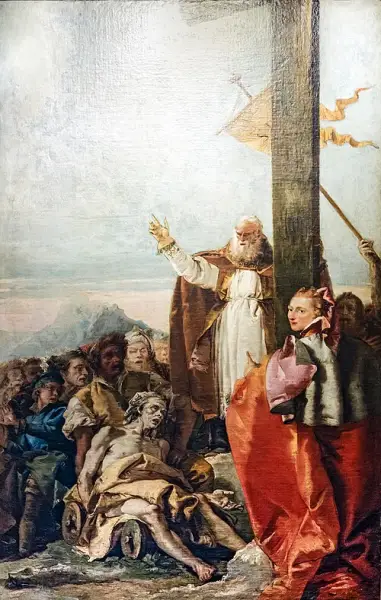
Macarius is recognized as a saint within both the Eastern Orthodox and the Roman Catholic traditions, a memory that arose from the reverence of the ancient Church rather than from any later formal canonization. His feast is kept on March 10. Devotion to him has traveled far from Jerusalem: relics of Saint Macarius, including his skull, are located today in Saint Anthony's Chapel in Pittsburgh, Pennsylvania, a destination for pilgrims an ocean away from the basilica he helped to found. In Christian art his memory is fixed above all by Giandomenico Tiepolo's painting of the Finding of the True Cross, which shows Bishop Macarius blessing the sick with the wood of the Cross he had labored to recover — an image that gathers together his two great titles to remembrance, the shepherd of the Jerusalem Church and the discoverer of its sacred past.
§ Veneration
Legacy
Macarius's legacy is written into the landscape of Jerusalem itself. The excavations he oversaw uncovered the monument of the Resurrection, and the Basilica of the Holy Sepulchre that Constantine ordered in response to his reports became the mother church of Christendom's most sacred site, reshaping the city's pilgrimage and its Christian topography permanently. His work at the Council of Nicaea secured Jerusalem's ancient honor in the council's seventh canon and, in the judgment of many scholars, left its mark on the very wording of the Nicene Creed. Athanasius's tribute — ranking him among the apostolical men whose honesty of style the orthodox party could point to with pride — kept his reputation bright in the generation after his death, when Arius's partisans were rewriting the story of the council. He also left the Church of Jerusalem a capable successor in Maximus, whom he had marked out for the episcopate. Among the long line of bishops and patriarchs of the Jerusalem Church, his episcopate remains the hinge on which the see's transformation from a hidden community into an imperial, pilgrim-filled church turned.
§ Introduction
Timeline
- 312
Accedes to the episcopate of Jerusalem, a date preserved in Jerome's version of Eusebius' Chronicle.
§ Introduction
- 325
Takes part in the Council of Nicaea and subscribes first among the bishops of Palestine.
§ Macarius and Arianism
- 325
Accompanies Helena Augusta at Jerusalem in the search for relics of the Passion, including the True Cross.
§ Introduction
- 335
Dies before the Council of Tyre; his successor Maximus is apparently present at that council.
§ Introduction
In Their Own Words
Such is our Saviour's grace, that no power of language seems adequate to describe the wondrous circumstance to which I am about to refer. For, that the monument of his most holy Passion, so long ago buried beneath the ground, should have remained unknown for so long a series of years, until its reappearance to his servants now set free through the removal of him who was the common enemy of all, is a fact which truly surpasses all admiration.
The Record
- Major works
- Superintendence of the excavations and construction of the Basilica of the Holy Sepulchre·Participation in the Council of Nicaea and probable contribution to the drafting of the Nicene Creed
- Patron of
- The Church of Jerusalem·The Holy Sepulchre
- Symbols
- Bishop's vestments and crozier·The True Cross
- Canonization
- Pre-congregation; venerated in the Eastern Orthodox Church and the Catholic Church
Prayer
Bibliography
Show 8 sources
- Tillemont, Mémoires pour servir à l'histoire ecclésiastique des six premiers siècles, VI, 741
- Eusebius, Vita Constantini, III, 30-32
- Epiphanius, "Hær.", LXIX, iv
- Theodoret, H. E., I, 4
- Sozomen, H. E., II, 20
- Zöckler, Otto (1914), "Macarius", in Jackson, Samuel Macauley (ed.), New Schaff–Herzog Encyclopedia of Religious Knowledge, Vol. VII (third ed.), London and New York: Funk and Wagnalls, p. 103
- "St. Macarius of Jerusalem", 10 March 2021
- "Saint Macarius of Jerusalem, Bishop", Archdiocese of Hobart, archived from the original on 2015-03-29
Profile text adapted from the Wikipedia article, licensed CC BY-SA 4.0.
Pray with this saint every day
Save St. Macarius of Jerusalem to your favorites, read the full profile, and get feast-day reminders in the Saints app.
Get the Saints AppFree on the App Store for iPhone and iPad