
c. 1349 – 1444·Feast October 25
St. Macarius of Unzha
Miracle worker and founder of Volga monasteries
Overview
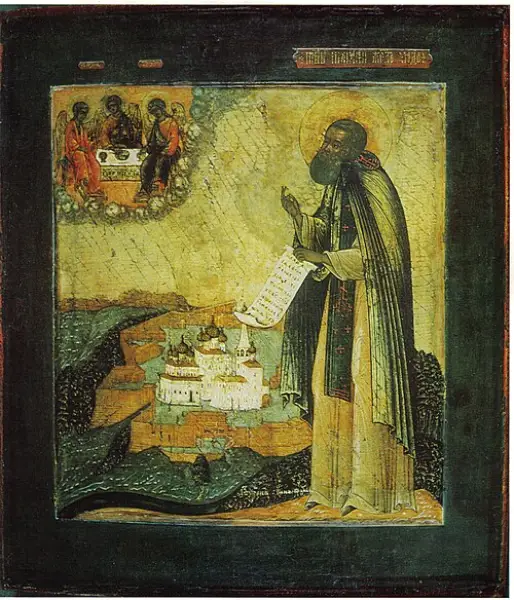
Macarius, revered as the wonderworker of the Yellow Water Lake and of the Unzha, was a Russian Orthodox monk whose ninety-five years spanned nearly the whole of the fourteenth and first half of the fifteenth centuries. Born in Nizhny Novgorod around 1349, he entered the Pechersky Ascension Monastery at the age of twelve and became one of the twelve disciples of its founder, Dionysius. After Dionysius was raised to the episcopate, Macarius set out for the wilderness along the Volga, founding a monastery near Reshma before withdrawing to a hermit's cave by the Yellow Water Lake, then a frontier belonging to neither the Russian principalities nor the Kazan Khanate. Disciples gathered around him, and in 1434 he established the Zheltovodsky Makariev Monastery of the Holy Trinity, whose ascetic witness drew both Christians and the pagan Mordvin, Mari, and Chuvash peoples of the region, many of whom he baptized in the lake itself. When the khan Olug Moxammat destroyed the monastery in 1439, the nonagenarian abbot was carried captive to Kazan and then released; barred from returning to the lake, he led his survivors north to the Unzha River and founded a second monastery, where he died in 1444 after an eighty-three-year monastic career.
The Complete Life
A Child Who Loved the Church Bells
Macarius was born around 1349 in Nizhny Novgorod, the capital of the Principality of Nizhny Novgorod-Suzdal under Prince Konstantine Vasilyevich, a land dominated like most Russian principalities of the age by the Golden Horde. He was baptized in his parents' parish church of the Holy Myrrhbearers; his baptismal name is not known. The Life of the saint preserves an endearing sign of the child's future: as a baby he cried whenever the bells of the nearby church rang, and could not be consoled, yet when his reluctant parents finally carried him through the church doors he fell quiet and smiled with joy. From then on the family attended every service, for the infant wept whenever he was left at home. The boy grew pious, above all fascinated by the lives of the hermits of earlier ages who dwelt alone or in small lavras in the wilderness. He loved to visit the Pechersky Ascension Monastery, newly established by Dionysius, a monk who had left the celebrated Kiev Cave Lavra to settle in Nizhny Novgorod, and at the age of twelve he slipped out of his parents' house to join it, receiving the monastic name Macarius.
§ Life
Disciple of Dionysius
At the Pechersky Ascension Monastery Macarius was counted among the dozen disciples gathered by Dionysius, and his fasting won notice for its severity and his prayer for its fervor. He remained under his abba's direction until 1374, when Dionysius was enthroned as archbishop of Suzdal and Nizhny Novgorod and departed; soon afterward Macarius too went out from the monastery, freed now to pursue the eremitical ideal that had drawn him since childhood. He traveled up the Volga and spent some time with the ascetic Tikhon on the Lukh River before founding a monastery in honor of the Epiphany of Jesus Christ near the village of Reshma, known today as Makaryev Reshma Monastery. Yet even a house he had founded could not satisfy his longing for the desert. Journeying down the Volga he found the site his heart sought: the Yellow Water Lake, near where the Kerzhenets falls into the great river some hundred kilometers below Nizhny Novgorod, a frontier belonging to neither the Russian principalities nor the Kazan Khanate. There he dug a small cave by the water and gave himself, day and night, to the imitation of the great hermits of the past.
§ Life
The Yellow Water Lake and the Unzha
Macarius's solitude by the Yellow Water Lake did not last. Pious people came from far and wide, some seeking his blessing, others asking to share his hermetic life, and in 1434 he founded the Zheltovodsky Makariev Monastery of the Holy Trinity for his disciples. His asceticism joined with a genuine love of neighbor attracted not only Christians but also the pagan Mordvin, Mari, and Chuvash peoples of the region and the Muslim Tatars, many of whom he baptized in the waters of the lake itself. The peace ended in 1439, when the khan Olug Moxammat of Kazan invaded Russia and destroyed the monastery; most of the monks were killed, and Macarius, then past ninety, was carried off to Kazan with a handful of other Christians. The khan, impressed by the piety of the nonagenarian abbot, released him and permitted him to bury the slain. On the journey home Macarius paused near the site of today's Sviyazhsk, blessing what would later become the Makaryev Sviyazhsk Monastery, but the lake itself was barred to him. Choosing safety, he led his companions north to the forests of the Unzha River, where — miraculously saved from starvation on the road, in what is remembered as his Miracle of the Moose — they founded the Makaryev Unzhensky Monastery.
§ Life
Ascetic and Wonderworker
The spirituality of Macarius joined the harshest ascetic practice to an open-hearted charity. His fasting and prayer were famous from his first years as a monk; his biographers rank him with the great hermits of the past whom he imitated in his cave by the Yellow Water Lake. Yet the same man who sought the wilderness welcomed every seeker who found him there, and his monastery became a fountain of Christianization for the peoples of the Middle Volga, as pagan Mordvin, Mari, and Chuvash and Muslim Tatars alike were drawn by his example and baptized in the lake. Legend relates that in his last years at the Unzha monastery he healed the sick and expelled devils from the possessed, deeds that earned him the title of Miracle Worker. His endurance under catastrophe displayed the same union of toughness and tenderness: he bore the destruction of his community and captivity in Kazan without bitterness, won the respect of the khan himself, and set out at ninety to build yet again rather than abandon his brethren. He died on July 25, 1444, at ninety-five, closing a monastic career of eighty-three years.
§ Life
Last Years on the Unzha
Macarius lived only a few years in the monastery he founded on the Unzha, but those years confirmed the holiness that had followed him from the Volga. The long journey north, undertaken in old age after the loss of nearly everything, tested the little company; when their food ran out, tradition says, they were preserved from starvation by the Miracle of the Moose, and the survivors reached the river where their new house rose among the forests. There the aged founder continued his ministry of healing and deliverance until his death on 25 July 1444, when he was ninety-five. A wooden church was soon built over his grave, and the monastery took his name, becoming known as Makaryev Unzhensky. From that grave, the faithful reported cures of many diseases; his intercession was credited with turning back a Tatar raid and, in the Time of Troubles, with shielding the region from Polish soldiery. The fame of the dead abbot drew pilgrims and novices to both of his monasteries and carried his veneration outward through the Russian lands, preparing the Church's formal recognition a century and a half later.
§ Canonization
Canonization and the Journey of the Relics
In 1619, when Feodor Romanov was enthroned as Patriarch Philaret of Moscow, he dispatched investigators to the Unzha to inquire into the marvels reported at Macarius's grave. He affirmed the miracles as confirmed in a letter to his son, the young Tsar Michael, that September, and urged the tsar to visit the Unzha Monastery in fulfillment of a vow — which Michael promptly did. At about that time a Sobor of the Russian Orthodox Church canonized Macarius, making his veneration nationwide. In 1671, while a grave was being dug in the church that held his body, his remains came to light, and after several years of debate — settled by minor miracles that convinced the doubters — they were placed in a reliquary in the Unzhensky Makaryev Monastery. The monastery was shut by Soviet authorities in 1929, and the relics passed into storage at a local history museum at Yuryevets, until they returned to the Kostroma Eparchy in 1990 and to the monastery itself in 1995. The saint's head, saved from the Bolsheviks by two generations of priests, was authenticated and returned with honors on March 23, 2006, and in August 2007 it was carried down the Volga by boat to be enshrined at the Zheltovodsky Makariev Monastery.
§ Canonization
Legacy
Macarius's four foundations made him the great monastic pioneer of the Middle and Upper Volga. The Zheltovodsky Makariev Convent of the Holy Trinity at the Yellow Water Lake and the Makaryev Unzhensky Convent on the Unzha remain living houses of prayer, joined by the Makaryev Reshma Monastery and the monastery his blessing marked out at Sviyazhsk. Two towns — Makaryev in Kostroma Oblast and Makaryevo in Nizhny Novgorod Oblast — grew up beside his cloisters and still bear his name, and the great Makariev Fair, once among Russia's most famous markets, took its patron from the saint whose monastery anchored it. The Russian Orthodox Church keeps two feasts in his memory: July 25, Julian calendar, now August 7, for his repose, and October 12, Julian, now October 25, for the recovery of his relics in 1671. He is honored as patron of craftsmen, merchants, and travellers, and is especially venerated in the eparchies of Nizhny Novgorod, Ivanovo, and Kostroma, where all his labor was spent; at monasteries such as Pechersky Ascension, the faithful still ask his prayers for success in honest work and for deliverance from poverty.
§ Monasteries and convents founded by Macarius
Timeline
- 1349
Born in Nizhny Novgorod, capital of the Principality of Nizhny Novgorod-Suzdal.
§ Life
- 1374
After Dionysius becomes archbishop of Suzdal and Nizhny Novgorod, leaves the monastery, travels up the Volga, and founds a monastery honoring the Epiphany near Reshma.
§ Life
- 1434
Founds the Zheltovodsky Makariev Monastery of Holy Trinity at the Yellow Water Lake.
§ Life
- 1439
The monastery is destroyed by the khan Olug Moxammat of Kazan; Macarius is taken prisoner, then released by the khan.
§ Life
- 1439
Barred from returning to the Yellow Water Lake, he and his companions found Makaryev Unzhensky Monastery on the Unzha River.
§ Life
- 25 Jul 1444
Dies at the age of 95 after an eighty-three-year monastic career.
§ Life
- 1619
Patriarch Philaret of Moscow confirms the miracles at Macarius's grave; a Sobor of the Russian Orthodox Church canonizes him.
§ Canonization
- 1671
His relics are discovered during a burial in the church over his grave.
§ Relics
- 1929
Soviet authorities close the Unzhensky Makaryev Monastery; most of the relics are moved to a museum at Yuryevets.
§ Relics
- 1990
The relics held in storage return to the Kostroma Eparchy.
§ Relics
- 1995
The bones and vestments are brought back to Unzhensky Makaryev Monastery.
§ Relics
- 23 Mar 2006
The saint's head, saved from the Bolsheviks by two priests, is returned at a service in the Holy Saviour Cathedral in Nizhny Novgorod Kremlin.
§ Relics
- 3 Aug 2007
The head is transferred down the Volga by boat and permanently enshrined at Makaryev Zheltovodsky Monastery.
§ Relics
The Record
- Major works
- Zheltovodsky Makariev Monastery of Holy Trinity (founded 1434)·Makaryev Reshma Monastery near Reshma·Makaryev Unzhensky Monastery on the Unzha River (founded 1439)·Blessing of the future site of Makaryev Sviyazhsk Monastery
- Patron of
- Craftsmen, merchants, and travellers·Makariev Fair·Nizhny Novgorod, Ivanovo, and Kostroma Oblasts·Against poverty (prayers for deliverance from need)
- Symbols
- Monastic habit·The Yellow Water Lake·Relics preserved in portable reliquary
- Canonization
- Canonized c. 1619 by a Sobor of the Russian Orthodox Church under Patriarch Philaret of Moscow
Prayer
Bibliography
Show 5 sources
- Metropolitan Macarius of Moscow and Kolomna, The History of Russian Church, Vol. 9, Chapter 3
- "Meeting the Honorable Head of Venerable Macarius" (The Archdiocese of Nizhny Novgorod; 23 March 2006), archived from the original on 2006-11-11
- "В Нижегородской епархии начался крестный ход с мощами преподобного Макария Желтоводского" (Blagovest-Info, 2007-Aug-03)
- "Крестный ход с мощами преподобного Макария Желтоводского начнет движение от Нижегородской Ярмарки 3 августа" (RIA Kreml, 2007-Aug-02)
- Great Synaxaristes: Ὁ Ὅσιος Μακάριος Ζελτοβόδας ὁ Θαυματουργός (Ρῶσος), 25 Ιουλίου, ΜΕΓΑΣ ΣΥΝΑΞΑΡΙΣΤΗΣ
Profile text adapted from the Wikipedia article, licensed CC BY-SA 4.0.
Pray with this saint every day
Save St. Macarius of Unzha to your favorites, read the full profile, and get feast-day reminders in the Saints app.
Get the Saints AppFree on the App Store for iPhone and iPad