
died c. 420·Feast January 24
St. Macedonius of Syria
Barley-eating hermit of Byzantine Syria
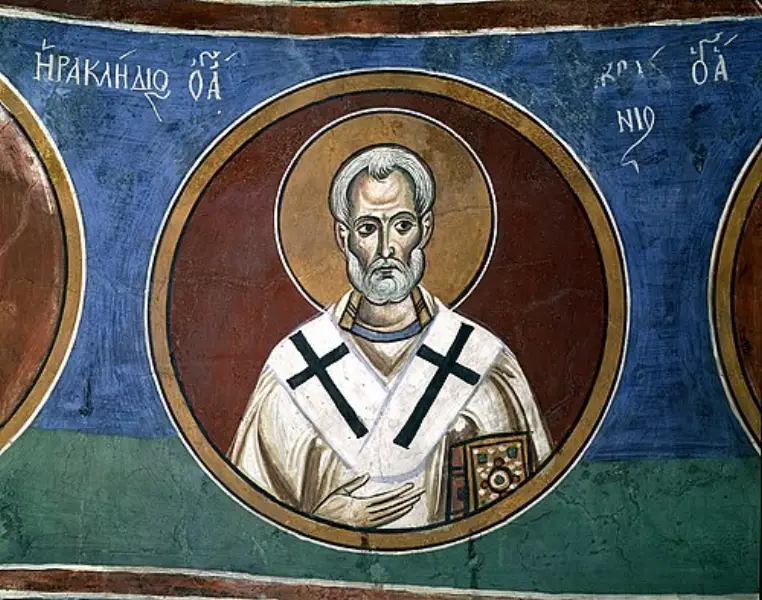
Overview
Macedonius the Hermit, sometimes called Macedonius Kritophagus, lived in Byzantine Syria as the fourth century gave way to the fifth, and stands among the austere ascetics of the early Syrian desert movement. His ascetic life began as a pilgrimage: he wandered from city to city through Syria, Phoenicia, and Cilicia, sustaining himself entirely on barley moistened with water, a regime so characteristic that it earned him the nickname Kritophagus, the barley-eater. In time he withdrew altogether from human contact, settling in the wilderness and taking shelter in a pit, where his reputation for holiness grew alongside reports of his gifts of healing and exorcism. Multitudes came from far and wide to seek his direction and intercession, though he received them from the depths of his retreat. Only in extreme old age did he consent to move into a cell that others had prepared for him. He regarded food strictly as medicine taken to stave off death, holding that no one may cut short the life God gives in order to escape its labors and battles. He died around the year 420, at about seventy years of age, and is commemorated in the Eastern Orthodox Church on January 24.
The Complete Life
The Pilgrim Ascetic
Macedonius's ascent into the ascetic life took the form of a long pilgrimage. As the fourth century closed and the fifth began, he wandered from city to city across Syria, Phoenicia, and Cilicia, owning nothing and eating nothing but barley moistened with water. The diet was so identified with him that he became known as Kritophagus, the barley-eater, a name by which he is still distinguished among the many hermits of the Syrian tradition. His wandering years trained him in the essential disciplines of the desert movement: poverty without provision, the mortification of appetite, and a life passed in the sight of God rather than of men. In time the pilgrim's road ended and the hermit's began. He settled in the wilderness, far from any human dwelling, and made his shelter in a pit — a dwelling so austere that it placed him among the precursors of those Syrian ascetics who would later take to pillars and other extremes of withdrawal. There, unseen by the world, his chief work was prayer and the conquest of his own body's demands.
§ Introduction
Food as Medicine, Life as Conflict
The heart of Macedonius's teaching lies in a single conviction his biographers preserve: he considered food a form of medicine, to be taken only to put off death, since no one may cut short the life God gives in order to escape its labors and battles. The maxim reveals an asceticism without escapism. Macedonius did not starve himself in the pursuit of death or the display of miracle; he ate the barest possible sustenance precisely so that he could remain at his post, enduring to the end the labors and spiritual conflicts for which God had set him in the wilderness. His holiness, disciplined through decades of this regimen, became visible to others in gifts of healing and exorcism, and his fame spread far and wide. Multitudes gradually made their way to the desert to seek his direction and intercession, and the hermit received them, though he yielded nothing of his withdrawal. When old age finally made the pit unlivable, he at last accepted the cell that others had prepared — his single concession to the body's weakness in a life that had made of the body's needs a theology of endurance.
§ Introduction
Repose
Macedonius lived to about seventy years of age, dying around the year 420. By then his long pilgrimage and his decades in the pit had made him one of the remembered fathers of Syrian monasticism, sought out by generations of pilgrims for healing and deliverance. The final accommodation of his old age — a cell built for him by those who revered him — closed a life that had begun in restless wandering and passed through total withdrawal into a holiness that drew the world to itself. The Eastern Orthodox Church enshrined his memory in its calendar, fixing his feast on January 24, and hands down his example among the hermits and ascetics of the desert tradition alongside the memory of the stylites and the dwellers in the poustinia, the desert places where men like him made their homes with God alone.
§ Introduction
Legacy
Macedonius belongs to the generation of ascetics in whom Syrian monasticism found its characteristic voice, and his memory has been kept alive in the Eastern Orthodox Church ever since, with his feast celebrated on January 24. The nickname Kritophagus, the barley-eater, preserved his principal ascetic practice in his very name, and his maxim about food as medicine — that one may not shorten one's life to escape labor and conflict — passed into the inherited wisdom of the desert tradition, correcting those who might mistake self-destruction for sanctity. He is remembered among the spiritual forebears of the Syrian hermits, in the company honored by the Church's memory of stylites, poustinia dwellers, and the monks of the wilderness, and his example of a lifetime's endurance, ending only when the body could no longer keep its post, remains the measure of his veneration.
§ Introduction
The Record
- Patron of
- Ascetics and hermits·Christian monasticism in Syria
- Symbols
- Hermit's habit·Barley and water
- Canonization
- Pre-congregation; venerated in the Eastern Orthodox Church
Prayer
Bibliography
Show 2 sources
- "St Macedonius the Hermit of Syria", retrieved 16 August 2016
- "Saint of the Day, January 24: Macedonius Kritophagos", Saint Patrick Catholic Church in Washington, D.C., retrieved 2012-03-06
Profile text adapted from the Wikipedia article, licensed CC BY-SA 4.0.
Pray with this saint every day
Save St. Macedonius of Syria to your favorites, read the full profile, and get feast-day reminders in the Saints app.
Get the Saints AppFree on the App Store for iPhone and iPad