
6th century·Feast Not recorded
St. Maches
Welsh princess, hermit, and martyr of Gwent
Overview
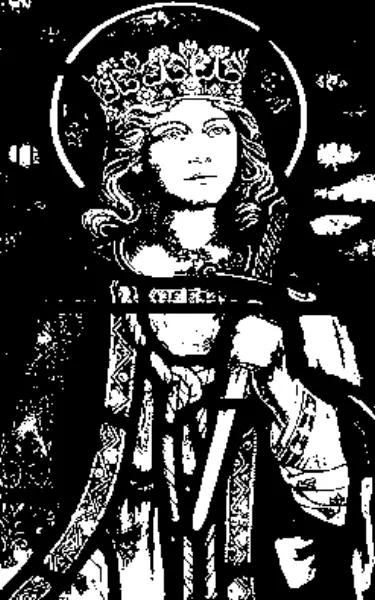
Maches was a sixth-century princess and pre-congregational saint honored in Cornwall, Devon, and the Welsh kingdom of Gwent. She was born a daughter of St. Gwynllyw and his wife Gwladys, a marriage of two of the most storied figures of early Welsh Christianity, and she was the sister of St. Cadog, one of the greatest of the Welsh saints. Turning from her royal birth to a life of prayer, Maches lived as a hermit, choosing solitude and ascetic discipline in the manner of the age's holiest men and women. Her retreat ended in violence: she was murdered by thieves at Merthyr Maches, the place afterwards known as Llanfaches in the kingdom of Gwent, becoming in Welsh tradition one of the martyrs slain at the hands of bandits rather than persecutors. The criminals later confessed their crime to St. Tathan, who buried her in the monastery at Caerwent, where her grave was honored in the church that now serves as the parish church of St. Stephen. Her cult, remembered in place-names and in the drawings of her figure from old windows, belongs to the earliest generations of British saints.
The Complete Life
A Royal Daughter of the Welsh Saints
Maches was born into one of the most celebrated families of early Welsh Christianity. Her father was St. Gwynllyw, the warrior king of Gwynllwg whose conversion is among the famous tales of the Welsh saints, and her mother was Gwladys, herself a woman of holy memory; through this royal house Maches belonged to the network of sixth-century princely families from which most of the saints of Wales sprang. Her brother was St. Cadog, among the greatest abbots and teachers of the age, whose monastery at Llancarfan made him a figure honored across Wales and in Brittany and Cornwall besides. The traditions that remember the children of Gwynllyw and Gwladys name Maches among a family whose members were nearly all enrolled among the saints, a household in which royal blood and religious vocation were joined. Of her childhood and education the old sources are silent, but her subsequent choice of the eremitical life suggests a formation in prayer and Scripture within the orbit of her brother's great religious community and the churches of her parents' kingdom.
§ Introduction
The Hermit of Gwent
Rather than remain within the privileges of her royal birth, Maches withdrew to live as a hermit, embracing the solitary life that the British Church of the sixth century honored as the summit of Christian vocation. Her retreat was in the kingdom of Gwent, in the country of her family's rule, at the place remembered ever after as Merthyr Maches — the martyrdom place of Maches — now called Llanfaches. The choice marked her out among the women of the Welsh princely houses, few of whom abandoned court and kindred for the solitude of a cell. Like the other hermits of her era, she would have given her days to prayer, psalmody, and the warfare of ascetic discipline, a hidden life of which the sources preserve only the outline and the place. That her retreat became a site of pilgrimage and, in time, a church bearing her name testifies that her sanctity was recognized by those who knew of her, and that the memory of the princess-turned-anchoress remained living in the region long after her death.
§ Introduction
Martyrdom and Burial
Maches's solitude ended in blood. Thieves discovered the woman in her retreat and murdered her, making her one of those saints whose martyrdom came not from a persecuting state but from the lawless violence of robbers — a fate the early Welsh Church counted worthy of a martyr's honor, as the place-name Merthyr Maches, the martyrium of Maches, records. The crime did not remain hidden: the bandits confessed the killing to St. Tathan, the saintly abbot whose monastery stood at Caerwent, the old Roman town near the coast of Gwent. Tathan buried her in the monastery there, and her grave was honored in the church that in later centuries became the parish church of St. Stephen at Caerwent, where her memory remained attached to the site of her tomb. The confession of her murderers and her burial by a saint gave the story of her death the shape the Church loved: violence answered by repentance, and a hidden life crowned by an honorable grave in a house of prayer.
§ Introduction
Legacy
Maches is counted among the pre-congregational saints of Cornwall and Devon as well as of Wales, her cult belonging to the earliest and least documented stratum of British sanctity. Her memory has survived above all in the landscape: Llanfaches in the old kingdom of Gwent preserves her name in the very form that commemorates her, and the parish church at Caerwent, where St. Tathan buried her, stands as the keeper of her grave. Devotion to her also passed into art; a drawing of St. Maches survives from an old window, evidence that her figure once looked down on worshippers in colored glass. Genealogists and hagiographers of the Welsh saints have kept her place in the family of Gwynllyw and Gwladys, sister of St. Cadog, ensuring that the royal martyr remained part of the written inheritance of Wales. Though little of her story can be recovered in detail, the essentials have endured: a princess who chose the hermit's cell, a death at the hands of thieves, a murderer's confession, and a martyr's burial in a saint's monastery.
§ Introduction
The Record
- Patron of
- Hermits and those who suffer violence·The parish of Llanfaches
- Symbols
- Princess's crown or royal dress·Palm of martyrdom·Hermit's cell
- Canonization
- Pre-congregation; venerated as a saint of Cornwall, Devon, and Wales from the early medieval period
Prayer
Bibliography
Show 4 sources
- Brian Daniel Starr, The Life of Saint Brychan: King of Brycheiniog and Family, Brian Daniel Starr, 2008, p. 80
- Hando, F. J., "Out and About in Monmouthshire", R. H. Johns, Newport, 1958
- "Saint Maches", CatholicSaints.Info
- "Caerwent Church Home of St. Tathyw"
Profile text adapted from the Wikipedia article, licensed CC BY-SA 4.0.
Pray with this saint every day
Save St. Maches to your favorites, read the full profile, and get feast-day reminders in the Saints app.
Get the Saints AppFree on the App Store for iPhone and iPad