
died c. 287·Feast January 6
St. Macra of Reims
Virgin Martyr of Fismes in Roman Gaul
Overview
Macra was a Christian woman of Reims in Roman Gaul, honored as a martyr of the persecution attributed to the emperors Diocletian and Maximian, conventionally dated around 287. Her legend relates that the governor Rictius Varus, charged with uprooting Christianity from Gaul, seized her as part of that campaign and demanded that she renounce her faith. Her refusal, famously expressed in words defying her tormentor, earned her a sequence of brutal torments: she was carried to Fismes, stripped and bound to a stake for death by fire, and mutilated before being returned to prison. There her wounds were said to have closed overnight, and when the governor demanded an explanation she credited her healing to Jesus Christ and renewed her refusal to serve any other. She was then forced to roll over shattered earthenware and glowing coals without suffering, and died at last while praying. Her memory is kept on January 6 in the Eastern Orthodox calendar, and artists frequently show her holding a pair of pincers, the emblem of her passion.
The Complete Life
A Christian of Reims
Macra belonged to the Christian community of Reims, one of the principal cities of Roman Gaul, in the closing decades of the third century. Nothing in her legend records her family, her age or the circumstances of her conversion, a silence that is itself characteristic of the early martyr acts, which were concerned less with biography than with witness. What the tradition preserves is her identity at the moment of trial: a woman of Reims whose allegiance to Christ was known to the authorities of the city. She lived at a time when the imperial government was turning decisively against the Church, and when the profession of Christianity, especially by those who refused the civic ritual of sacrifice, could cost a believer everything. The church at Reims was among the oldest in Gaul, and it was from this rooted community of faith that Macra emerged when the storm of persecution broke over the province.
§ Introduction
Trial Before the Governor
The persecution in which Macra suffered was remembered as the work of the emperors Diocletian and Maximian, who entrusted its execution in Gaul to the governor Rictius Varus. Brought before him, Macra was ordered to renounce Christianity, and her reply has survived as the most famous moment of her passion: a direct rebuke to the tyrant and a declaration that no human power could shake her faith. When words failed, Varus turned to force. She was conveyed from Reims to Fismes, stripped of her clothing and tied to a stake so that she might die by fire; the legend records that she showed no visible fear, and that her breasts were severed before she was sent back to prison. The ordeal did not end there. On the following day, finding her wounds miraculously healed, the governor demanded to know the cause of her recovery, and Macra answered that she had been healed by Jesus Christ. Commanded once more to deny her Lord, she declared that she would serve God alone.
§ Introduction
Memory and Emblems
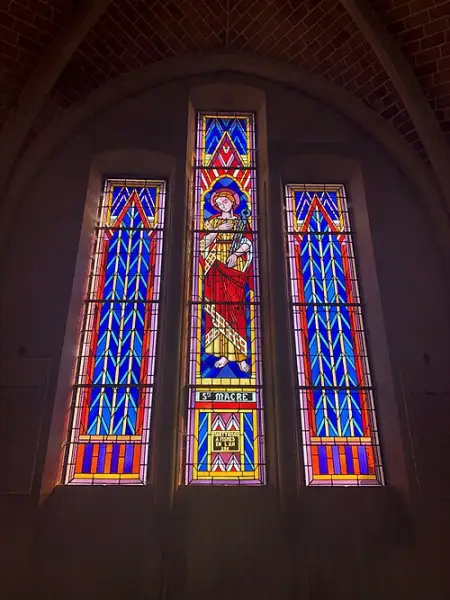
Macra died in the midst of her torments, the legend saying that she breathed her last while engaged in prayer, having been made to roll over broken earthenware and hot coals yet feeling no pain, an intervention the tradition ascribes to God. Her cult is ancient, though the narrative of her passion has come down in legendary form rather than as a contemporary court record, and hagiographers have long recognized the stylized character of the story. Her feast is kept on January 6 in the Eastern Orthodox calendar, a date enshrined in the Roman Martyrology and the Acta Sanctorum. In art she is readily identified by the pair of pincers she holds, the instrument associated with her mutilation, and her image survives in the Église Sainte-Marie-Madeleine de Mont-Notre-Dame. The town of Fismes, near Reims, remains the place most closely bound to her memory, and her story stands among the many accounts of women who bore witness in Gaul during the age of persecutions.
§ Introduction
Timeline
- 287
Governor Rictius Varus, acting for Diocletian and Maximian, seizes Macra at Reims and orders her tortured for refusing to renounce Christ
§ Introduction
- 287
Is taken to Fismes, bound to a stake for burning and mutilated, then returned to prison, where her wounds reportedly heal overnight
§ Introduction
- 287
Dies while at prayer after being made to roll over broken pottery and hot coals, feeling no pain
§ Introduction
In Their Own Words
Know, tyrant and child of the devil, it is not in the power of man to shake my faith.
The Record
- Symbols
- Pair of pincers·Palm of martyrdom
- Canonization
- Pre-congregation; venerated as a martyr since antiquity
Prayer
Bibliography
Show 8 sources
- Hutchison-Hall, Dr John (Ellsworth) (19 January 2025). "Orthodox Saints of the Pre-Schism See of Rome 19th January (NS) — 6th January (OS) 2025". Dr. John (Ellsworth) Hutchison-Hall. Retrieved 22 October 2025.
- Butler, Alban (1799). The Lives of the Primitive Fathers, Martyrs, and Other Principal Saints. Vol. 10 (3rd ed.). J. Moir. p. 2.
- Herbermann, Charles, ed. (1913). "Archdiocese of Reims". Catholic Encyclopedia. New York: Robert Appleton Company.
- Cowie, Leonard W. (1974). The Christian calendar: a complete guide to the seasons of the Christian year telling the story of Christ and the saints, from Advent to Pentecost. Weidenfeld & Nicolson. p. 149. ISBN 978-0-297-76804-3.
- Brewer, Ebenezer Cobham (1884). A Dictionary of Miracles, Imitative, Realistic, and Dogmatic. Lippincott. pp. 405-406.
- The Book of Saints: A Dictionary of Servants of God Canonized by the Catholic Church: Extracted From the Roman & Other Martyrologies. A. & C. Black. 1921. p. 384.
- Catholic Church. Martyrology (1916). The Roman Martyrology. John Murphy Company. p. 7.
- Bollandus, Joannis; Henschenius, Godefridus; Carnandet, Jean Baptiste (1863). Acta sanctorum [Acts of the Saints] (in Latin). Victorem Palmé. p. 169.
Profile text adapted from the Wikipedia article, licensed CC BY-SA 4.0.
Pray with this saint every day
Save St. Macra of Reims to your favorites, read the full profile, and get feast-day reminders in the Saints app.
Get the Saints AppFree on the App Store for iPhone and iPad