
c. 327 – 379·Feast July 19
St. Macrina the Younger
Consecrated Virgin and Teacher of the Cappadocians
Overview
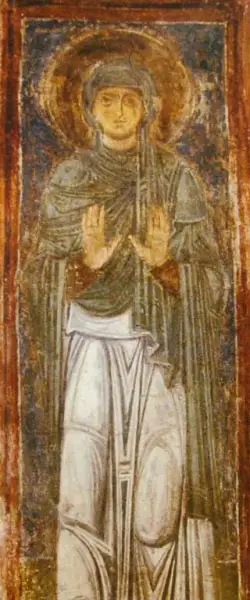
Macrina the Younger was an early Christian consecrated virgin of Cappadocia, the eldest sister of Basil the Great, Gregory of Nyssa, Naucratius and Peter of Sebaste. Born around 327 at Caesarea, she was formed in a household of saints, her grandmother being Macrina the Elder and her parents Basil the Elder and Emmelia. Betrothed in youth, she lost her fiancé before the wedding and resolved to remain unmarried, regarding Christ as her eternal bridegroom. She devoted herself to prayer, to the study of Scripture and to the spiritual education of her youngest brother Peter, and exercised a profound ascetic influence over her brothers and her mother. Macrina never left her mother, moving with her to a rural estate that became a community of virgins drawn from both aristocratic and non-aristocratic families, where slave and free shared the same rights and obligations. After Naucratius's death she took a leading role in the family's domestic life. She died at the Pontus estate, by then a convent, on July 19, 379. Her brother Gregory commemorated her in the Life of Macrina and in the Dialogue on the Soul and Resurrection, one of the rare philosophical dialogues of antiquity with a woman as its protagonist.
The Complete Life
A Household of Saints
Macrina was born around 327 at Caesarea in Cappadocia, the firstborn of Basil the Elder and Emmelia and granddaughter of Macrina the Elder, in a family that would become the most celebrated Christian household of the fourth century. Among her nine siblings were Basil the Great and Gregory of Nyssa, two of the three Cappadocian Fathers, together with Peter of Sebaste and the Christian jurist Naucratius. Her childhood, as her brother Gregory remembered it in his Life of Macrina, was marked by an uncommon devotion to the study of Scripture, and in particular to the Wisdom of Solomon and those portions of it bearing on conduct; passages that would seem far beyond a child's grasp were, he wrote, the very subject of her studies. Her father arranged a marriage for her, as was customary for a daughter of her rank, but the young man to whom she was betrothed died before the wedding could take place. Macrina concluded that it was not fitting for her to marry another, and from that point she regarded Christ himself as her eternal bridegroom.
§ Family
Bride of Christ
The death of her fiancé settled the direction of Macrina's life. Rather than treating the broken engagement as a misfortune to be remedied, she received it as a release into a higher commitment, and she resolved never to leave her mother. This resolve bound the two women together for the rest of Emmelia's life and gave their household a new spiritual character. Macrina's adherence to the ascetic ideal was not a private preference but a force that reshaped everyone near her: her brothers Basil, Gregory and Peter, and her mother alike came under the influence of her example of chastity, humility and unceasing prayer. Gregory of Nyssa, who knew her intimately and wrote of her sanctity throughout her life, remembered her above all as a woman consecrated from youth, whose conversation with Scripture and whose rejection of worldly marriage marked her out as a virgin in the fullest early Christian sense. In her, the consecrated life was not an institution she entered but a vocation she embodied, first in her family home and later in the community she would gather around her mother.
§ Family
The Estate at Pontus
Macrina persuaded her mother to withdraw with her to one of the family's rural estates in Pontus, and there, around the two women, a community of virgins took shape. Its members came from both aristocratic and non-aristocratic backgrounds, and the community practiced a radical equality: every member was free, with those held as slaves enjoying the standing and carrying the duties of their owners. This household, in which rank dissolved in common prayer and work, became in time a true convent of virgins, its organization owing much to the help of Macrina's youngest brother Peter. When Naucratius died, the blow crushed his mother, and Macrina stepped forward to shoulder the family's daily affairs, and she bore the double burden of governing the community and sustaining her mother through grief. Her time was devoted to prayer and to the spiritual education of Peter, whom she raised within the ascetic life. What began as a daughter's fidelity to her widowed mother thus matured into one of the earliest documented communities of consecrated women in Asia Minor.
§ Family
A Holy Death
Macrina died on July 19, 379, at the family estate in Pontus, the community she had founded standing around her. Even in dying she preserved the sanctity that had marked her life: she refused a bed and chose to lie on the ground, a final gesture of the humility and ascetic discipline she had practiced for decades. Her brother Gregory reached her side, and from their conversation at her deathbed he later composed the Dialogue on the Soul and Resurrection, written under the title ta Makrinia to commemorate her. Modeled on Plato's Phaedo, the work purports to record their exchange on the soul and its destiny, and it stands among the very rare philosophical dialogues of antiquity in which a woman is the protagonist. In it Macrina appears as she lived: a teacher whose reason was as disciplined as her prayer. The record of her final plea, that the Lord who broke the flaming sword would remember her in his kingdom and not let the terrible chasm separate her from his elect, preserves the voice of a dying Christian of the fourth century with unusual immediacy.
§ Introduction
Standard of Holy Womanhood
Macrina's significance was recognized at once by her family and has endured in the Church's memory. She set what later generations regarded as the standard for a holy early Christian woman, and she left her mark on her brother's writing and on his belief that a life of consecrated virginity mirrors the shining holiness of God. Through the Life of Macrina and the Dialogue on the Soul and Resurrection, Gregory gave the Church two of its most enduring portraits of female sanctity and philosophy. Later readers have debated her teaching: universalist writers such as Thomas Allin and J. W. Hanson counted her among their own on the strength of dialogue passages implying that every sinner, and even the demons, will in the end be cleansed and acknowledge Christ; others dispute that reading, citing the deathbed appeal in which she begged to be numbered among the elect — a plea pointing toward a subtler final hope. Macrina is honored on July 19 in the Church of England and the Episcopal Church, as well as in the Catholic, Eastern Orthodox and Oriental Orthodox traditions, and she is named patron of virgins, monastics, theologians, educators and students of Scripture.
§ Legacy
Timeline
- 327
Is born at Caesarea in Cappadocia, eldest child of Basil the Elder and Emmelia
§ Family
- 19 Jul 379
Dies at the family estate in Pontus, which she and her brother Peter had turned into a convent of virgins
§ Introduction
In Their Own Words
such parts as you would think were incomprehensible to young children were the subject of the girl's studies
Thou that didst break the flaming sword and didst restore to Paradise the man that was crucified with Thee and implored Thy mercies, remember me, too, in Thy kingdom; because I, too, was crucified with Thee, having nailed my flesh to the cross for fear of Thee, and of Thy judgments have I been afraid. Let not the terrible chasm separate me from Thy elect.
The Record
- Major works
- Life of Macrina (hagiography by Gregory of Nyssa)·Dialogue on the Soul and Resurrection (ta Makrinia, by Gregory of Nyssa)
- Patron of
- Virgins·Monastics·Theologians·Educators·Students of scripture
- Canonization
- Pre-congregation; venerated in the Catholic, Eastern Orthodox, Oriental Orthodox and Anglican churches
Prayer
Bibliography
Show 12 sources
- Peter Brown, The Body and Society, Columbia University Press, 1988, p. 272.
- Gregory of Nyssa, Life of St. Macrina.
- Cvetković, Vladimir (February 22, 2021). "Sex, gender and Christian identity in the patristic era" (PDF). Philosophy and Society. 32 (2): 168. doi:10.2298/FID2102162C. ISSN 0353-5738.
- Susan Ashbrook Harvey, "Women and words", in Frances Young, Lewis Ayres, Andrew Louth, eds, The Cambridge History of Early Christian Literature, (2010), p. 385.
- "L'Ascensione del Signore nella riflessione di Gregorio di Nissa". Cronaca Oggi Quotidiano (in Italian). 28 May 2022. Retrieved May 28, 2024.
- Allin, Thomas (1887). Universalism Asserted. p. 121.
- Hanson, J. W. (1889). Universalism: The Prevailing Doctrine of the Christian Church during Its First Five Hundred Years. Lulu.com. p. 105. ISBN 978-0-935461-31-2.
- Gregory of Nyssa (1916). Life of St. Macrina. Translated by Clarke, B. D.; Lowther, W. K. London: Society for Promoting Christian Knowledge. pp. 55-57 – via Tertullian.org.
- "The Calendar". The Church of England. Retrieved 2021-03-27.
- Lesser Feasts and Fasts 2018. Church Publishing, Inc. 2019-12-17. ISBN 978-1-64065-235-4.
- Silvas, Anna M. (2008). Macrina the Younger. Philosopher of God. Turnhout: Brepols. ISBN 978-2-503-52390-3.
- Muehlberger, Ellen (2012). "Salvage: Macrina and the Christian Project of Cultural Reclamation". Church History. 81 (2): 273-297. doi:10.1017/S0009640712000601.
Profile text adapted from the Wikipedia article, licensed CC BY-SA 4.0.
Pray with this saint every day
Save St. Macrina the Younger to your favorites, read the full profile, and get feast-day reminders in the Saints app.
Get the Saints AppFree on the App Store for iPhone and iPad