
died 705 or 706·Feast September 7
St. Madelberte of Maubeuge
Merovingian Abbess of Maubeuge Abbey
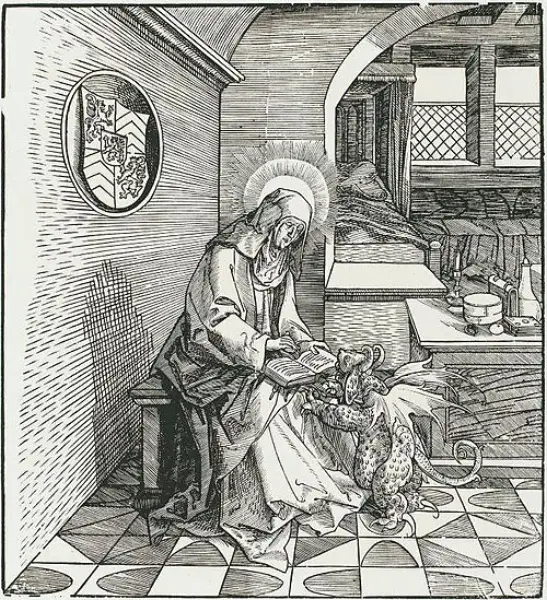
Overview
Madelberte of Maubeuge, also called Machtelberthe, was a seventh-century nun of noble Merovingian blood who governed one of the great monasteries of the Frankish world, set in the County of Hainaut on what is today the frontier between France and Belgium. She was the daughter of two saints, Vincent of Soignies and Waltrude, and belonged to a family whose women directed religious houses across Hainaut for generations. Educated in the monastery of Maubeuge alongside her sister Aldetrude, she watched her aunt Aldegonde, the house's founder, be succeeded as abbess by her own sister, and around 697 Madelberte in turn received the community's government. As abbess she carried forward Maubeuge's Benedictine observance. She died there in 705 or 706, and her feast is kept on September 7 in the Belgic and other Martyrologies. About fifteen years after her death her relics were carried from Maubeuge to Liège by St. Hubert, a translation that secured her continuing veneration in the region.
The Complete Life
Born into a Family of Saints
Madelberte came from one of the most remarkable devout families of seventh-century Francia, a line entwined with the Merovingian dynasty and prodigal in its supply of saints. Her father was Vincent of Soignies and her mother Waltrude, both honored as saints in their own right, and through her mother she belonged to the circle of noble founders who shaped religious life in Hainaut. Her earliest formation took place not in a secular household but within the monastery itself: with her sister Aldetrude she was educated at Maubeuge, the abbey founded by her aunt Aldegonde. In this world the cloister was simultaneously school, family inheritance and path of holiness, and the daughters of such houses commonly remained within its walls. Madelberte's childhood among the nuns of Maubeuge thus prepared her for the office she would eventually hold, joining her by blood to the abbey's founding family and by education to its Benedictine tradition. Her story illustrates how, in the Frankish Church, sanctity ran through generations and through the women who governed its monasteries.
§ Butler's account
Abbesse of Maubeuge
The succession at Maubeuge followed the pattern of a holy dynasty. Aldegonde, the founding abbess, was succeeded after her death by her niece Aldetrude, Madelberte's sister, as the second head of the community. When Aldetrude in turn died, around the year 697 the choice of the nuns fell on Madelberte, who thus became the third abbess in the direct line of the founder's family. Her office carried responsibility for one of the principal religious houses of the County of Hainaut, a region of monasteries founded by aristocratic women that anchored Christian life along what is now the French-Belgian border. Under its Benedictine tradition Maubeuge joined prayer, work and the education of noble daughters, and its abbess stood among the notable figures of the Frankish Church. Madelberte governed this inheritance until her death, continuing the observance she had learned as a child within its walls and linking the third generation of the founding family to the community's flourishing.
§ Life
Death and Translation of Relics
Madelberte died at Maubeuge about the year 705, though some records place her death in the following year. Her memorial was fixed on September 7, the date kept in the Belgic Martyrology and other calendars of the region, a sign of the stable local cult that grew around her memory. The devotion did not remain confined to the abbey that had sheltered her whole life. About 722, St. Hubert translated her relics from Maubeuge to Liège, joining her cult to that great center of piety in the Meuse valley and ensuring that her veneration outlived the political upheavals of the Carolingian age. Such translations were acts of both devotion and statecraft, carrying a saint's presence to a new shrine and binding communities together through her patronage. For Madelberte, the movement of her remains within a single generation of her death testifies to the esteem in which the abbess of Maubeuge was held by the churchmen of her day, Hubert among them.
§ Butler's account
Memory in Hainaut
The chief witness to Madelberte's life is the biography composed at Maubeuge, preserved and studied in modern times in the Analecta Bollandiana, together with the summary account that Alban Butler included in his eighteenth-century collection of the saints' lives. Her commemoration on September 7 endured in the liturgical books of the Belgian churches, and her name survives in the long gallery of Merovingian abbesses — Aldegonde, Aldetrude, Madelberte — whose family sanctity made Maubeuge a byword for holiness in the early medieval Church. She belongs to that generation of noble Frankish women who converted the aristocratic energies of their class into foundations of prayer, and whose monasteries preserved learning and stability through an age of dynastic change. Though little of her personal character can now be recovered, the continuity of her abbacy, the devotion to her relics and her place in the martyrologies of Hainaut secure her a lasting, if quiet, position among the saints of northern France and Belgium.
§ Notes
Timeline
- 697
Succeeds her aunt St. Aldegonde and her sister St. Aldetrude as abbess of Maubeuge Abbey
§ Life
- 705
Dies at Maubeuge; sources give the year as 705 or 706
§ Life
- 722
Her relics are translated from Maubeuge to Liège by St. Hubert
§ Butler's account
The Record
- Symbols
- Abbot's (abbess's) staff
- Canonization
- Pre-congregation; ancient local cult in Hainaut
Prayer
Bibliography
Show 2 sources
- Bertrand, Paul, ed. (1997), "La Vie de Sainte Madelberte de Maubeuge", Analecta Bollandiana (Text (BHL 5129) and French translation), 115 (1-2), doi:10.1484/J.ABOL.4.01703
- Butler, Alban (1866), The Lives of the Fathers, Martyrs, and Other Principal Saints, James Duffy, retrieved 2021-07-26
Profile text adapted from the Wikipedia article, licensed CC BY-SA 4.0.
Pray with this saint every day
Save St. Madelberte of Maubeuge to your favorites, read the full profile, and get feast-day reminders in the Saints app.
Get the Saints AppFree on the App Store for iPhone and iPad