
1779 – 1865·Feast May 25
St. Madeleine Sophie Barat
Foundress of the Society of the Sacred Heart
Overview
Madeleine Sophie Barat, a French sister in religious life, established the Society of the Sacred Heart — a global institute devoted to education — and guided it for sixty-five years. Born in Joigny in Champagne on December 12, 1779, she was delivered two months premature when a fire at a neighboring house sent her mother into labor, and she was baptized at dawn the next morning. Educated far beyond the norm for girls of her day by her brother Louis, she absorbed Latin, Greek, history, the sciences and modern languages. The French Revolution marked her youth: she followed her hunted brother to Paris, worked as a seamstress and embroidress, and studied the Fathers of the Church under his instruction. In 1800, at twenty, she abandoned her plan to enter the Carmel and instead took vows with three companions, founding the society that became the Society of the Sacred Heart. Under her leadership its schools spread across Europe, the Americas and North Africa, always pairing schools for the well-to-do with free schools for the poor. She died in Paris on May 25, 1865, and was canonized by Pope Pius XI in 1925.
The Complete Life
A Fragile Beginning in Joigny
Madeleine Sophie Barat entered the world in circumstances as perilous as any she would later face. On the night of December 12, 1779, a fire broke out at a neighbor's home in Joigny, and the terror of it sent her pregnant mother into labor two months early. The child was judged so frail that she was rushed to baptism the following dawn at Saint Thibault Church, a few steps from the family house; the intended godparents could not be summoned in time, and a local woman on her way to Mass, Louise-Sophie Cédor, stood in alongside the baby's brother Louis. She grew up in a financially comfortable household rooted for generations in the Burgundian town, where her father Jacques worked as a cooper and vine-grower, trades of long standing and local honor. The family's Catholicism carried a Jansenist severity that is said to have shaped her spirituality profoundly, and from childhood she showed the readiness to help those in need and to pray for others that would define her adult life.
§ Early life and family
Revolution and a Hidden Formation
Madeleine Sophie owed her remarkable education to her brother Louis, a brilliant student who had decided as a boy to become a priest. Ordained a deacon but too young for priesthood, he returned to Joigny as a mathematics teacher and took charge of his sister's learning, under his direction she worked through Latin and Greek, history, natural science, Spanish and Italian — schooling almost no girl of her era could obtain. The Revolution then upended the family. After Louis renounced his oath to the Civil Constitution, the household lived in danger; he fled to Paris, spent two years in prison, and was saved from the scaffold only by a friend's brave intervention. When he returned to Paris to exercise his ministry in secret, sixteen-year-old Sophie went with him. In a safe house belonging to Madame Duval she worked as a seamstress and became an accomplished embroidress, while Louis led her through the Fathers of the Church and through mathematics, Latin and the sacred page. Around her eighteenth year she made up her mind to enter the Carmel — a hopeless plan, since the orders had been suppressed back in 1790. Through five Parisian years she kept a rhythm of prayer and reading, and gave catechism lessons in secret to the children of the Marais.
§ French Revolution
The Society of the Sacred Heart
On her return to Paris, Madeleine Sophie met Joseph Varin, who envisioned a congregation of women devoted to the Sacred Heart of Jesus and to the education of young women, complementary to the Fathers of the Faith. On November 21, 1800, at twenty, she gave up the Carmelite hope and, joining three other women of the safe house in a vow, brought the Society of the Sacred Heart into being. The civil power had outlawed devotion to the Sacred Heart of Jesus, so the young group went by the discreet title Dames de la Foi, the Ladies of the Faith. In September 1801 its first school received its pupils at Amiens, and a school for the town's poor followed — the beginning of the double provision that would characterize the whole enterprise. In December 1802, at twenty-three, she became Superior of the young society, and in January 1806 she was elected Superior General. From Grenoble, where she received the Visitation community that included Philippine Duchesne, foundations multiplied across France and then abroad, reaching North America, Italy, Switzerland, Belgium, Algiers, England, Ireland, Spain, Holland, Germany, South America, Austria and Poland. In 1826 the society received its decree of approbation from Rome.
§ Expansion
A Style of Governing and of Souls
Madeleine Sophie's spirituality joined the rigor of the Jansenist household where she was raised to the warmth of devotion to the Sacred Heart, and it showed itself in a distinctive way with people. Contemporaries credited her with two gifts: an instinct for choosing well those fitted for office, and a confidence in the judgment of those she set over her houses — undertakings at the frontier of the congregation were always placed in hands other than her own. Her recorded sayings carry the same temper. Prudence, she counseled, and a deliberate unhurried pace belong to every beginning; mildness accomplishes what harshness cannot; and since our companions are not angels, human nature must be borne with and pardoned. Her ideal for the classrooms was congenial rather than coercive: teachers should model what they require of children, never reprove while irritated, reach the young through their devotion and their affections, and wrap even correction in gentleness, praising and rewarding as they go. She was remembered as one who assumed the best of everyone until events proved otherwise, one who looked past people's failings to whatever was finest in them. Her advice that the sisters should bequeath deeds rather than print captured a spirituality of quiet, effective charity. When a rupture threatened between Rome and the Archbishop of Paris in 1840, and her own daughters urged her to take a side, she declined and brought the quarrel to an end.
§ Quotes
The Last Years in Paris
Madeleine Sophie led the Society of the Sacred Heart for sixty-five years, through the regime of Napoleon, two further French revolutions and the struggle for Italian unification. By the end of her life the congregation numbered more than 3,500 members, educating women across Europe, North Africa and the Americas. To the end she held to her vision of schooling every child whatever the family's income: nearly each new house she opened was matched by a free school giving poorer pupils the same high standard of teaching. She died at the general motherhouse in Paris on Ascension Day, May 25, 1865, at the age of eighty-five. Her lifelong reluctance before the camera and the painter's easel proved so complete that for generations no likeness from her lifetime was thought to survive; the one image now known is a photograph made as she lay dying. Her mortal remains rest in an ornate reliquary in the Church of Saint-François-Xavier in Paris, the shrine where her devotees have gathered ever since.
§ Death
From Venerable to Saint
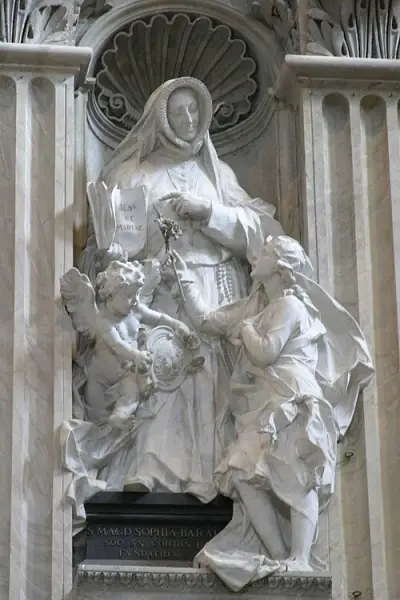
The cause of Madeleine Sophie Barat moved with notable speed through the stages set by the Church. She was declared venerable in 1879, fourteen years after her death, and was beatified by Pope Pius X on May 24, 1908, in Saint Peter's Basilica. On May 24, 1925, in the same basilica, Pope Pius XI canonized her, sealing the recognition of the foundress whose congregation by then encircled the globe. Her founder's statue stands in Saint Peter's Basilica itself, a rare honor for a woman religious of the modern era. In 1992 a painted portrait — thought to date from before her beatification and dispatched from Italy to the Paris mother house in 1879 — emerged while the convent of Sante Rufina e Seconda in Rome was being restored; it can now be seen in the congregation's archive rooms, giving her spiritual daughters at last a face to set beside the memory their tradition keeps.
§ Death
Schools That Outlived Their Foundress
Madeleine Sophie's most direct inheritance runs through the network of over a hundred schools her congregation still runs, establishments celebrated for the calibre of the teaching they offer the young — among them today co-educational houses and boys' schools beside the original academies for girls. Her influence also passed through her students: Eugénie Smet, formed at Lille, created the Helpers of the Holy Souls; Anne de Meeûs, formed in Paris, composed constitutions for her own Religious of Perpetual Adoration, settled at the little Château in Jette; and Henriette d'Osseville likewise came out of a Paris classroom to bring into being the Sisters of Our Lady of Fidelity. Institutions bearing her name continue her work, among them the Sophie Barat School in Hamburg, an independent co-educational grammar school run by the Society. In the United States, Barat College in Lake Forest, Illinois, descended from the Academy of the Sacred Heart founded in 1858, carried her name until its closure in 2005, when the Barat Education Foundation was charged with continuing its educational heritage. Even popular culture keeps an unexpected trace: the French children's toy Sophie the Giraffe, first produced on May 25, 1961, is indirectly named for her, having launched on St. Sophie's day.
§ Legacy
Timeline
- 12 Dec 1779
Is born prematurely at Joigny during the night, after a fire at a neighboring house triggers her mother's labor
§ Early life and family
- 13 Dec 1779
Is baptized at five o'clock in the morning at Saint Thibault Church, with Louise-Sophie Cédor and her brother Louis as godparents
§ Early life and family
- 1784
Her brother Louis, sixteen, leaves Joigny for the seminary at Sens, beginning the path that will later make him her teacher
§ Education
- 1790
Religious communities, including the Carmelites she will one day hope to join, are abolished in France
§ French Revolution
- Jan 1791
Her brother Louis takes the oath of loyalty to the Civil Constitution of the Clergy
§ French Revolution
- May 1792
Louis renounces his oath on learning the pope has condemned the Constitution, and flees the family home for Paris
§ French Revolution
- May 1793
Louis is arrested in Paris and imprisoned for two years, escaping the guillotine through the intervention of a friend
§ French Revolution
- 1795
After his release, Louis returns to Paris for secret ministry and brings sixteen-year-old Sophie with him to continue her education
§ French Revolution
- 1800
Returns for a short stay to Joigny, helping bring in the family's grape harvest
§ French Revolution
- 21 Nov 1800
Marks the founding of the Society of the Sacred Heart by taking vows alongside three companions from the safe house
§ Founding of Society of the Sacred Heart
- Sep 1801
The society's first school opens at Amiens, and she travels to the city to teach
§ Founding of Society of the Sacred Heart
- 7 Jun 1802
Makes her vows in the young congregation
§ Founding of Society of the Sacred Heart
- Dec 1802
At twenty-three, becomes Superior of the Society of the Sacred Heart
§ Founding of Society of the Sacred Heart
- Nov 1804
Travels to Sainte-Marie-d'en-Haut near Grenoble to receive a community of Visitation nuns, among them Philippine Duchesne
§ Expansion
- Jan 1806
The sisters choose her as head of the whole congregation, its Superior General
§ Expansion
- 1818
Founds the Children of Mary of the Sacred Heart in Paris
§ Expansion
- 1820
Summons all the superiors to a council at Paris to set a uniform course of studies for the growing school network
§ Expansion
- 1826
The Society of the Sacred Heart receives its decree of approbation from Rome
§ Expansion
- 1832
Establishes a second chapter of the Children of Mary at Lyons, under the name Congregation of the Children of Mary
§ Expansion
- 1840
Refuses to take sides when her sisters press her during a breach between the Vatican and the Archbishop of Paris, and heals it
§ Expansion
- 25 May 1865
Dies at the general motherhouse in Paris on Ascension Day, aged eighty-five
§ Death
- 1879
Is declared venerable
§ Death
- 24 May 1908
Is beatified by Pope Pius X in Saint Peter's Basilica
§ Death
- 24 May 1925
Is canonized by Pope Pius XI in Saint Peter's Basilica
§ Death
- 1992
A portrait of her, believed painted before her beatification, is discovered during restoration work at a convent in Rome
§ Death
In Their Own Words
We don't live with angels; we have to put up with human nature and forgive it.
Before making any change take counsel ... Prudence and a wise slowness are necessary in the beginning.
More is gained by indulgence than by severity.
Be humble, be simple, bring joy to others.
For the sake of one child, I would have founded the Society.
Let us leave acts, not words. Nobody will have time to read us.
The Record
- Major works
- Society of the Sacred Heart (founded 1800)·Children of Mary of the Sacred Heart (founded 1818)·Network of Sacred Heart schools across Europe, the Americas, North Africa and Asia
- Symbols
- Founder's statue in Saint Peter's Basilica
- Canonization
- Canonized 24 May 1925 by Pope Pius XI at Saint Peter's Basilica; beatified 24 May 1908 by Pope Pius X
Prayer
Bibliography
Show 12 sources
- Foley O.F.M., Leonard. "Saint Madeleine Sophie Barat", Saint of the Day, Franciscan Media.
- "St. Madeleine Sophie Barat", FaithND.
- "Madeleine Sophie Barat", Network of Sacred Heart Schools. Retrieved 2014-08-11.
- "History", Society of the Sacred Heart, United States – Canada.
- Power, Alice. "Ven. Madeleine-Sophie Barat." The Catholic Encyclopedia. Vol. 2. New York: Robert Appleton Company, 1907.
- Duffy, Patrick. "St. Madeleine Sophie Barat", CatholicIreland.net.
- "St. Madeleine Sophie Barat (1779–1865)", Society of the Sacred Heart, United States – Canada.
- Baunard, Louis (1900). Fullerton, Georgiana (ed.). The Life of the Venerable Madeleine Barat: Foundress of the Society of the Sacred Heart of Jesus. New York: O'Shea and Company. p. 199.
- Baunard, Louis (1892). Histoire de la vénérable mère Madeleine-Sophie Barat : fondatrice de la Société du Sacré-Cœur de Jésus. Paris: Ch. Poussielgue.
- "Commemorating 150 years of the death of St. Madeleine Sophie with a \"new\" portrait". Religious of the Sacred Heart of Jesus.
- Kilroy RSCJ, Phil, Madeleine Sophie Barat – A Life, Cork University Press, Cork, Ireland, 2000.
- Richard, Bernard (23 September 2014). "Madeleine-Sophie Barat, une sainte de Joigny (Yonne) et sa communauté dans le monde, les dames du Sacré-Cœur". bernard-richard-histoire.com (in French). Retrieved 5 November 2016.
Profile text adapted from the Wikipedia article, licensed CC BY-SA 4.0.
Pray with this saint every day
Save St. Madeleine Sophie Barat to your favorites, read the full profile, and get feast-day reminders in the Saints app.
Get the Saints AppFree on the App Store for iPhone and iPad