
c. 558 – 632·Feast January 31
St. Máedóc of Ferns
First Bishop of Ferns and founder of thirty churches
Overview
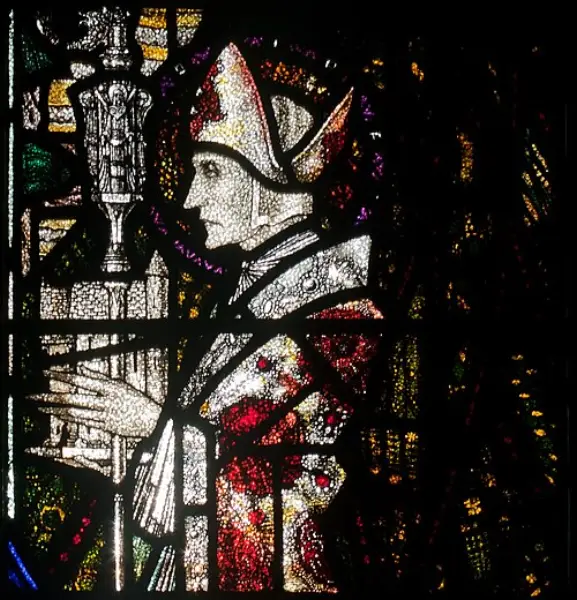
Máedóc of Ferns, remembered across languages as Saint Aidan, Saint Madoc, and Saint Mogue, was the first Bishop of Ferns in County Wexford and, by tradition, the founder of thirty churches. Born around 558 on the island of Inisbrefny in Templeport Lake, in the district of Magh Slécht in County Cavan, he crossed between the Irish and Welsh worlds of early medieval monasticism: Irish sources make him the son of the chieftain Sedna and his wife Eithne, while Welsh genealogies call him a son of Gildas or Aneurin, of the royal house of Strathclyde. Educated at Clonard under Saint Finnian, he withdrew to Wales to study under Saint David, who ranked him among the three disciples he trusted most. In 570 Aedan sailed home, famously bringing hives of honey bees to an island where they were said to be scarce, and settled at Brentrocht in Leinster. His blessing was credited with King Brandubh's victory over the Uí Néill at the Battle of Dún Bolg in 598, and the grateful king granted him Ferns, where he founded a monastery and was recognized as Chief Bishop of Leinster. Noted for benevolence and hospitality, he died on 31 January 632 on the shore of Lough Melvin in County Leitrim.
The Complete Life
An Island Birth and Two Genealogies
Áed, as he was first called, was born around the year 558 on Inisbrefny, an island in Templeport Lake, in the district then known as Magh Slécht and now forming the parish of Templeport in County Cavan. From his birth legends begin to attach themselves to him: Irish tradition relates that Saint Caillín presented the infant with the bell that became known as the Bell of St. Mogue, and that when no boat could be found to carry the child across the lake to the place where Caillín waited to baptize him, the infant was set adrift on a flat stone and borne safely to land. A font at St Mogue's church in Bawnboy is said to be carved from that same stone. His parentage is told in two irreconcilable ways. The Welsh genealogies of the saints call Aeddan a son of Gildas or of Aneurin, both sons of Caw, king of the Strathclyde Britons. Irish accounts instead give him a different line: father Sedna, a chieftain of Connaught; mother Eithne; and the poet-saint Dallán Forgaill as a first cousin. The double pedigree, together with his Welsh career, the remarkable length of his recorded activity, and two rival dates of death, has led scholars such as Sabine Baring-Gould to suggest that the surviving stories may conflate two different Aeds who held the bishopric of Ferns a generation apart.
§ Biography
Hostage, Student, and Disciple of David
The boy who would be Ferns's first bishop first appears in history as a political pawn. As a youth he was held as a hostage at the court of Ainmuire mac Sétnai of the Cenél Conaill, the High King of Ireland, and the king grew so impressed with the captive that he offered him freedom to stay or go. Aedan replied that he would indeed leave, on one condition: his fellow hostages must go free as well, and Ainmuire let the whole company return home. He went on to study at the great monastic school of Saint Finnian at Clonard Abbey, where he formed a friendship with Molaise, the future founder of the monastery on Devenish Island in the River Erne. So many began to gather around the young man as disciples that he judged himself unready for such attention: instead of accepting followers, he fled Ireland for Wales to study under Saint David. Welsh tradition made much of these years, placing his upbringing in David's household and recounting attempts on his life by David's steward, and the Welsh triads ranked him among the three disciples of David judged most faithful. With Saint Cadoc he was said to have crushed a host of Saxons or Irishmen by hurling boulders down onto the camp they had pitched in a narrow valley, before news of home finally called him back.
§ Biography
Bees, Churches, and the See of Ferns
Aedan came back to Ireland in 570 and put in on the Wexford shore carrying hives of honey bees, having learned that the insects were scarce on the island. He arrived in the middle of a local raid, came swiftly to the defense of strangers who were being plundered, and so impressed the chieftain of the district that he was granted land for religious communities, settling first at Brentrocht in Leinster. There he embraced a severe asceticism, fasting for seven years on nothing but barley bread and water. Over his long career he was credited with founding thirty churches and many monasteries, the earliest of them on the island of his birth, where eighteenth-century ruins and a burial ground still mark the site. Other foundations followed at Drumlane near Milltown in County Cavan, at Dissert-Nairbre in County Waterford, and at Rosinver in Leitrim near the place of his death; in Wales he left the church of Saint Madoc at Haroldston West in Pembrokeshire and the church of Llawhaden, which commemorates a ford he is said to have discovered while leading his oxen. The turning point of his Irish mission came through King Brandubh: for the victory at Dún Bolg in 598 and other favors, the king granted him Ferns in County Wexford, where he established a monastery, and a synod convened under Brandubh's influence made Ferns a see with Aedan as its bishop and Chief Bishop of all Leinster.
§ Biography
Mercy, Miracles, and a Meek Temper
The portrait the lives draw of Aidan's character is dominated by benevolence and hospitality, often exercised against the grain of strict observance. Finding a delegation of British bishops worn out by their journey, he allowed them beef during Lent and even supplied them with a face-saving excuse, permitting them to describe the slaughtered cow as nothing more than condensed milk and vegetables, while the whey and biscuits on which his own monks lived were so full of weevils as to trouble the visitors' consciences. His meekness was tested directly when companions once shoved him into a lake purely to test his temper; he climbed out composed, and his tormentor confessed and apologized. The miracle stories follow the same pattern of a holiness that bends nature to charity. A shattered jug, broken as he fetched ale for his brothers, was mended by the sign of the cross; a deliberately undersized yoke from David's steward accommodated his oxen all the same. He could also be severe: a beggar who disguised himself as blind to extort a second portion of meal was cursed with blind descendants, and Sarán, who had killed his father-in-law, was told his right hand would wither, gaining forgiveness at Brandubh's tomb but not the hand. Yet the same curse-working power was credited with healing the monks whom Saint Fintan Munnu brought to him, and with comforting a heifer that mourned her calf.
§ Miracles
Death on Lough Melvin's Shore
Aeddan died on the thirty-first of January in the year 632, on the shore of Lough Melvin in County Leitrim, far from the Wexford see he had made famous but near the Rosinver monastery that counted as his last foundation. The place of his death carried his memory onward, and his remains were honored at two centers that both claimed his patronage. At Ferns, the church of St. Edan's asserts its claim to his relics: his stone tomb stands inside the cathedral, while his actual remains are said to rest in the crypt of the original cathedral below. His cult also produced one of the treasured objects of early Irish art, the Breac Maodhóg, a shrine bearing his name that dates from the ninth century and ranks among the notable early medieval reliquaries. It served not only as a vessel of devotion but as the sacred object on which binding oaths were sworn, a measure of the authority the saint still exercised in the public life of his region centuries after his death. The shrine eventually entered the National Museum of Ireland, acquired in the 1890s, where it remains among the chief monuments of his cult and of the craftsmanship his memory inspired.
§ Biography
A Saint of Three Communions
No act of canonization ever formalized the cult of Máedóc; he belongs to the pre-congregation saints whose veneration arose in the communities they founded and was carried forward by centuries of local observance. What is striking about his case is the breadth of that observance today: he is venerated in the Roman Catholic Church, in the Anglican Communion, and in the Eastern Orthodox Church, a triple recognition rare for any early medieval figure and a reflection of his double Irish and Welsh career. His feast is kept on the thirty-first of January, the anniversary of his death, and his principal shrine is honored at Enniscorthy in County Wexford, where the Catholic cathedral of St. Aidan's stands on the site, and partly within the ruins, of the medieval cathedral that once housed his cult. The Anglican inheritance runs through the church of St. Edan's at Ferns itself, which remains the seat of the Church of Ireland diocese within the United Dioceses of Cashel and Ossory. Thus the bishop who united Irish and Welsh monasticism in his own person now unites, at least in memory, the divided communions of his two countries, each keeping his name on the same winter day and each tracing its claim back to the stone tomb at Ferns.
§ Saint Máedóc of Ferns
Mogue of the West, Aidan of the South
Máedóc's memory took root most deeply in the two regions that marked the beginning and end of his life. He is the patron saint of Hy Kinsellagh, that is Wexford, of Ferns, and of Templeport in County Cavan, and in Bawnboy his feast is still kept by pilgrims who come to pray at his church and at the island in Templeport Lake where he first saw light. In the west Cavan country the names Mogue and Aidan remain common that remembers him as its own. His monastic heirs were also remembered: Fearghus mac Ailill succeeded to Rosinver Abbey in County Leitrim and Faircheallaigh mac Ailill to Drumlane Abbey in County Cavan. A curious folk devotion attaches to his first monastery, where clay and mortar taken from the church ruins are preserved in local houses in the belief that it protects against fire and drowning. The ecclesiastical institutions he founded endured through fire and reconstruction: the old Catholic cathedral at Ferns was burned by the O'Byrnes of Wicklow in 1575 and, though Queen Elizabeth I ordered it rebuilt, only half of it ever rose again. The Catholic seat moved to St. Aidan's Cathedral in Enniscorthy, while St. Edan's in Ferns continues as the Church of Ireland cathedral, so that a single saint's name shelters the church life of an entire county.
§ Legacy
Timeline
- 558
Born on the island of Inisbrefny in Templeport Lake, in Magh Slécht, County Cavan.
§ Biography
- 570
Sailed home from Wales, putting in on the Wexford shore with hives of honey bees.
§ Biography
- 598
King Brandubh of Leinster defeated the Uí Néill at the Battle of Dún Bolg, a victory credited to the saint's blessings.
§ Miracles
- 31 Jan 632
Died on the shore of Lough Melvin in County Leitrim.
§ Biography
- 1575
The earlier Catholic cathedral at Ferns was burned down by the O'Byrnes of Wicklow.
§ Legacy
In Their Own Words
milk and vegetables in condensed form
conscientious scruples
The Record
- Major works
- Monastery of Ferns·Thirty churches and several monasteries, including Drumlane, Rosinver, Dissert-Nairbre, and Templeport·Saint Madoc of Ferns church, Haroldston West, Pembrokeshire
- Patron of
- Patron saint of Hy Kinsellagh (Wexford), Ferns, and Templeport in County Cavan·Ferns Abbey·Templeport Abbey·Drumlane Abbey·Rosinver Abbey·Disert Nairbre Abbey·Llawhaden Abbey
- Symbols
- Honey bees
- Canonization
- Pre-congregation; venerated in the Roman Catholic Church, the Anglican Communion, and the Eastern Orthodox Church.
Prayer
Bibliography
Show 8 sources
- Attwater, Donald & John, Catherine Rachel: The Penguin Dictionary of Saints, third edition. New York: Penguin Books, 1993. ISBN 0-14-051312-4.
- Baring-Gould, Sabine & al. The Lives of the British Saints: The Saints of Wales and Cornwall and Such Irish Saints as Have Dedications in Britain, Vol. I, pp. 122 ff. Chas. Clark (London), 1908.
- Doherty, Charles: "The Transmission of the Cult of St Máedhog", in Ní Chatháin, P. and Richter, M. (ed.), Ireland and Europe in the Early Middle Ages: Texts and Transmission. Dublin: Four Courts Press, 2002.
- Doherty, Charles: "Leinster, saints of (act. c.550–c.800)", in Oxford Dictionary of National Biography. Oxford: Oxford University Press, 2004.
- Gallogly, Daniel: Templeport. Souvenir of the Solemn Dedication of St. Mogue's Church. Templeport, County Cavan: James McCabe, 1979.
- Gillespie, Raymond: "A Sixteenth-Century Saint's Life. The Second Life of St Maedoc", in Breifne Journal, vol. X, no. 40 (2004), pp. 147–155.
- Galloway, Peter (1992). The Cathedrals of Ireland. The Institute of Irish Studies. pp. 108–109. ISBN 0-85389-452-3.
- Webb, Alfred (1878). "Aedan, Saint". A Compendium of Irish Biography. Dublin: M. H. Gill & son.
Profile text adapted from the Wikipedia article, licensed CC BY-SA 4.0.
Pray with this saint every day
Save St. Máedóc of Ferns to your favorites, read the full profile, and get feast-day reminders in the Saints app.
Get the Saints AppFree on the App Store for iPhone and iPad