
c. 1195 – 1256·Feast May 2
St. Mafalda of Portugal
Queen of Castile and Cistercian abbess of Arouca
Overview
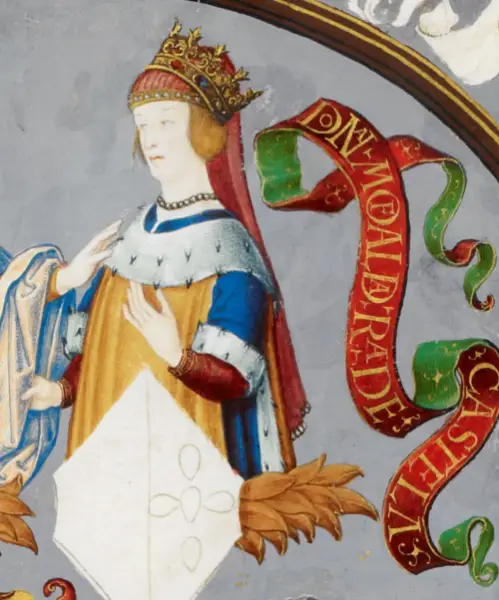
Mafalda of Portugal was born around 1195, a daughter of King Sancho I of Portugal and his queen, Dulce of Aragon. Her father's will endowed her with the castle and revenues of Seia and granted her the right to be styled queen, a provision that drew her into a long dispute with her brother Afonso II, who feared the division of the realm. In 1215 she was married to her young cousin Henry I of Castile, but the union was never consummated and was dissolved the next year because the spouses were too closely related. Back in Portugal, she declined further marriage and in 1220 entered the Abbey of Arouca, where she eventually served as abbess and secured the community's transfer to the Cistercian Order in 1226. She devoted her income to works of mercy, raising bridges, churches, monasteries, hospitals, and a hospice for travelers, and honored the shrine of Our Lady of Silva in Porto with generous gifts. Falling ill on her way back from a pilgrimage to that shrine, she died at Rio Tinto on 1 May 1256. Her remains were found undecayed in 1616, and five centuries after her death she was beatified by Pope Pius VI.
The Complete Life
A Princess of Portugal
Mafalda was born around 1195, one of the younger daughters of King Sancho I of Portugal and Dulce of Aragon. The king's will provided that she should receive the castle of Seia, the surrounding lands, and all the income they produced, and granted her as well the title of queen. So lavish a settlement set her at odds with her brother Afonso II, who was determined to concentrate power in the crown and blocked his sister from taking possession of her bequests. He feared that his sisters Teresa and Sancha might pass their claims to heirs of their own, creating a sovereignty problem capable of splitting the kingdom. Much of the Portuguese nobility took the side of Mafalda and her sisters, but the faction was defeated in the struggle that followed. Only after Afonso's death did his son Sancho II extend a settlement, granting some lands and castles to his aunts while requiring them to give up the title of princess-queen. A final peace between the royal siblings was reached in 1223, freeing Mafalda to order her life anew. The settlement held, and Mafalda was free at last to dispose of her life as she chose.
§ Early life
A Brief Crown and a Lasting Call
In 1215 a political marriage joined Mafalda to her cousin Henry I of Castile. The bridegroom was about ten years old, the union was never consummated, and within a year it was dissolved on the grounds of consanguinity between the spouses. Mafalda went back to her homeland, and when the question of another marriage arose she refused it. In 1220 she entered the Abbey of Arouca as a nun, though she obtained a special dispensation allowing her to keep control of her inheritance, whose revenues she intended to spend on works of piety. Her sisters Sancha and Teresa later joined the same community. The abbey at that time belonged to Benedictine nuns, and Mafalda in due course became its abbess. In 1226 she petitioned the pope for the community's affiliation with the Cistercian Order and had the favor granted, giving the house a stricter observance and a surer institutional footing. The bride of a few months had become, by steady resolve, the mother of a religious family. In the cloister the disappointments of the world found their cure, and the abbey of Arouca gained a mother.
§ Marriage
Builder of Mercies
As abbess and as a wealthy woman in her own right, Mafalda turned her resources toward the relief of ordinary people. She held Our Lady of Silva in deep devotion and poured generous gifts into the Porto sanctuary raised in the Virgin's honor, undertaking a pilgrimage there as an act of piety. From her income she built a hospice where travelers could find shelter, and she financed bridges, churches, monasteries, and hospitals in many places across the region. These works answered the daily needs of pilgrims, the sick, and the poor who moved through the Portuguese countryside. Beyond her almsgiving she strengthened the institutional Church in her land, helping to establish her own abbey of Arouca as a major religious center, a standing it would keep for centuries after her death. Her combination of noble birth, disciplined monastic life, and energetic generosity made her a pattern for the royal women of her house, several of whom, like her sisters Sancha and Teresa, likewise gave themselves to the religious life. Few royal women of her generation turned inherited quarrels into so durable a harvest of charity.
§ Monastic life
The Last Journey
In the last years of her life Mafalda remained at the center of her community at Arouca, directing its affairs and continuing her benefactions. Journeying home from pilgrimage to her cherished sanctuary of Our Lady of Silva, she was seized by illness at Rio Tinto in the lands of Gondomar. She was carried to the monastery of Cistercian monks there, and on 1 May 1256 she died, aged about sixty-one, far from her abbey but under the roof of the order she had loved and served. Her death closed a life that had moved from the splendor of the Portuguese court through the disappointment of an annulled royal marriage to the settled holiness of the cloister. Those who had known her as abbess, benefactor, and peacemaker mourned her, and the desire to honor her arose almost at once among the nuns of Arouca and the people of the surrounding country, who had been the objects of her unflagging charity. The nuns of Arouca received the news of her death as an inheritance of sorrow and of honor. Her tomb at Arouca became the center of that grief.
§ Monastic life
Incorrupt and Beatified
Devotion to Mafalda grew steadily in the generations after her burial. In 1616, when the church wished to bring her body back to Arouca as part of the process looking toward her possible canonization, those who opened her tomb found that her remains had not deteriorated. The discovery of her incorrupt body generated an even stronger public devotion, and pilgrims continued to seek her intercession at Arouca. The formal recognition of her cult came five centuries after her death: on 27 June 1792 Pope Pius VI beatified her in Rome, confirming the reverence in which the people of Portugal had long held her. Her feast is kept on 2 May, the day after her death. Though she has not been canonized, the title Blessed has attached to her name in the Cistercian calendar and in Portuguese piety, and her image in the gallery of Arouca Abbey, painted in 1740, shows her robed as a queen yet covered with the monastic cowl and bearing the crozier of an abbess. Her beatification confirmed a devotion that the Portuguese people had never allowed to grow cold.
§ Monastic life
A Light at Arouca
The abbey Mafalda governed and enriched remained a major religious center of the region for centuries, a standing she had done much to win for it. Through her affiliation of the house with the Cistercian Order in 1226 she linked Portuguese monasticism to one of the great reforming currents of medieval religious life. Her charitable foundations — the hospice, the bridges, the hospitals, and the churches — long outlived her and marked the landscape of her native land with the memory of her generosity. Among the infantas of the House of Burgundy she stands with her sisters Teresa and Sancha as an example of royal daughters who exchanged courtly prospects for consecrated life, and her disputed inheritance, settled by peace in 1223, became instead an endowment for the poor. The faithful of Portugal continue to invoke Blessed Mafalda on her feast of 2 May, and at Arouca her memory abides in the abbey she led, in the undecayed remains that drew pilgrims to her tomb, and in the quiet fame of a queen who preferred the Cross to a crown.
§ Monastic life
Timeline
- 1195
Born in Portugal, a daughter of King Sancho I and Queen Dulce of Aragon
§ Early life
- 1215
Married her young cousin Henry I of Castile in a political union
§ Marriage
- 1216
Marriage dissolved on grounds of consanguinity; she returned to Portugal
§ Marriage
- 1220
Became a nun at the Abbey of Arouca, keeping control of her inheritance by dispensation
§ Monastic life
- 1223
Final peace under Sancho II left her lands granted but required renouncing the title of princess-queen
§ Early life
- 1226
Obtained papal approval transferring Arouca Abbey to the Cistercian Order
§ Monastic life
- 1 May 1256
Died at the Cistercian monastery of Rio Tinto in Gondomar after falling ill returning from pilgrimage
§ Monastic life
- 1616
Her body, found incorrupt during its return to Arouca, stirred stronger public devotion
§ Monastic life
- 1792
Beatified in Rome by Pope Pius VI
§ Monastic life
The Record
- Major works
- Transfer of Arouca Abbey to the Cistercian Order·Bridges, churches, monasteries, and hospitals built from her revenues·Hospice for travelers
- Symbols
- Cistercian cowl over royal robes·Abbatial crozier
- Canonization
- Beatified by Pope Pius VI in Rome on 27 June 1792
Prayer
Bibliography
Show 4 sources
- McMurdo, Edward. The History of Portugal: From the Commencement of the Monarchy to the Reign of Alfonso III. S. Low, Marston, Searle, & Rivington, 1888.
- A History of Portugal. CUP Archive.
- Merton, Thomas. In the Valley of Wormwood. Liturgical Press, 2013. ISBN 9780879077587.
- "Santos do Dia: Beata Mafalda". Evangelho Quotidiano. Retrieved June 20, 2020.
Profile text adapted from the Wikipedia article, licensed CC BY-SA 4.0.
Pray with this saint every day
Save St. Mafalda of Portugal to your favorites, read the full profile, and get feast-day reminders in the Saints app.
Get the Saints AppFree on the App Store for iPhone and iPad