
1611 – 1634·Feast September 28
St. Magdalene of Nagasaki
Augustinian tertiary and martyr of the persecution in Japan
Overview
Magdalene of Nagasaki was born in 1611 near Nagasaki, the daughter of Christian parents who were martyred for the faith when she was still a child. When the Augustinian friars reached Japan in 1623, the young woman put her linguistic gifts at their service, interpreting for Francis of Jesus Terrero and Vincent of Saint Anthony Simoens as they ministered to a hounded Church. In 1625 she bound herself to the Order of Augustinian Recollects as a tertiary, wearing its habit while continuing to teach catechism to children, gather alms for the poor, and hearten Christians under threat. After her two Augustinian counselors were burned alive in 1632, and the two friars who succeeded them were likewise put to death, she withdrew with other believers to the hills of Nagasaki in 1629's aftermath, baptizing the young and visiting the sick. Seeing so many apostatize, she finally presented herself to the authorities in her habit and confessed herself a follower of Jesus. After thirteen days of torture, she died on 15 October 1634, suffocated while suspended upside down in a pit that was then flooded. John Paul II beatified her in Manila in 1981 and canonized her in 1987.
The Complete Life
A Child of Martyrs
Magdalene was born in 1611 near Nagasaki, in the Japan of the Tokugawa shoguns, where the Christian faith that had spread through the port cities was already entering its darkest hour. Her parents were devout Christians, and their fidelity cost them everything: around 1620 they were put to death for the faith, leaving their daughter an orphan of the persecution before she had reached her teens. The child thus learned the price of baptism not from books but from her own family's blood. When the Augustinian Order arrived in Japan in 1623, Magdalene, still in her early adolescence, came forward to help the newcomers. She served as interpreter for the friars Francis of Jesus Terrero and Vincent of Saint Anthony Simoens, standing between the European missionaries and the Japanese faithful, and in time the two religious became her spiritual counselors. The orphan of martyrs grew into a young woman whose whole life was given to sustaining a Church that the power of the state was determined to extinguish. She grew up knowing both the tenderness of that faith and the price it exacted. Nagasaki, the cradle of Japanese Christianity, was becoming its calvary.
§ Life
Tertiary of the Recollects
In 1625, at about fourteen, Magdalene bound herself to God as a tertiary of the Order of Augustinian Recollects, taking on the Augustinian habit while remaining in the world, since open conventual life was impossible in a land where religious houses were being uprooted. From that cloister of the heart she organized her days around the works that the persecution made both necessary and perilous. She taught catechism to the young, ensuring that children who might never see a priest would still learn the faith of their parents. She begged alms for the poor of the Christian communities, whose breadwinners were often dispossessed for refusing to trample the sacred images the authorities imposed. And she moved among the frightened faithful, encouraging them to stand firm when arrest and torture threatened every household. The tertiaries and helpers like her became the sinews of the underground Church in Nagasaki, carrying messages, sheltering the hunted, and keeping alive the memory of the sacraments in families cut off from their pastors. In teaching children and feeding the poor she helped build the Church that the sword could not reach, and danger gave her small works a martyr’s weight.
§ Life
Service Amid the Storm
The persecution claimed Magdalene's spiritual directors one after another, and each loss deepened rather than broke her resolve. In 1632 Francis of Jesus Terrero and Vincent of Saint Anthony Simoens, the friars who had been her guides, perished at the stake. She gave her allegiance next to a second pair of friars, Melchior of Saint Augustine and Martin of Saint Nicholas; when they too were slain, she placed herself under the direction of Giordano Ansaloni de San Esteban, a Dominican, refusing to be left without a spiritual father even as confessors fell around her. From 1629 she had shared the precarious refuge of the Christians who hid in the hills around Nagasaki, and there she exercised a quiet apostolate: baptizing the young whose parents dared not bring them to the cities, and visiting the sick in their hiding places. When at last she saw so many believers apostatize under threat, she concluded that her own witness was demanded, and she determined to offer it publicly and without ambiguity. Persecution could kill her pastors one after another, but it could not shake her resolve to find new ones.
§ Life
Confession and Martyrdom
Seeing whole communities collapse into apostasy, Magdalene chose the path that few dared: she arrayed herself in her Augustinian habit, walked before the officials, and declared herself a follower of Jesus. The gesture was itself a sermon — a woman in religious dress openly owning the faith that others renounced to save their lives. The authorities subjected her to the torture of the tsurushi, the gibbet by which prisoners were suspended upside down over a pit of filth, a slow agony designed to break the strongest. For thirteen days she endured it. At the age of twenty-three, on 15 October 1634, she was suffocated, and the pit was at last filled with water so that she drowned. Her persecutors, so often foiled by the endurance of their victims, denied the Christians even a grave: after her death her body was burned and her ashes scattered in the waters of Nagasaki Bay. The sea received what the Church of Nagasaki could not bury, and her memory was preserved in the hearts of the faithful who survived. The authorities looked for a spectacle of collapse; they watched instead a confession that outlasted the water that drowned it.
§ Tortured and drowned
Raised to the Altars
For three and a half centuries Magdalene's martyrdom was honored locally and within the Augustinian family, while the cause of the Japanese confessors moved slowly through the Roman processes. On 18 February 1981 Pope John Paul II beatified her in Manila, a city whose own deep devotion to the martyrs of Japan reflects the long Augustinian presence in the Philippines. On 18 October 1987, in St. Peter's Basilica, the same pope canonized her among the sixteen Martyrs of Japan, a band of missionaries and lay faithful who sealed with blood the faith planted in the Japanese islands. Her feast is kept on 28 September in the General Roman Calendar, together with Saints Lorenzo Ruiz and his companions, while the Augustinian family commemorates her on 20 October. The minor basilica and national shrine of Saint Lorenzo Ruiz and Companions in Binondo, Manila, serves as a center of the veneration that unites the Japanese martyr with the Filipino ones, a single witness offered across two persecutions and three centuries. The celebration at Manila in 1981 had prepared the way for the Roman honor of 1987.
§ Legacy
Memory and Images
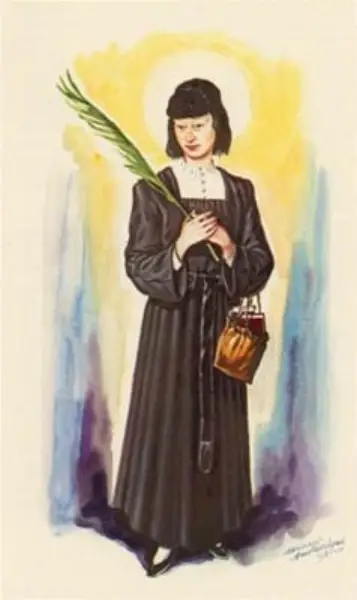
Magdalene's memory lives not only in the calendar but in the images by which the faithful picture her. The official portrait shows her in the black Augustinian habit, holding the palm of martyrdom and carrying a bag on her arm — the bag of the alms-seeker who sustained the poor of the hidden Church. The Dominicans, whose Giordano Ansaloni guided her last years, cherish a different likeness: instead of the habit she wears a kimono, cross in hand, a reminder that she was a daughter of Japan before she was a daughter of Augustine. Some sculptures crown or halo the veiled head; other depictions place the palm in one hand and the rosary in the other. These varied images testify to the breadth of her appeal: to Augustinians and Dominicans, to Japanese and Filipino Christians, and to all who honor a young woman who lost her parents to the executioners, her directors to the flames, and finally her own life to the pit and the water, yet never surrendered the name she had confessed in the face of the judges.
§ Depiction
Timeline
- 1611
Born near Nagasaki into a Christian family
§ Life
- 1620
Her parents were martyred for their Christian faith when she was about nine
§ Life
- 1623
The Augustinian Order arrived in Japan and she began serving as their interpreter
§ Life
- 1625
Became a tertiary of the Order of Augustinian Recollects
§ Life
- 1629
Took shelter with fellow believers in the hills above Nagasaki, baptizing children and tending the sick
§ Life
- 1632
Her spiritual counselors Francis of Jesus and Vincent of Saint Anthony were burned alive
§ Life
- 15 Oct 1634
Died at about age 23 after thirteen days of torture, suffocated in the tsurushi pit
§ Tortured and drowned
- 18 Feb 1981
Beatified by Pope John Paul II in Manila
§ Legacy
- 18 Oct 1987
Canonized among the sixteen Martyrs of Japan at St. Peter's Basilica
§ Legacy
The Record
- Major works
- Catechist and interpreter for the Augustinian Recollect missionaries in Japan
- Symbols
- Augustinian habit·Palm of martyrdom·Cross·Rosary
- Canonization
- Canonized by Pope John Paul II at St. Peter's Basilica on 18 October 1987 among the sixteen Martyrs of Japan
Prayer
Bibliography
Show 6 sources
- Office of Papal Liturgical Celebrations (October 18, 1987). "Lawrence Ruiz, et al". vatican.va. Retrieved September 29, 2017.
- Order of the Discalced Augustinians (2022). "Liturgical Calendar" (PDF). oadnet.org. Retrieved September 28, 2022.
- Ambrosioni, Adriano. "St. Magdalene of Nagasaki, OSA".
- Augustinian Recollects.
- "Saint Magdalene of Nagasaki". Augustinians - Province of St. Thomas of Villanova.
- "Life of St. Magdelene of Nagasaki". Augustinians of the Midwest. Archived from the original on 2012-07-13. Retrieved 2006-10-10.
Profile text adapted from the Wikipedia article, licensed CC BY-SA 4.0.
Pray with this saint every day
Save St. Magdalene of Nagasaki to your favorites, read the full profile, and get feast-day reminders in the Saints app.
Get the Saints AppFree on the App Store for iPhone and iPad