
died c. 530·Feast November 1
St. Magnus of Milan
Archbishop of Milan under the Arian persecution
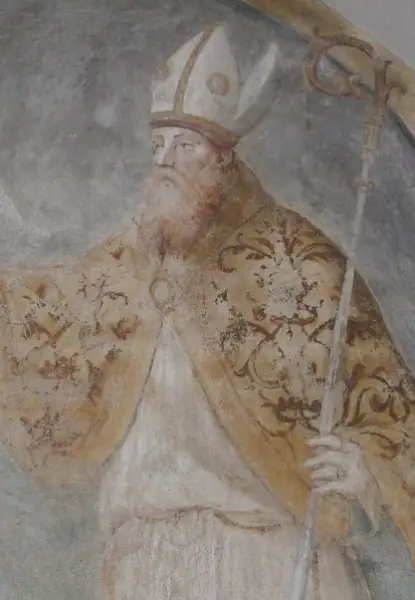
Overview
Magnus served as Archbishop of Milan from 518 to about 530, shepherding the Ambrosian church in the difficult years when the Arian king Theodoric the Great ruled Italy. Almost nothing else is recorded of his life or his governance of the see, yet the memory the Milanese church preserved of him is telling: the text of his funeral epitaph, handed on by the thirteenth-century chronicler Goffredo da Bussero, describes him as a man of great charity who came to the aid of prisoners of war — men seized in the ceaseless wars that accompanied the Gothic domination of the peninsula. Theodoric, who probably favored Magnus at the outset of his episcopate, later turned against him as the king's suspicion fell upon orthodox churchmen, as had already befallen the philosopher Boethius. Magnus died on 1 December 530 and was buried in the Basilica of Sant'Eustorgio in Milan. Honored as a saint in both the Catholic and Orthodox Churches, he is remembered especially at Legnano, whose great basilica bears his name and received a portion of his relics in 1900.
The Complete Life
The See of Ambrose in Troubled Times
In 518 Magnus took up the archbishopric of Milan as successor to Eustorgius II, assuming the leadership of a church that traced itself to Barnabas and Ambrose but now lived under the rule of an Arian sovereign. Theodoric the Great, master of Italy, maintained at first a policy of toleration toward the Catholic hierarchy, and he probably gave Magnus his initial support; but the relationship darkened. In the later years of the reign the king's suspicion of the orthodox clergy hardened into persecution, and Magnus suffered under it, as the philosopher Boethius had suffered before him — the great senator executed on charges that contemporaries read as the price of loyalty to Roman law and Nicene faith. How precisely the trial touched the archbishop the sources no longer tell us; what remains is the picture of a prelate governing the foremost see of northern Italy through a decade in which the favor of the court could turn, without warning, into the menace of the court, and steering the Ambrosian church safely to the end of it. Under such a sovereign the office of bishop demanded both prudence and endurance.
§ Life
Mercy to the Captives
The Milanese church preserved Magnus's memory chiefly through the words cut over his grave. His funeral epitaph, transmitted by Goffredo da Bussero in the thirteenth century, characterizes him as a man of great charity whose compassion singled out the prisoners of war. The sixth century gave such mercy constant occasion: Gothic Italy was a military state, campaigning in Gaul and the Balkans, and every campaign left captives — soldiers taken in battle, civilians dragged from sacked towns, hostages moved in the wake of armies — who languished in chains unless someone ransomed or sheltered them. That the Milanese chose to remember their archbishop for this work above all suggests that he spent himself and the resources of his see upon it. A late and unsupported tradition, with no historical basis, attaches his name to the Milanese family of the Trincheri, but the epitaph's witness to his charity needs no such embellishment. In an age that remembered bishops for their controversies, Milan remembered Magnus for his mercy, and inscribed that judgment in stone beside his remains. The captives of the Gothic wars had in him a friend who counted their chains his own concern.
§ Life
Death and Burial
Magnus governed the Milanese church for roughly twelve years, until his death on 1 December 530 closed an episcopate that had spanned the turn from toleration to persecution under Theodoric. His remains were laid to rest in the Basilica of Sant'Eustorgio, the burial church of the Milanese archbishops, where the bodies of the Magi were said to repose and where the line of Ambrose's successors kept their tombs. There the faithful of Milan sought his intercession, and there in 1248 the Dominican friars who ministered to the basilica carried out the first formal survey of his relics, an early testimony to the organized care with which his memory was guarded. The date of his death, kept as his feast on 1 November in the universal calendar, preserved the thought of the archbishop who had died as the Arian hegemony entered its final generation; within a few decades the Gothic kingdom would fall, and the Catholic hierarchy his generation had defended would emerge to rebuild. His epitaph's praise of mercy outlasted the politics of his age. The basilica that received his body kept his name before the faithful of Milan for centuries.
§ Life
The Saint of Legnano
Magnus's cult spread from Milan into the towns of the Ambrosian countryside, and nowhere took deeper root than at Legnano, some twenty kilometers from the city. The principal church of Legnano was dedicated to him, and between 1503 and 1513 the town raised the splendid Basilica di San Magno in his honor, one of the architectural treasures of Lombardy. On 5 November 1900 a portion of the saint's relics was translated from Sant'Eustorgio to the Legnano basilica, binding the modern town to the archbishop of the sixth century, and there his feast is celebrated on 5 November, while the universal Church keeps him on 1 November. The Church of Milan, faithful to its own calendar, joins him in the common commemoration of all the saintly bishops of the Ambrosian see on 25 September. Twenty-five years of an obscure but faithful episcopate, one line of epitaph praising charity to captives, and a basilica in Lombardy that bears his name: these constitute the enduring monument of a bishop whose sanctity needed no chronicle to be remembered. For Legnano he remains the gift of Milan’s ancient church, a patron drawn from its own diocesan history.
§ Veneration
Timeline
- 518
Appointed Archbishop of Milan, succeeding Eustorgius II
§ Life
- 1 Dec 530
Died at Milan and was buried in the Basilica of Sant'Eustorgio
§ Life
- 1248
The Dominicans of Sant'Eustorgio made the first formal survey of his relics
§ Veneration
- 1503
Construction of the Basilica of Saint Magnus at Legnano, dedicated to him, was begun
§ Veneration
- 1513
The Basilica of Saint Magnus at Legnano was completed
§ Veneration
- 5 Nov 1900
A portion of his relics was translated to the Basilica of San Magno in Legnano
§ Veneration
The Record
- Symbols
- Bishop's vestments
- Canonization
- Pre-congregation saint, venerated in the Catholic and Orthodox Churches
Prayer
Bibliography
Show 5 sources
- Majo, Angelo (1989). "Magno, santo (518-530 c.)". Dizionario della Chiesa Ambrosiana. Vol. 3. Milano: NED. p. 1844. ISBN 88-7023-102-X. (in Italian)
- Ruggeri, Fausto (1991). I Vescovi di Milano. Milano: NED. p. 16. ISBN 88-7023-154-2. (in Italian)
- "La vita di San Magno vescovo". Contrada San Magno. Archived from the original on 25 April 2012. Retrieved 28 October 2011. (in Italian)
- Cazzani, Eugenio (1996). Vescovi e arcivescovi di Milano. Milano: Massimo. pp. 31-32. ISBN 88-7030-891-X. (in Italian)
- "Guida alla visita della Basilica di San Magno". Parrocchia San Magno. Archived from the original on 16 November 2011. Retrieved 28 October 2011. (in Italian)
Profile text adapted from the Wikipedia article, licensed CC BY-SA 4.0.
Pray with this saint every day
Save St. Magnus of Milan to your favorites, read the full profile, and get feast-day reminders in the Saints app.
Get the Saints AppFree on the App Store for iPhone and iPad