
1080 – 1117·Feast April 16
St. Magnus Erlendsson, Earl of Orkney
Martyred Norse earl and patron saint of Orkney
Overview
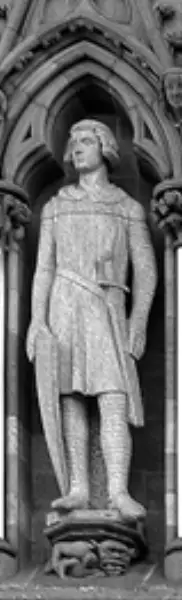
Magnus Erlendsson, called Magnus the Martyr, was Earl of Orkney from 1106 until his death and stands among the few Norse magnates whom the Church has honored as a saint. Born in 1080, the first son of Earl Erlend Thorfinnsson and Thora, daughter of Sumarlidi Ospaksson, he inherited the feuds of a ruling house whose cadets quarreled over the divided earldom. Deposed and carried off as a hostage by King Magnus Barefoot of Norway in 1098, he showed his character most clearly at the Battle of the Menai Straits, where he would not take part in the Viking assault and stayed aboard, singing psalms. Restored by King Eystein I of Norway, he governed Orkney jointly and peaceably with his cousin Haakon Paulsson until rivalry between their followers broke out. Summoned to a negotiated meeting on Egilsay, he was trapped by Haakon's treachery, offered the choice of exile or prison, and finally condemned to death by an assembly weary of joint rule; his cook Lifolf struck him down with an axe after Easter, on 16 April 1117. Miracles at his grave, a cathedral raised in his name at Kirkwall, and a cult confirmed by Pope Leo XIII in 1898 mark him as the saint of Orkney.
The Complete Life
Born to a Divided Earldom
Magnus was born in 1080 into the ruling house of the Orkney earls, the first son of Earl Erlend Thorfinnsson and Thora, daughter of Sumarlidi Ospaksson. His grandfather Thorfinn the Mighty and grandmother Ingibiorg Finnsdottir had left two twin sons, Erlend and Paul, and through Ingibiorg's father Finn Arnesson the family was kin to the Norwegian kings Olav II and Harald II. Magnus had a brother Aerling, sisters Gunnhild and Cecilia, and grew up amid the prosperity and the quarrels of a house too rich in heirs. The friendship of the two ruling brothers soured as their children matured, for Haakon Paulsson and Aerling Erlendsson, both talented but both quarrelsome and arrogant, contended for precedence, each father backing his own son until the earldom itself had to be divided into two distinct territories. In this feuding company Magnus stood apart: the saga describes him as a quiet sort of man, and that temperament of peace, set against a kindred of strivers, foreshadowed both the shape of his rule and the manner of his death. In such a house, gentleness was itself a vocation.
§ Family background
Exile, Hostage, and Earl
The politics of the North Sea swept Magnus into captivity before he ever ruled. Haakon Paulsson, abroad in Scandinavia, persuaded King Magnus Barefoot of Norway to reclaim direct control of Orkney, and in 1098 the king descended on the islands with a fleet, deposing both Erlend and Paul Thorfinnsson, sending the old earls to Norway as prisoners, and carrying off their sons as hostages while his eight-year-old son Sigurd reigned as nominal earl. From Orkney the king led his fleet down Scotland’s western seaboard and across the Irish Sea, and it was on this expedition, at the Battle of the Menai Straits in Anglesey, that Magnus Erlendsson refused to fight, remaining aboard ship and singing psalms while the fleets joined battle. Aerling died in the campaigning, in Wales or Ulster. Magnus escaped to Scotland and took refuge there, but in 1105 he returned to Orkney to claim his inheritance; failing to agree with Haakon, he obtained from King Eystein I of Norway the grant of the earldom, and from 1106 the cousins ruled Orkney together in amity, until 1114. Peace, however, proved fragile.
§ Norwegian influence
The Psalmist in the Rigging
The Orkneyinga Saga gives Magnus a reputation for piety and gentleness that was no ornament of hindsight but a fact his contemporaries remarked. His refusal to fight at the Menai Straits was an act of conscience in a warrior society that counted refusal dishonor: while his kinsmen rowed into the Viking raid on Anglesey, he kept to the ship, singing psalms as the battle raged, and made no secret of the religious convictions that held his hand. That peaceable constancy governed his rule as well; the joint earldom he shared with Haakon was remembered as amicable, a rarity in Orkney's bloodstained succession. When at last the quarrel of their followers forced the cousins to arms, Magnus went to the meeting on Egilsay in good faith, keeping the agreed terms of two ships. Caught overnight in the island's church, offered exile or prison but demanded of by chieftains as a sacrifice, he met death as he had met the battle he would not join: it was said that he prayed first for the souls of his executioners, asking pardon for the cook Lifolf whose axe was forced upon him.
§ Battle of Menai Straits
Treachery at Egilsay
The peace of the twin earls did not outlast the ambitions of their households, and when the followers of Magnus and Haakon fell out, the two sides met at the Thing on the Orkney mainland ready for battle. Rather than fight, they negotiated, agreeing to meet on the island of Egilsay at Easter, each earl to bring only two ships. Magnus kept the truce and arrived with his two; Haakon came treacherously with eight. Magnus took refuge through the night in the island's church, and in the morning he was taken. Exile and prison were offered him, but an assembly of chieftains, weary of divided government, insisted that one of the two earls must die. the standard-bearer Ofeigr would not lift his hand against him, and in anger the earl commanded his cook Lifolf to strike. After Easter, on 16 April — the year most surely 1117, since the date could not have fallen before Easter in 1115 — the axe fell, and Magnus, who had prayed for his killers, died in the churchyard he had fled to for sanctuary. His death at Eastertide fixed the day his Church would remember forever.
§ Execution
Miracles at the Grave
Magnus was buried first where he fell, and his legend relates that the rocky ground about the grave turned miraculously to a green field. His mother Thora obtained Haakon's leave to bury him in a church, and he was laid in Christchurch at Birsay, where reports of wondrous happenings and healings gathered. So strong did the reports grow that William the Old, Bishop of Orkney, publicly warned that it was heresy to spread such tales — and was struck blind in his church, recovering his sight only after praying at Magnus's grave upon his return from Norway. The bishop's own healing silenced his skepticism, and in 1136 he formally sanctified the murdered earl, making him Saint Magnus. St Magnus Church on Egilsay probably rose soon afterward at or near the site of the killing. The cult received Rome's seal much later: on 11 July 1898 Pope Leo XIII confirmed the ancient cultus, and in 2017 the nine hundredth anniversary of the martyrdom was commemorated in the cathedral at Kirkwall that bears the martyr's name. From a disputed killing on a small island there had come a devotion that reached the papal throne.
§ Burial
The Stone Minster and the Hidden Relics
Magnus's nephew Rognvald Kali Kolsson, claiming the earldom in 1136 on the counsel of his father Kol, vowed to the islanders a great stone minster at Kirkwall, to be raised in honor of his sainted uncle; the promise became St Magnus Cathedral, begun in 1137, and once the building stood ready for its consecration, the martyr’s relics were borne into it. There they remained, their exact resting place forgotten, until 31 March 1919, when restoration work opened a hidden cavity in a pillar and found a wooden box of bones, among them a damaged skull, held with little doubt to be the relics of the saint. The box, carved from Scots pine, was radiocarbon-dated in 2025 to timber felled between 1034 and 1168, and the bones were returned to the pillar in 1926, with a cross marking the spot. The cult spread widely: some twenty-one European churches honor him, including the Faroese cathedral at Kirkjubour, where relics were found in 1905, and St Magnus the Martyr by London Bridge. George Mackay Brown's novel Magnus, Peter Maxwell Davies's opera of 1977, and Clive Strutt's hymns of 1989 keep the martyr present in Orkney's arts.
§ Burial
Timeline
- 1080
Born, first son of Earl Erlend Thorfinnsson and Thora, daughter of Sumarlidi Ospaksson
§ Family background
- 1098
King Magnus Barefoot seized Orkney, deposed his father, and took Magnus hostage to Norway
§ Norwegian influence
- 1098
Refused to fight in the Viking raid at the Battle of the Menai Straits, staying aboard ship singing psalms
§ Battle of Menai Straits
- 1105
Returned from exile in Scotland to Orkney and contested the succession against his kinsman Haakon
§ Battle of Menai Straits
- 1106
Granted the earldom by King Eystein I of Norway and began ruling jointly with Haakon Paulsson
§ Battle of Menai Straits
- 1114
The amicable joint rule with Haakon ended as their followers fell out
§ Execution
- 16 Apr 1117
Killed by axe blows at Egilsay after Haakon arrived with eight ships to their meeting arranged for two
§ Execution
- 1136
Bishop William of Orkney sanctified the murdered earl; St Magnus Church, Egilsay, was probably built soon after
§ Burial
- 1137
St Magnus Cathedral at Kirkwall was begun by his nephew Rognvald Kali Kolsson in his memory
§ Burial
- 11 Jul 1898
Pope Leo XIII confirmed his cultus
§ Introduction
- 31 Mar 1919
A cavity opened in a cathedral pillar revealed a wooden box of bones, held to be his relics
§ Burial
- 1926
His remains were replaced in the pillar, the spot marked with a cross
§ Burial
In Their Own Words
a quiet sort of man
The Record
- Major works
- St Magnus Cathedral, Kirkwall, founded in his memory by his nephew Rognvald Kali Kolsson
- Patron of
- Orkney·Anglican Church Grammar School, Brisbane
- Symbols
- Viking clothing·Axe
- Canonization
- Proclaimed a saint by Bishop William of Orkney in 1136; cultus confirmed by Pope Leo XIII on 11 July 1898
Prayer
Bibliography
Show 9 sources
- Antonsson, Haki (2007). St. Magnús of Orkney: A Scandinavian Martyr-Cult in Context. Leiden: Koninklijke Brill. ISBN 978-90-04-15580-0.
- Ellis, Caitlin (2022). "The Development of the Cult of Magnús: The Interplay between Saints, Bishops and Earls of Orkney". In The Cult of Saints in Nidaros Archbishopric: Manuscripts, Miracles, Objects. Turnhout: Brepols. pp. 111-41.
- Muir, Tom (2005). Orkney in the Sagas: The Story of the Earldom of Orkney as told in the Icelandic Sagas. Kirkwall: The Orcadian. ISBN 0954886232.
- Crawford, Barbara E. (2003). "Orkney in the Middle Ages". In Omand, Donald (ed.). The Orkney Book. Edinburgh: Birlinn. ISBN 1-84158-254-9.
- Orkneyinga Saga: The History of the Earls of Orkney. Translated by Pálsson, Hermann; Edwards, Paul Geoffrey. London: Penguin. 1981. ISBN 0-14-044383-5.
- Vigfusson, Gudbrand (1887). Orkneyinga saga, and Magnus saga, with appendices. Icelandic sagas and other historical documents. Vol. 1. London: HMSO.
- Hermann Pálsson; Edwards, Paul (1996). Magnus' Saga: The Life of St Magnus, Earl of Orkney 1075-1116. Kirkwall, Orkney: Kirk Session of St Magnus' Cathedral, Kirkwall. ISBN 0-9528164-0-7.
- Thomson, William P. L. (2008). The New History of Orkney. Edinburgh: Birlinn. ISBN 978-1-84158-696-0.
- Williams, Gareth (2007). "Moddan of Dale". In West Over Sea. Leiden: Brill. ISBN 978-90-04-15893-1.
Profile text adapted from the Wikipedia article, licensed CC BY-SA 4.0.
Pray with this saint every day
Save St. Magnus Erlendsson, Earl of Orkney to your favorites, read the full profile, and get feast-day reminders in the Saints app.
Get the Saints AppFree on the App Store for iPhone and iPad