
died 660·Feast August 19
St. Magnus of Avignon
Bishop and governor of Avignon, father of St. Agricola
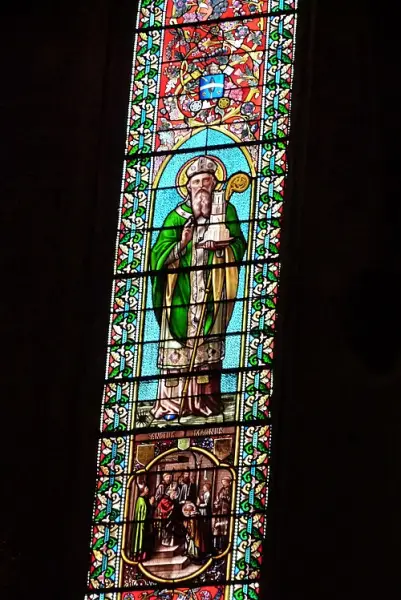
Overview
Magnus of Avignon, honored in French as Saint Magne, died in 660 after a life that joined civic and ecclesiastical service in his native city. A Gallo-Roman senator by rank, he governed Avignon before turning to the religious life. Widowed, he became a monk and was then raised to the episcopate as bishop of Avignon, where he associated his own son in the government of the diocese by appointing the boy, the future Saint Agricola of Avignon, as his coadjutor. This father-and-son episcopate made the two the great ecclesiastical pair of the city in the seventh century. Above all the tradesmen of the fish markets invoke him, dealers and fishmongers alike, an association that has kept his name alive in the marketplaces of Provence long after the details of his career were forgotten. His feast is kept on 19 August, and a stained glass window in Avignon's church dedicated to his son shows his figure, preserving his memory in the very church dedicated to his son.
The Complete Life
From Senator's House to the Cloister
Magnus belonged to the Gallo-Roman senatorial class of Avignon, his native city, and in the manner of his order he first served it as governor, administering civil affairs in an age when the old Roman offices still lent order to the towns of the Rhone valley. His path to holiness, as the tradition tells it, passed through sorrow: he was a widower before he embraced the religious state. Freed from domestic ties by the death of his wife, he became a monk, exchanging the senator's dignity for the discipline of the cloister. Such a conversion was not the end of his public responsibility but its transformation. The reputation for sanctity and prudence that he had earned in government and deepened in monastic life marked him out for the episcopate, and he was made bishop of Avignon, returning to the city he had once governed, no longer as its magistrate but as its chief shepherd. The sequence of his life — senator, widower, monk, bishop — displays the characteristic seventh-century conviction that the best pastors were often those who had first learned obedience and detachment under a rule before they took up the crozier.
§ Magnus of Avignon
A Father and Son on the Throne of Avignon
The most striking feature of Magnus's episcopate is his association of his own son in its government. Agricola, who would himself be honored as a saint of Avignon, was appointed coadjutor by his father, sharing and eventually succeeding to the pastoral charge of the diocese. Father and son thus formed a single line of episcopal service in the city, and the memory of the pair is preserved together there to this day: the church of Saint-Agricol in Avignon, dedicated to the son, contains a stained glass window that portrays the father. Magnus died in 660, leaving behind him a diocese governed by his own blood and a cult that endured through the centuries. Popular devotion assigned him a distinctive patronage, that of fish dealers and fishmongers, so that his name passed from the cathedral into the marketplace, invoked by the tradesmen of the rivers and coasts. His feast is kept on 19 August. Though the written record of his deeds is slight, the persistence of his cult in Avignon — in glass, in liturgy, and in the guild memory of the fish trade — witnesses to a bishop whom his city never forgot.
§ Magnus of Avignon
The Record
- Patron of
- patron saint of fish dealers and fishmongers
- Canonization
- Pre-congregation; ancient popular veneration, especially in Provence.
Prayer
Profile text adapted from the Wikipedia article, licensed CC BY-SA 4.0.
Pray with this saint every day
Save St. Magnus of Avignon to your favorites, read the full profile, and get feast-day reminders in the Saints app.
Get the Saints AppFree on the App Store for iPhone and iPad