
died 3rd century·Feast August 19
St. Magnus of Cuneo
Legendary Theban Legion martyr of the Piedmont Alps
Overview
Magnus of Cuneo, called San Magno in Italian, is honored as a martyr and, by local tradition, a soldier of the legendary Theban Legion, the Christian unit said to have been commanded by Maurice and destroyed at Agaunum. According to the story preserved in the Valle Grana, Magnus escaped the massacre, fled into the mountains of Piedmont, and preached the Christian faith among the Alpine valleys before he too was put to death and buried on the spot where the Santuario di San Magno at Castelmagno now stands. His cult, like those of several neighboring Alpine saints, was joined to the memory of the Theban Legion in the early Middle Ages, clothing a local holy man about whom nothing historical was known with the antiquity and prestige of the legionary martyrs. Scholars note that neither documentary nor archaeological evidence supports the link to the legion, and some have suggested that the cult actually reflects that of a later Magnus, the monk of Füssen in Bavaria, carried south by Benedictines. Whatever the truth of his origins, Magnus has been venerated for centuries as the patron of the mountain pastures, and his mountain sanctuary remains the center of his feast, kept on 19 August.
The Complete Life
A Soldier of the Theban Legion
The tradition of the Valle Grana makes Magnus one of the soldiers of the famous Theban Legion, the wholly Christian unit said to have served under the command of Maurice in the Roman army of the late third century. When the legion, according to the legend, was decimated at Agaunum around the year 286 rather than take part in acts against the faith, Magnus did not remain with his condemned comrades. He made his way south and east into the mountains of Piedmont, carrying with him the faith for which his legion had died. There, high among the Alpine valleys, he took up a new kind of service: instead of the military banner he now bore the banner of Christ, preaching the Christian religion to the scattered communities of the mountains. The story places him squarely in the company of the other legionary saints venerated in the Alpine districts — Chiaffredo at Crissolo, Bessus at Val Soana, Tegulus at Ivrea, Constantius at Villar San Costanzo, and Dalmatius at Borgo San Dalmazzo — a whole constellation of soldier-martyrs whose cults flourished along the western edge of the peninsula. In every account he stands as the missionary-soldier whose arms gave way to the word of God.
§ Legend
Preacher of the Alpine Valleys and Martyr
In the Piedmontese mountains Magnus found the field of his apostolate. The tradition tells that he preached the Christian religion in the Alps, bringing the Gospel to the high valleys of what is now the province of Cuneo, regions still only partly Christian in the closing decades of the third century. His preaching, in the legend's telling, ended as the preaching of the legion had ended: he was eventually arrested and martyred for the faith he had carried into the mountains. The faithful buried him where he fell, and his grave became the seed of the sanctuary that bears his name. The Santuario di San Magno stands in the Valle Grana above Castelmagno, on what may once have been a site dedicated to the Roman god Mars, as though the old religion of the heights had been displaced by the martyr's tomb. A church has stood there since remote times; the present building, raised between 1704 and 1716 in the Piedmontese Baroque style, still preserves frescoes of the fifteenth and sixteenth centuries on its interior walls, painted images that have watched over the martyr's shrine for five hundred years and more.
§ Legend
An Ancient Cult Examined by Scholars
Magnus has never undergone a formal process of canonization; he belongs to the great company of pre-congregation saints whose cult arose spontaneously at their tombs and was later confirmed by enduring liturgical use. His feast is kept on 19 August, the same day as those of Magnus of Anagni and Magnus of Cappadocia, from whom he must be carefully distinguished. The center of his veneration has always been the mountain sanctuary in the Valle Grana, where he is honored as a martyr in the Roman Catholic Church. Modern scholarship, however, has weighed the legend with care. Damiano Pomi has shown that no document and no excavation binds the martyr of Cuneo to the Theban Legion; the link, like those forged for Chiaffredo, Bessus, Tegulus, Constantius, and Dalmatius, seems manufactured to clothe an utterly obscure regional holy man with the borrowed dignity of the legionary martyrs. An alternative hypothesis identifies him with Magnus of Füssen, the Bavarian monk called Mang, whose cult could have traveled south to Piedmont with the Benedictines and there been recast in legionary guise.
§ Legend
Shepherd of the High Pastures
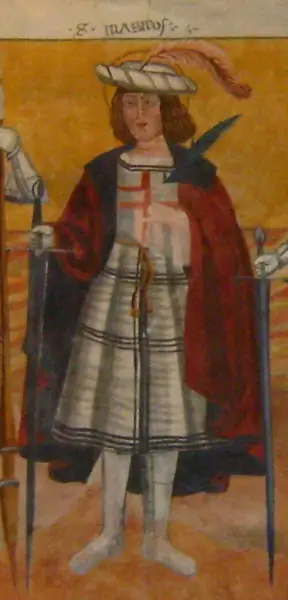
Whatever the historian concludes about his identity, the Magnus of popular devotion has never lost his place in the religious life of the Cuneo valleys. He is invoked for protection over pastures and livestock, a patronage that belongs naturally to the shepherd-saint of the Alpine heights, watched over by his church above Castelmagno. In art he appears as the tradition shaped him: because legend enrolled him among the Theban Legion, artists show him as a Roman legionary, banner in one hand and martyr's palm in the other — emblems of his supposed double service to empire and to Christ. His sanctuary remains a goal of pilgrims in the Valle Grana, a Baroque church preserving medieval frescoes on one of the most dramatic sites in the Piedmontese Alps. His cult has even crossed the Atlantic, though obscurely: in 1901 a set of relics was translated from Anagni to St. Martin of Tours Catholic Church in Louisville, Kentucky, relics which, since the feast days of the three Magnuses coincide, may belong to Magnus of Anagni or Magnus of Cappadocia rather than to the martyr of the Alps. The uncertainty has never dimmed the local veneration of San Magno.
§ Legend
Timeline
- 286
By legend, the Theban Legion under Maurice was decimated at Agaunum for refusing to persecute Christians.
§ Legend
- 286
Magnus, a soldier of the legion by tradition, fled to the mountains of Piedmont and preached Christianity in the Alps.
§ Legend
- 1704
Construction began on the present sanctuary church of San Magno at Castelmagno in Piedmontese Baroque style.
§ Legend
- 1716
The new sanctuary church of San Magno was completed.
§ Legend
- 1901
A set of relics was translated from Anagni to St. Martin of Tours Catholic Church in Louisville, Kentucky, though their identity is uncertain.
§ Legend
The Record
- Patron of
- protection over pastures and livestock
- Symbols
- depicted as a Roman soldier bearing a banner·the palm of martyrdom
- Canonization
- Pre-congregation; venerated as a martyr in the Roman Catholic Church from remote antiquity.
Prayer
Bibliography
Show 3 sources
- Pomi, Damiano (July 16, 2004). "San Magno". Santi e Beati. Retrieved December 28, 2008.
- "Sanctuary of Saint Magnus", museodiffusocuneese.it
- Odden, Per Einar. "Den hellige Magnus av Cuneo (d. ~286)", Den katolske kirke.
Profile text adapted from the Wikipedia article, licensed CC BY-SA 4.0.
Pray with this saint every day
Save St. Magnus of Cuneo to your favorites, read the full profile, and get feast-day reminders in the Saints app.
Get the Saints AppFree on the App Store for iPhone and iPad