
c. 200 – c. 250·Feast August 19
St. Magnus of Trani
Bishop and martyr of Trani and Anagni
Overview
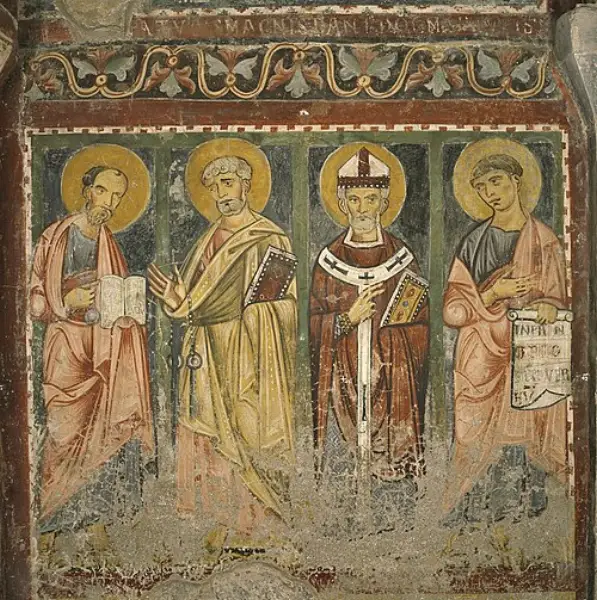
Magnus of Trani, also honored as Magnus of Anagni or Magnus Episcopus, is the patron saint of Anagni in Lazio and one of the most widely venerated figures of early Italian Christianity. The legend places his birth at Trani in Apulia around the year 200, the son of a pagan father whom he eventually converted; after serving as a generous shepherd boy he was baptized with his father by Bishop Redento of Trani, and on the bishop's death the congregation acclaimed Magnus as his successor. Driven from his see during a persecution, he journeyed as a disguised pilgrim through Naples and Rome into Lazio, where he became famed as a healer and exorcist, built a basilica, and gathered disciples including the virgin martyr Secundina. Under Emperor Decius he was seized by soldiers on the Via Latina and killed near Fabrateria, probably around 250. His relics were later translated to Anagni Cathedral, where Bishop Peter recovered a sarcophagus beneath the church floor around 1100 and the great crypt was decorated with frescoes of his life. His cult spread across Europe, from Rome and Fondi to Germany, Frisia, and Scandinavia, and since 1901 relics venerated as his rest in Louisville, Kentucky. His historical identity remains debated, but his liturgical commemoration on 19 August has never ceased.
The Complete Life
The Shepherd Boy of Trani
The earliest manuscripts of the Passion set the story in Trani, the Adriatic town of Apulia, in the opening decades of the third century. Magnus was born there around the year 200, the son of a pagan named Apollo, and while still young he took up the work of a shepherd to support his household. His flock grew rapidly, and the boy directed his earnings not to himself but to the poor, a generosity that marked him out even before his baptism. One manuscript adds a marvel: an angel brought him ten pounds of gold, capital that let him establish himself in the sheep-farming business on a proper footing. The conversion of the household followed. Magnus and his father sought out Bishop Redento of Trani, by whose hands both were baptized, the father receiving the Christian name Reperatus in place of Apollo. Instructed in the faith, the new Christian made a final disposition worthy of the Gospel, vowing that everything he owned should go to the destitute, and died soon afterward. The orphaned Magnus remained within the orbit of the bishop who had regenerated him, serving the church of Trani until Redento's own death, when the whole congregation proclaimed the young man bishop in his place. Thus the shepherd of sheep became, almost without interval, the shepherd of a flock of souls.
§ Bishop in Trani
Bishop, Prisoner, and Fugitive
Magnus governed the church of Trani as its bishop until persecution reached Apulia. Under the proconsul Severinus he was seized and held inside a pagan temple because he confessed Christ without shame, derided the idols, and would not sacrifice to them. There the tradition locates one of its most beloved episodes: the idols in the temple shattered of their own accord — or, in an alternate telling, Magnus himself destroyed the statues — and when he prayed, the Archangel Michael came to him, opened the temple's doors, and bade him hand out the gold of Jupiter's statue to the poor. Escaping with his life, the bishop fled northward, most accounts say on foot, disguised as a beggar. The journey became a pilgrimage of the apostolic places. In Naples he sheltered for three nights with St. Januarius before pressing on to Rome to pray at the tombs of Peter and Paul. On the road an angel warned him that his traveling companion, a man who had joined him some twenty-five miles beyond Naples, was in truth the devil preparing to attack him in a lonely place; the fiend was unmasked and vanished, changing into a snake or casting himself into a river. The angel then attended the fugitive bishop, steering him toward the appointed field of his second apostolate.
§ Bishop in Trani
Wonderworker of Lazio
Blocked by floodwaters from crossing the river Vulturnus, and finding no boat, Magnus took shelter at a church nearby, and there the angel gave him his commission: to remain in that place, where the Lord intended to work many miracles through him. In Central European versions of the legend the angel bore him dry-shod over the swollen waters to show him the venerable church awaiting him. Sitting at the ceremonial doors on a great feast day, pretending to be poor, he was found by a young man named Paternus, who had been granted a vision of the stranger's coming and now took him into his home for an extended stay. From that house Magnus's fame spread through the whole province: with God's help he healed the sick and cast out devils, and the gifts of the grateful crowds were spent on a basilica, exactly as the angel had foretold. When twenty-two robbers tried to plunder the supposed treasures of his monastery they were struck blind, and Magnus, moved by their pleas, restored their sight and persuaded them to abandon their violent trade. He drove out demons from the leading citizens of Sora, Aquino, and Picenum, and recruited from Anagni a young woman named Secundina, who would die a martyr under his teaching.
§ Missionary in Lazio
Athlete of Christ
The twelfth-century tradition unequivocally presents Magnus as an athleta Christi, an athlete of Christ, and the title gathers up everything the legend says about his manner of holiness. He is first of all a thaumaturgus, a wonderworker whose healings, exorcisms, and signs — the shattered idols, the blinded robbers restored, the angelic ministrations — display the power of God over every enemy. He is also a monastic champion fighting the devil, and no episode expresses this more vividly than the recognition scene on the road from Rome, where the companion walking beside him is revealed as the adversary himself, scheming to cast the saint's body into a hidden ravine. The legend thus casts the interior combat of the monk in the outward form of a journey. Medieval readers found in the figure still another resonance: the parallel with the crusading ideals of the twelfth century, the soldier of Christ whose campaigning is fought with prayer instead of arms. The oldest liturgical witness to his cult, the Gelasian liturgy of the eighth century, fixes his name to the feast of 19 August and summons a prayer for release from death's captivity — a fitting collect for a saint whose whole legend is a passage through imprisonment, pursuit, and martyrdom into the freedom of the martyrs' glory.
§ Magnus of Trani
Martyrdom on the Road to Fabrateria
The persecution intensified under Emperor Decius and the prefecture of Valerian, and the emperor, alarmed by the growing fame of the holy man, dispatched thirty soldiers to arrest him. The devil met the troop forty miles outside Rome on the Via Latina, denounced Magnus as a magician and seducer, and counseled them to seize his disciple Secundina first, even demanding that Magnus himself be made her executioner if she refused sacrifice. A fervent pagan named Tarquinius betrayed the virgin's hiding place, and with their double prisoner the soldiers came to the church where Magnus dwelt. They struck him down and burned the church utensils. Granted time to reflect, the dying bishop shut himself in his cell and prayed to be taken; when the soldiers broke in they found his body and fled in terror, though accounts agree the corpse was decapitated afterward, some adding that the limbs were hacked and the monastery burned. The Utrecht manuscript states plainly that he was tortured to death, while the thirteenth-century Anagni frescoes show the crown of his skull severed after death. Paternus, who had seen angels carrying his teacher's soul to heaven, buried the body with his own hands, escaped the soldiers sent to seize him — they died that same night — and received from the martyr's ghost a dream of comfort. A later Austrian recension surrounds the death with bears and wolves that lick his feet and an oven whose flames heavenly dew extinguishes.
§ Missionary in Lazio
A Martyr in the Ancient Calendars
Magnus belongs to the earliest stratum of the Church's recognized saints, honored long before any formal canonization process existed. The cult of a local martyr of this name was widespread in Lazio and the surrounding regions from the fourth or fifth century, and his name appears in the fifth-century martyrology of Jerome, which lists his death or resting place at Fabrateria, probably Fabrateria Nova near Ceprano. He is named in Bede's martyrology and in the eighth-century Sacramentarium Gelasianum, and his memory fills many other liturgical calendars and martyrologies. During the ninth and tenth centuries his fame spread across Europe, often entangled with that of Andrew the Tribune through the martyrologies of Usard, Ado of Vienne, and the Vetus Romanum. Pope Gregory XIII's Roman Martyrology of 1583 described him as bishop and martyr of Anagnia; the revised edition of 2001 classifies him as a martyr of Lazio, with the express proviso that the data concerning his actual life are uncertain — a caution scholars such as Gennaro Luongo have underlined, noting that the many legendary versions of his Passion have made his historical identity one of the most intriguing puzzles of medieval hagiography. Yet the feast of 19 August has been celebrated at Anagni and in countless other places without interruption.
§ Veneration
From Anagni's Crypt to the Churches of Europe
The definitive shaping of Magnus's cult came in the age of the Gregorian reform. Bishop Peter of Anagni, rebuilding his cathedral between 1072 and 1104, is said to have discovered beneath the church floor a marble sarcophagus sealed with iron bands that miraculously loosened, holding a skull and bones attributed to the saint. The Passion was edited at Anagni around 1100, and the political program of the papacy, strengthening the Papal State during the Investiture Controversy, gave the renewed cult a public face. In 1231 the recovered relics were buried anew beneath a cosmatesque mosaic floor, and the thirteenth-century crypt of the cathedral was painted with frescoes of the saint's life, death, and afterlife, his shrine rendered symbolically as the Ark of the Covenant. His patronage was claimed by Anagni, by Colle San Magno, and by towns across Lazio, Campania, Calabria, Umbria, and Apulia. Farther north the Carolingian abbey of Saint-Riquier honored his relics by the 790s; Pope Nicholas I sent relics to Münster; Braunschweig consecrated a church to him in 1031; and he became patron of parishes in Frisia and Lower Saxony and a name freely bestowed on royal children in Germany and Scandinavia. In Rome his second relics kept at Santi Michele e Magno made him patron of the Frisian national church, while his skull was translated to St. Peter's Basilica in 1602, and in 1901 further relics reached Louisville, Kentucky, where he is still venerated.
§ Veneration
Timeline
- 200
According to the legend, born at Trani in Apulia, son of the pagan Apollo.
§ Bishop in Trani
- 250
Martyred during the persecution of Emperor Decius, struck down by soldiers near Fabrateria on the Via Latina.
§ Missionary in Lazio
- 522
The Abbey of Fondi was erected by Abbot Honoratus and, according to a ninth-century document, dedicated to St. Magnus.
§ Veneration
- 846
After the Arab raid against Rome, tribune Plato of Veroli looted the saint's relics from the ruins of Fondi and carried them to Veroli.
§ Translation to Anagni
- 1031
The church of Saint Magnus was consecrated at Braunschweig, boosting his popularity in northern Germany.
§ Veneration
- 1043
A village church dedicated to Magnus was founded at Niedermarsberg in the Sauerland.
§ Veneration
- 1072
Bishop Peter of Anagni began rebuilding Anagni Cathedral, work that continued until 1104.
§ Veneration
- 1100
The Passion of Magnus was edited at Anagni Cathedral, where his relics had supposedly been found under the church floor.
§ Magnus of Trani
- 1105
Death of Bishop Peter of Anagni, the restorer of the saint's cult, who was himself soon canonized.
§ Magnus of Trani
- 1112
The body of St. Peter of Anagni was laid to rest next to Magnus's remains in the crypt beneath the high altar.
§ Veneration
- 1141
The Roman church of Santi Michele e Magno was reconstructed, housing a second set of the saint's relics.
§ Veneration
- 1215
The body of St. Paternus was discovered at the Abbey of San Magno in Fondi and transferred to the Cathedral of Saint Peter.
§ Martyrer in Fondi
- 1231
During reconstruction of the Anagni crypt, Magnus's relics were recovered and reburied beneath a new cosmatesque mosaic floor.
§ Veneration
- 1583
Pope Gregory XIII's Roman Martyrology described Magnus as bishop and martyr of Anagnia.
§ Magnus of Trani
- 1602
His skull, which had been translated to St. Peter's Basilica in the Vatican during the papacy that ran from 1417 to 1431, was set in a silver bust worth 800 florins.
§ Veneration
- 1603
The Chapter of Saint Peter had the saint's other arm transferred to the basilica as well.
§ Veneration
- 1901
Relics including a skull were sent from Anagni to St. Martin of Tours Catholic Church in Louisville, Kentucky.
§ Magnus of Trani
- 2001
The revised Roman Martyrology classified Magnus as a martyr of Lazio, noting that the data on his life are uncertain.
§ Magnus of Trani
In Their Own Words
Stay in this place, for the Lord intends to work many miracles through you.
Hic requiescit gloriosus martyr et insignis praesul meritis et nomine Magnus
moved by divine love, learned that the most precious treasure of the sacred body had long lain neglected and forgotten in the aforementioned place
The Record
- Major works
- A basilica built in Lazio with the offerings of the people he healed (per the Passion)·The Christian community and monastery at his Lazio settlement, whose treasury the robbers sought·The church of Trani that bore his name by 834 as the city's episcopal church
- Patron of
- patron saint of Anagni·patron of the church of Santi Michele e Magno in Rome·patron of Colle San Magno·patron of the Frisian districts of Harlingerland and Wûnseradiel
- Symbols
- episcopal attire·palm of martyrdom
- Canonization
- Pre-congregation; listed as a martyr in the Roman Martyrology (first under Gregory XIII in 1583, revised 2001) and venerated since at least the fifth century.
Prayer
Bibliography
Show 9 sources
- Filippo Carcione (ed.), Magno di Trani. Memoria e culto di un martire paleocristiano nelle Valli del Liri e del Sacco, Venafro 2004.
- Ekkart Sauser (2003). "Magnus Episcopus". In Bautz, Traugott (ed.). Biographisch-Bibliographisches Kirchenlexikon (BBKL). Vol. 21. Nordhausen: Bautz. col. 890. ISBN 3-88309-110-3.
- Frederick George Holweck, A Biographical Dictionary of the Saints, London 1924, repr. New York 1969, p. 892.
- Francesco Lanzoni, Le diocesi d'Italia dalle origini al principio del secolo VII (an. 604). Studio critico, Faenza 1927.
- Sabine Baring-Gould, Lives of the Saints, vol. 9: August, London 1898, p. 176.
- Johann Evangelist Stadler, Vollständiges Heiligen-Lexikon, vol. 4, Augsburg 1875, p. 46-53.
- Manlio Simonetti, 'Sulla tradizione agiografica di S. Magno di Trani', in: Il paleocristiano in Ciociaria. Atti del convegno, Fiuggi, 8-9 ottobre 1977, Rome 1978, p. 97-121.
- Martinus Muskens, Santi Michele e Magno dei Frisoni, Rome 1993.
- Willem Cuypers, 'De S. Magno Episc. et Mart. in Italia', in: Acta Sanctorum ... Augusti, vol. 3, Antwerp 1737, col. 701-716.
Profile text adapted from the Wikipedia article, licensed CC BY-SA 4.0.
Pray with this saint every day
Save St. Magnus of Trani to your favorites, read the full profile, and get feast-day reminders in the Saints app.
Get the Saints AppFree on the App Store for iPhone and iPad