
fl. late 6th century·Feast January 2
St. Mainchín of Limerick
Founder of the church of Limerick and its patron
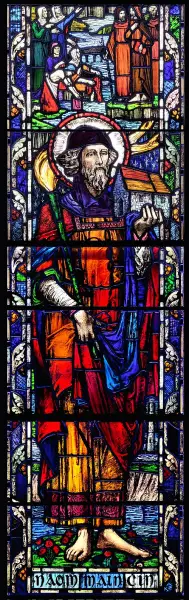
Overview
Mainchín mac Setnai, anglicized as Munchin, is honored in Irish tradition as the founder of the church of Luimneach, the modern Limerick, and as the special patron of that city. He flourished in the late sixth century. Through his father Sétna the tradition gives him a pedigree among the Dál Cais, the people from whom the O'Brien dynasty would descend, and his tutor is named as Mac Creiche, the saint of the Corco Mruad, in the Life of that holy man. According to the story of the church's origin, Ferdomnach, a king of the Dál Cais, granted Mainchín land at Inis Sibtond, and there the saint established Luimneach. He is also venerated as patron of Bruree, the Brug Ríg of old, formerly the royal seat of the Uí Fidgenti. The historical difficulties surrounding him are considerable: the Dál Cais appear in no source under that name until the 930s, and no successors of Mainchín at Limerick are recorded before the twelfth century, so that some scholars argue his presence in the city reflects the adoption of a regional saint by the later Norse and their allies. His memory nonetheless remains fixed in Limerick, where his name is borne by the college of St. Munchin.
The Complete Life
A Son of the Dál Cais
Mainchín's very name joins him to his father: he was Mainchín mac Setnai, Mainchín son of Sétna, and through Sétna the genealogists give him a place among the Dál Cais, with a pedigree reaching back to the ancestors of the O'Brien dynasty, the great royal house of Thomond. His formation in holiness is assigned to a recognized master, for the Life of Mac Creiche states that the saintly Mac Creiche of the Corco Mruad was Mainchín's tutor, binding the future patron of Limerick to the older generation of Munster's ascetics. Beyond this, the record falls silent, and even what it offers is contested by historical scholarship. No writer calls the Dál Cais by that name until the 930s, and historians judge them to descend from a Déisi population that migrated into the lower Shannon region at an uncertain period. Before the Dál Cais rose, the greater region had been dominated by the Uí Fidgenti, who had themselves overrun the Déisi in those same territories, and who were in turn displaced by the Dál Cais from the second half of the tenth century onward. Mainchín's pedigree, in other words, may reflect the ambitions of the later dynasty as much as the family of the sixth-century holy man.
§ Background
Founding Luimneach and the Patronage of Bruree
The tradition tells that Mainchín founded the church of Luimneach, the Viking and later city of Limerick, when Ferdomnach, a king of the Dál Cais, granted him land at Inis Sibtond, an island site suited to the monastic settlements of early Ireland. From this foundation, according to the common account, the ecclesiastical life of Limerick takes its beginning, and from it the saint acquired his enduring eminence as the city's patron. His care was not confined to the Shannon, however, for Mainchín is also the patron saint of Brug Ríg, the present Bruree in County Limerick, formerly the royal seat of the Uí Fidgenti. This double patronage is one of the puzzles of his cult, linking him simultaneously to the people of his supposed pedigree and to the royal seat of those they displaced. It may be that a saint honored across the region was claimed successively by different populations, or that the founder of Limerick was a figure of wider Munster significance whose memory gathered several shrines to itself. In either case, the pairing of Limerick and Bruree has stood in the tradition, and both communities have kept his feast, Bruree observing it on 2 January down to later times.
§ Brug Ríg
The Saint Adopted by a City
The strangest feature of Mainchín's cult is the argument that his presence in Limerick owes less to the sixth century than to the tenth and eleventh. It has been proposed that his adoption as the city's patron came about through the later Norse rulers of Limerick, allies as they were of the O'Donovans, the last leading family of the Uí Fidgenti kingdom; through such channels a regional saint may have been brought into the Hiberno-Norse town and there established as its father in God. The evidential basis for an earlier presence is indeed slight: no successors of Mainchín, no abbots or bishops standing in his line, are known in Limerick before the twelfth century, and so his existence in the city cannot be verified before that date. His liturgical commemoration shows a corresponding complexity. The Martyrology of Donegal gives his feast on 29 December, while at Bruree and in the Roman Martyrology, which lists the memorial of Mainchín of Limerick on 2 January, the later date prevails — though scholars suspect the January date was borrowed in error from St Manchán of Min Droichit in the Félire Óengusso. Modern Limerick still keeps his name before its people in St. Munchin's College, the city's oldest secondary school.
§ Limerick
Timeline
- 575
Flourished in the late sixth century; by tradition founded the church of Luimneach on land at Inis Sibtond granted by King Ferdomnach.
§ Background
- 930
The Dál Cais, to whom Mainchín's pedigree links him, are first attested under that name around this time.
§ Background
- 1100
The earliest century in which any successors of Mainchín are known in Limerick; his existence there cannot be verified before this point.
§ Limerick
- 1864
The Martyrology of Donegal, published in this year, records Mainchín's feast under 29 December.
§ Limerick
- 2004
The second edition of the Roman Martyrology listed 2 January as the memorial of Mainchín of Limerick.
§ Limerick
The Record
- Major works
- The church of Luimneach (Limerick), which he is said to have founded
- Patron of
- patron of Limerick City·patron of Brug Ríg (Bruree)
- Canonization
- Pre-congregation; a saint of Irish tradition honored as patron of Limerick City, with his memorial on 2 January in the Roman Martyrology.
Prayer
Bibliography
Show 4 sources
- Johnston, Elva (May 2008). "Saints of Munster". Oxford Dictionary of National Biography (online ed.). Oxford University Press. doi: 10.1093/ref:odnb/51008.
- Begley, John (1906). The Diocese of Limerick, Ancient and Medieval. Dublin: Browne & Nolan.
- O'Donovan, John; James Henthorn Todd; William Reeves (1864). The Martyrology of Donegal: A Calendar of the Saints of Ireland. Dublin: Irish Archaeological and Celtic Society.
- Martyrologium Romanum 80 (edito altera 2004).
Profile text adapted from the Wikipedia article, licensed CC BY-SA 4.0.
Pray with this saint every day
Save St. Mainchín of Limerick to your favorites, read the full profile, and get feast-day reminders in the Saints app.
Get the Saints AppFree on the App Store for iPhone and iPad