
1094 – 1148·Feast November 3
St. Malachy
Archbishop of Armagh and reformer of the Irish Church
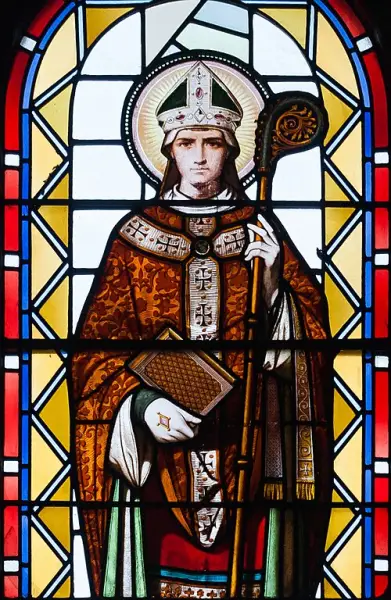
Overview
Malachy, born Máel Máedóc Ua Morgair at Armagh in 1094, was the great reforming archbishop of the Irish Church in the twelfth century. Trained by the recluse Imhar O'Hagan and ordained priest by St. Cellach of Armagh in 1119, he studied for three years under Bishop Malchus at Lismore before becoming Abbot of Bangor in 1123 and a bishop the following year. As Bishop of Down and Connor he laboured to organize the young dioceses, and in 1132, with great reluctance, he accepted election as Archbishop of Armagh, where he spent three years restoring church discipline, expelling the intruded rule of lay abbots, and introducing the Roman liturgy. He resigned the sees of Armagh and Connor in 1136 or 1137, keeping only Down, founded a priory of Austin Canons at Downpatrick, and travelled twice to Rome on the Church's business, becoming papal legate for Ireland. On his first journey he met St. Bernard of Clairvaux, whose friendship shaped his last decade; from Clairvaux came the monks who founded the great Cistercian Abbey of Mellifont in 1142. Setting out for Rome a second time in 1148, he fell ill at Clairvaux and died in Bernard's arms on November 2. Canonized in 1190 by Pope Clement III, he was the first native-born Irish saint formally raised to the altars.
The Complete Life
The Student of Armagh
Máel Máedóc Ua Morgair was born at Armagh in 1094 into a family of noble birth, as Bernard of Clairvaux assures us. His baptismal name meant a servant or devotee of St. Máedóc of Ferns, and Latin writers rendered it Malachus, from which comes the English Malachy. His formation fell to Imhar O'Hagan, a famous recluse who afterwards became Abbot of Armagh; Imhar sympathised with the party that sought to reform the Irish Church along continental lines, and it was almost certainly through this teacher that the young Malachy first drank in their principles. The reformers' cause was urgent: much of the Irish Church lay under the hereditary control of lay dynasties, and its discipline had grown lax. Malachy pursued a long course of studies and in 1119 was ordained priest by Cellach of Armagh, the reigning coarb of Patrick, whom Latin writers called Celsus. Cellach promptly appointed the young priest as his vicar, and for a year or more afterwards Malachy bore the burden of governing the Armagh church, planting in every congregation the teaching of the holy fathers together with the usages of Rome. When Cellach and Imar gave their consent, he went south to study under Bishop Malchus at Lismore, spending three years in that school of reform.
§ Life
Abbot and Bishop
In 1123 the coarb of Bangor Abbey, the principal religious site of north-eastern Ireland, died, and his successor, Malachy's own uncle, offered to surrender both the office and the monastic site to his nephew. Malachy became Abbot of Bangor, and the dignity became an instrument of reform. Under the plan of the Synod of Rathbreasail, Ireland was to be governed by territorial dioceses rather than monastic federations; Cellach, as coarb of Patrick, had been able to organize Armagh accordingly, and Malachy, bearing the prestige of the coarb of Comgall, could now do the same for Connor. In 1124 he made his way to Bangor, took his place in the abbot's stall, and received the episcopate at Cellach's hands. As Bishop of Down and Connor he resided at Bangor and laboured for the organization of his twin dioceses, winning from Bernard of Clairvaux high praise for his zeal. In 1127 he made a second visit to Lismore and served for a time as confessor to Cormac MacCarthy, Prince of Desmond, a friendship that would later shelter his monks. When native princes sacked the dioceses of Down and Connor, Malachy withdrew the Bangor community to Iveragh in County Kerry, where the monks were welcomed by Cormac, now king. Meanwhile Celsus had died and, on his deathbed influence, named Malachy Archbishop of Armagh.
§ Abbot of Bangor
Archbishop of Armagh
Malachy accepted the primacy of Armagh in 1132 with great reluctance, and possession proved harder than election. Through the intrigues of the intruded faction he was unable to occupy his see for two years, and entry came only by buying back from Niall, the usurping lay-primate, the Bachal Isu, the Staff of Jesus. Once installed, he worked with an energy Bernard compared to that of Boniface in Germany. During three years at Armagh he restored ecclesiastical discipline, grown lax under a series of lay-abbots who had made the primacy hereditary; he caused the Roman liturgy to be adopted, renewed the practices of confession and confirmation, restored order in marriage, and introduced Roman chant. Bernard records that he extirpated barbarism and re-established Christian morals before peace returned. He was equally known for his care of the needy, his reputation as a worker of miracles and healer, and a charity of striking concreteness: during seasons of hunger he set apple trees all over Ireland, so that the poor of later months might be fed. Having set all in order, he judged his work done; in 1136 or 1137 he resigned the sees of Armagh and Connor and retired to the humble bishopric of Down, where he founded a priory of Austin Canons at Downpatrick and continued his episcopal labours unceasingly.
§ Life
Rome, Clairvaux, and a Holy Death
The closing decade of Malachy's life bound the Irish Church to the wider Latin world. Early in 1139 he set out for Rome by way of Scotland, England, and France, and at Clairvaux he met Bernard, the most influential churchman of the age. Before Pope Innocent II he petitioned for pallia, the badges of metropolitan authority, for the sees of Armagh and Cashel, and he was appointed legate for Ireland. Returning home by way of Clairvaux, he obtained five monks under an Irish superior, Christian, and from this gift arose the great Abbey of Mellifont in 1142, the first Cistercian house in Ireland and a seedbed of the reform he had spent his life pursuing. In 1148 he began a second Roman journey, but sickness overtook him at Clairvaux. There, on November 2, 1148, he died in the arms of Bernard himself, the friend who would write his Life and preserve his memory for posterity. Bernard's portrait of him dwells on his meekness, humility, obedience, modesty, and diligent study; centuries later Charles Borromeo praised his attention to the poor and his care that all alike should receive the sacraments with renewed fervour. His body remained at Clairvaux, laid near Bernard's own after the abbot's death, while portions were sent back to Ireland in 1194.
§ Life
Canonization and Veneration
In 1190, forty-two years after his death, Pope Clement III canonized Malachy, making him the first native-born Irish saint to receive formal canonisation. His feast is kept on November 3, a date chosen deliberately so as not to clash with All Souls Day. The Visio Tnugdali, written about 1149, shows how quickly his reputation for generosity took hold: in that vision the seer Tundale beholds among the blessed bishops one Malachias O'Moore, who had become Archbishop of Armagh after St. Cellach and who gave everything he had to the poor, founding as many as forty-four churches and colleges, endowing them with land and rents so that many religious might serve God, though he hardly kept enough for himself to live on. His patronage extends to the Archdiocese of Armagh and the Diocese of Down and Connor. The Dominican house at Carlingford, founded in 1305, was placed under his patronage, and Belfast's Saint Malachy's Church was intended as the cathedral church of Down and Connor; the Irish Famine intervened, and the funds set aside for the grand cathedral were diverted to feed the needy, itself a fitting tribute to the saint of the apple trees. Parishes from California to Illinois and New York bear his name to this day.
§ Veneration
Relics and the Reputed Prophecy
Malachy's remains rested at Clairvaux Abbey, eventually in a tomb near that of Bernard of Clairvaux. An arm bone and a piece of his skull were taken and housed in precious containers within the treasury: the arm in a silver case studded with gems, the skull in a gilt-silver bust reliquary crowned with a mitre. The French Revolution destroyed the reliquaries, though the relics themselves were preserved: Malachy's head is now kept in the treasury of Troyes Cathedral near the site of Clairvaux, while the tombs of the two friends were broken up and their bones distributed among the parishes of the district. A stranger afterlife awaited his name. A text called the Prophecy of the Popes, attributed to Malachy and claiming to predict 112 more popes before the Last Judgment, was discovered and published by the Benedictine Arnold de Wyon in 1590. Most scholars regard the document as an elaborate sixteenth-century hoax, and modern theologians have dismissed it roundly: one calls it a grand old fun tale with no more reliability than a morning horoscope, another simply nonsense. The attribution is apocryphal and says nothing about the saint himself, whose genuine legacy lies in the reformed Irish Church he built, the abbey of Mellifont he planted, and the friendship of saints he exemplified.
§ Prophecy of the Popes
Timeline
- 1094
Born at Armagh into the noble family of Ua Morgair, and baptized Máel Máedóc.
§ Life
- 1119
Ordained priest by Cellach of Armagh, who soon made him his vicar.
§ Life
- 1123
Became Abbot of Bangor Abbey on the surrender of the office by his uncle.
§ Abbot of Bangor
- 1124
Went to Bangor, took up the abbatial office, and received episcopal consecration from Cellach for the ordering of Connor.
§ Abbot of Bangor
- 1127
Paid a second visit to Lismore and served for a time as confessor to Cormac MacCarthy, Prince of Desmond.
§ Life
- 1132
Appointed Archbishop of Armagh on the death of Celsus, accepting the dignity with great reluctance.
§ Life
- 1136
Resigned the sees of Armagh and Connor, retaining only the bishopric of Down.
§ Life
- 1139
Journeyed to Rome through Scotland, England, and France, visiting Bernard of Clairvaux and petitioning the Pope for pallia for Armagh and Cashel.
§ Life
- 1142
The great Cistercian Abbey of Mellifont arose in Ireland from the five monks he obtained at Clairvaux.
§ Life
- 2 Nov 1148
Fell sick at Clairvaux on his second journey to Rome and died in the arms of Bernard of Clairvaux.
§ Life
- 1190
Canonized by Pope Clement III, the first native-born Irish saint formally canonized.
§ Veneration
- 1194
Fragments of his body reached Ireland and were enshrined at Mellifont Abbey among the other Cistercian houses.
§ Relics
The Record
- Major works
- Priory of Austin Canons at Downpatrick·Abbey of Mellifont, the first Cistercian house in Ireland
- Patron of
- Archdiocese of Armagh·Diocese of Down and Connor
- Canonization
- Canonized in 1190 by Pope Clement III, the first native-born Irish saint formally canonized
Prayer
Bibliography
Show 5 sources
- Grattan-Flood, William (1910). "St. Malachy". The Catholic Encyclopedia. Vol. 9. New York: Robert Appleton Company.
- Lawlor, H.J., St. Bernard of Clairvaux's Life of St. Malachy of Armagh. The Macmillan Company, London, 1920
- Bernard of Clairvaux, The Life and Death of St. Malachy the Irishman, translated and annotated by Robert T. Meyer. Cistercian Publications, Kalamazoo, MI, 1978
- O'Hanlon, John (1859). The Life of St. Malachy O'Morgair. Dublin: John O'Daly. pp. 188-213.
- "Patrologia Latina". Migne. 1844. pp. 1661-1798 (PL 185 bis).
Profile text adapted from the Wikipedia article, licensed CC BY-SA 4.0.
Pray with this saint every day
Save St. Malachy to your favorites, read the full profile, and get feast-day reminders in the Saints app.
Get the Saints AppFree on the App Store for iPhone and iPad