
died c. 390·Feast October 21
St. Malchus of Syria
Captive monk of Chalcis, hero of chastity
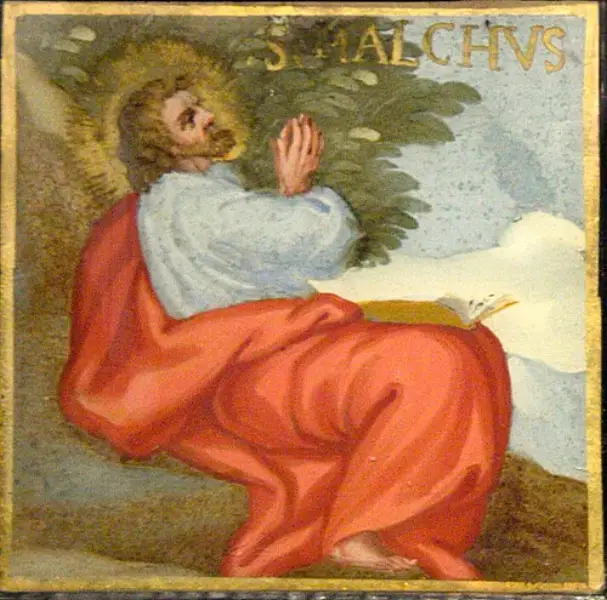
Overview
Malchus of Syria, also called Malchus of Chalcis or Malchus of Maronia, was a fourth-century monk whose story has come down entire through the pen of St. Jerome, who wrote his Life of Malchus the Captive Monk in Latin around 391 or 392 and interviewed the old monk himself at his home in Maronia. Born the only child of a farming family near Nisibis, Malchus refused the marriage his parents planned and withdrew to the desert of Chalcis to pursue the monastic life. Years later, on hearing of his father's death, he left the monastery against his abbot's command to claim his inheritance; on the road his party was overrun by Saracens and he was sold into slavery. His master forced him into a marriage with a fellow slave, but he and his bride lived in perfect continence as brother and sister, partners of each other's chastity. The two escaped on inflated goatskins, were nearly recaptured, and were saved when a lioness killed their pursuers. Reaching a Roman fort under Sabinianus, they were freed; she entered a women's monastery, and he, finding his own abbot dead, settled at Maronia under Bishop Evagrius, laboring in asceticism until his death around 390.
The Complete Life
The Farmer's Son Who Chose the Desert
In the fourth century, near the frontier city of Nisibis, a farming family rejoiced in an only son, Malchus. His parents, prosperous enough in land and labor, looked forward to the ordinary continuation of their house: when their child reached mature age they desired that he should marry and raise a family of his own. The young man's heart inclined elsewhere. He had heard the call of the monastic movement then transforming the Christianity of the East, and he desired to become a monk rather than a husband and father. The choice demanded a decisive break, for monastic life meant leaving family, property, and the whole expected course of a provincial Christian's life. Malchus left his home and made his way to the desert of Chalcis, the celebrated proving ground of Syrian asceticism, where monks contended with hunger, solitude, and the heat of the wilderness in their pursuit of unceasing prayer. There he began his monastic life under a rule and an abbot, exchanging the inheritance of his fathers for the daily bread of the cloister. Everything that followed in his extraordinary story — captivity, a forced marriage, escape, and return — grew from that first obedience, and from the single act of disobedience by which he later put it at risk.
§ Life
Captivity and the Partnership of Chastity
After several years in the desert of Chalcis, news reached Malchus of his father's death. The monk traveled homeward to claim the property now his, quitting the monastery against the plain command of his superior — a step the narrative never excuses. Joining a group of pilgrims traveling toward his native region, he was overtaken on the journey by Saracens and sold into slavery. His new master insisted that he marry another slave of the household, a woman captured in the same raid, whose own husband had been sold elsewhere. Malchus stayed true to his vows and would not complete the imposed marriage, going so far as to threaten his own life rather than break his vow. The woman then revealed that she too wished to live a celibate life; she offered to be his companion in continence, while both hid from their master that they lived as brother and sister. Thus, in the very house of bondage, an unexpected communion of purity took root, and the marriage imposed by violence became for both captives a school of mutual fidelity. The date of these events can only be inferred, though the description of the fort commander Sabinianus as Dux Mesopotamiae suggests the 340s or early 350s for Malchus's capture.
§ Life
Escape, the Lioness, and Return
Freedom came at last by a desperate stroke. Malchus and his companion won free of their owner by drifting downstream atop inflated skins of goats, crude craft of the Euphrates country; when the slaveowner caught up with them, the pair hid in a cave, but they were tracked to their refuge. There, in Jerome's telling, divine protection appeared in the form of a lioness that had chosen the cave for her den: she attacked and killed the pursuers, then departed with her cub, leaving the fugitives untouched. Unharmed amid the corpses of their enemies, Malchus and his wife mounted the dead men's camels and rode to a Roman fort commanded by Sabinianus, who received them and allowed them to go free. The partners of chastity then parted, each to the proper cloister: Malchus sent his companion to a women's monastery at her request, while he set out to return to his own monastery of Chalcis. He found that the igumen, the abbot of his youth, was no longer alive, and the desert community of his vocation was closed to him. He went instead to Maronia, where a men's monastery flourished under the direction of Bishop Evagrius, and there he took up once more the ascetic life he had never abandoned in his heart.
§ Life
The Tale Told to Jerome
At Maronia, in his old age, Malchus found a new work: for the edification of the monks he often recounted his trials, which he himself attributed to his disobedience in leaving his monastery without leave. His wife, who had transferred to a women's monastery in the same place, became his close companion again in their last years, the two veterans of a shared captivity growing old within sight of one another. It was in this setting that Jerome, the great scholar of the Latin Church, interviewed the monk at his own home while both he and his wife were still alive, and out of that interview composed the Life of Malchus the Captive Monk around 391 or 392, a narrative so vivid that modern readers have compared its artistry to the ancient novel. Except for this single biographical account, no record of Malchus exists, a fact that has made him at once a puzzle and a treasure for historians of early monasticism. The East and West have both kept his memory: the Eastern Orthodox and Eastern Catholic Churches commemorate him on 26 March, while the Roman Martyrology enters him under 21 October, honoring the captive whose chains became a witness to consecrated love.
§ Life
Timeline
- 350
Journeying home to claim his inheritance against his abbot's direction, Malchus was captured by Saracens and sold into slavery; the office of Sabinianus suggests this period.
§ Life
- 390
Died at Maronia in Syria after years of ascetic labor in the monastery under Bishop Evagrius.
§ Life
- 391
St. Jerome, who had interviewed Malchus alive at Maronia, wrote the Life of Malchus the Captive Monk around this year.
§ Life
The Record
- Canonization
- Pre-congregation; commemorated 26 March by the Eastern Orthodox and Eastern Catholic Churches, and listed for 21 October in the Roman Martyrology.
Prayer
Bibliography
Show 5 sources
- Christa Gray (2015). Jerome, Vita Malchi: Introduction, Text, Translation, and Commentary. Oxford: Oxford University Press.
- Schaff, Philip, ed. (1893). A Select Library of Nicene and Post-Nicene Fathers of the Christian Church. 2nd series. Vol. VI. Henry Wace. New York: The Christian Literature Company.
- Shahîd, Irfan (1984). Byzantium and the Arabs in the Fourth Century. Dumbarton Oaks. ISBN 978-0-88402-116-2.
- Šubrt, Jiří. "Hagiographic Romance: Novelistic Narrative Strategy in Jerome's Lives of Hermits", The Ancient Novel and the Frontiers of Genre. Ancient Narrative, vol. 18, Supplementum. Groningen: Barkhuis, 2014, pp. 205-14.
- "St Malchus of Chalcis in Syria". Orthodox Church in America. Retrieved 2011-01-11.
Profile text adapted from the Wikipedia article, licensed CC BY-SA 4.0.
Pray with this saint every day
Save St. Malchus of Syria to your favorites, read the full profile, and get feast-day reminders in the Saints app.
Get the Saints AppFree on the App Store for iPhone and iPad