
c. 520 - 621·Feast 15 November
St. Malo of Aleth
Founder of Saint-Malo and First Bishop of Aleth
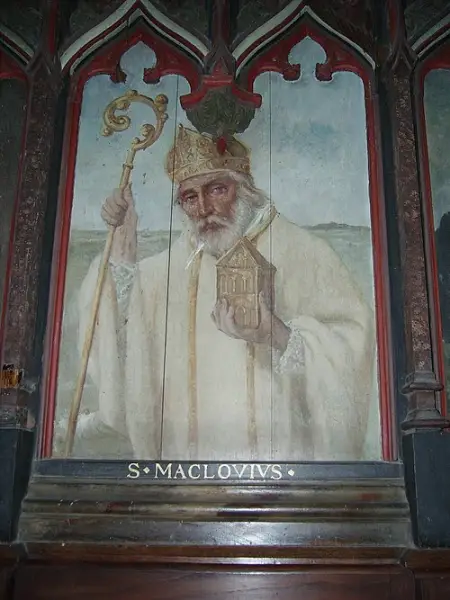
Overview
Malo, also rendered Maclou, Maloù, Maclovius or Machutus, was a Welsh churchman of the sixth century reckoned among the seven founding saints of Brittany. Tradition places his birth at Llancarfan around 520 into a family related to St. Samson, he was entrusted as a boy to the abbey there, where he was ordained priest and given the office of preacher. As a monk he joined the seafaring expeditions of Brendan the Navigator and became his favourite disciple, sharing in the legendary quest for the Island of the Blest and in missionary travel to the islands of the north. Settling at Aleth in Brittany, he served under the hermit Aaron, and on Aaron's death in 544 he took up the spiritual direction of the district and was consecrated its first bishop. His episcopate was marked by reported miracles, by unrest that once drove him from his see and a popular demand that brought him back, and finally by withdrawal to solitary penance. He died at a great age, traditionally on 15 November 621, during a journey toward Archambiac in Saintonge. The cathedral city of Saint-Malo bears his name, and his memory reaches even the South Atlantic, since the Falkland Islands owe their Spanish name, Islas Malvinas, to the mariners of his port.
The Complete Life
Early Life
The tradition preserved in Welsh and Breton sources makes Malo a child of Llancarfan in Glywysing, born around the year 520. His name is explained from Old Breton elements meaning something like a brilliant pledge or bright hostage. His mother Dervel was sister to Amwn Ddu, which made the boy a cousin of the great Welsh abbot St. Samson. While still young he was given over to the abbot's care and grew up inside the monastery, receiving there the formation that led to priestly ordination and an assignment as preacher to the community. This monastic upbringing, at one of the chief schools of Celtic Christianity, shaped both his learning and his readiness for the seaborne missions that would define the rest of his life.
§ Life
Voyages with Brendan
At Llancarfan Malo attached himself to Brendan the Navigator and became his best-loved disciple. The legends that grew around their partnership made the two monks heroes of the Atlantic: the Voyage of Saint Brendan the Abbot tells how the company found the Island of the Blest, while another tale relates how Brendan momentarily raised and baptized Maclovius, a dead giant. A second expedition is said to have carried Brendan and Malo to Cézembre off the Breton coast, to the Orkney Islands and to the northern isles of Scotland, evangelizing as they went. However much embroidery the stories have gathered, they preserve the memory of Malo as a monk of the open sea, formed in a church whose missionaries crossed water as readily as roads.
§ Voyages with Brendan
Breton Evangelist
Malo's life's work began at Aleth, where he served under a venerable hermit named Aaron. When Aaron died in 544, the disciple carried on the spiritual governance of the surrounding district, the region afterwards called Saint-Malo, and was consecrated the first Bishop of Aleth, the see now known as Saint-Servan. Many miracles were reported of him there. In his old age disorder on the island forced him to withdraw, but the people soon begged for his return, and he came back to restore peace among them. Feeling his strength fail, he resolved to close his life in solitary penance, and he died on the road, during a journey from Aleth toward Archambiac near Archingeay in the Saintonge, at an extreme old age traditionally fixed on 15 November 621, though the sources admit this date may belong to another saint, Marcoult.
§ Breton evangelist
Veneration
Malo's cult took deep root in the lands his mission touched. Saint-Malo Cathedral became his principal shrine, and the city is one of the seven stations of the Tro Breizh, the ancient tour of Brittany honouring its founding saints, a pilgrimage still walked in modern times. Pontoise Cathedral is dedicated to him, as is Lesmahagow Priory in Scotland under the Latin form Machutus; churches in Monmouthshire, Anglesey and Rome, the last under the name San Macuto, also carry his dedication. The place-name Saint-Maclou likewise preserves his memory. Farther afield, the mariners and fishermen who sailed from his port gave their name to the Falklands, which Bougainville christened Îles Malouines in 1764, so that the Spanish Malvinas descends from a Breton saint. He is honoured across the Anglican Communion, the Roman Catholic Church and the Eastern Orthodox Church.
§ Veneration
Timeline
- 520
Traditionally born at Llancarfan in Wales, son of Dervel and cousin of St. Samson, and placed in the care of the abbey while still a child
§ Life
- 544
On the death of the hermit Aaron at Aleth, continues the spiritual rule of the district and is consecrated first Bishop of Aleth
§ Breton evangelist
- 621
Dies on 15 November, worn out with age, while travelling from Aleth toward Archambiac in Saintonge; the sources allow that this date may really belong to St. Marcoult
§ Breton evangelist
- 1764
Louis Antoine de Bougainville names the Îles Malouines after settlers from Saint-Malo, a name the Spanish render as Islas Malvinas
§ Veneration
- 2014
Some 1,200 pilgrims walk from Saint-Brieuc to Saint-Malo as part of the Tro Breizh, the tour honouring the seven founding saints of Brittany
§ Veneration
The Record
- Patron of
- Saint-Malo·Pig-keepers·Lost items
- Symbols
- Depicted as an abbot and a bishop
- Canonization
- Pre-congregation; venerated as one of the seven founding saints of Brittany
Prayer
Bibliography
Show 8 sources
- Fleuriot, Léon. Les Origines de la Bretagne, ed. Payot, 1982, p. 150 and 281.
- Emanuel, Hywel David (1959). "Malo". Dictionary of Welsh Biography. National Library of Wales.
- Grattan-Flood, William. "St. Machutus." The Catholic Encyclopedia Vol. 9. New York: Robert Appleton Company, 1910. Public domain.
- Ramsay, Raymond (1972). No Longer on the Map. New York: Viking Press. p. 81. ISBN 0-670-51433-0.
- "Brendan for today - Feast Day, May 16th". www.saint-brendan.org. Retrieved 15 November 2021.
- "Tro Breiz : 1200 pèlerins ont relié Saint-Brieuc à Saint-Malo". Le Pèlerin (in French). 14 May 2014.
- Beaurepaire, François de (1981). Les noms des communes et anciennes paroisses de l'Eure (in French). A. et J. Picard. p. 180. ISBN 978-2-7084-0067-2.
- Baring-Gould, S.; Fisher, J. (1911). Lives of the British Saints. Vol. 3. pp. 411-434.
Profile text adapted from the Wikipedia article, licensed CC BY-SA 4.0.
Pray with this saint every day
Save St. Malo of Aleth to your favorites, read the full profile, and get feast-day reminders in the Saints app.
Get the Saints AppFree on the App Store for iPhone and iPad