
died c. 462·Feast 30 March
St. Mamertinus of Auxerre
Monk and Abbot of Auxerre
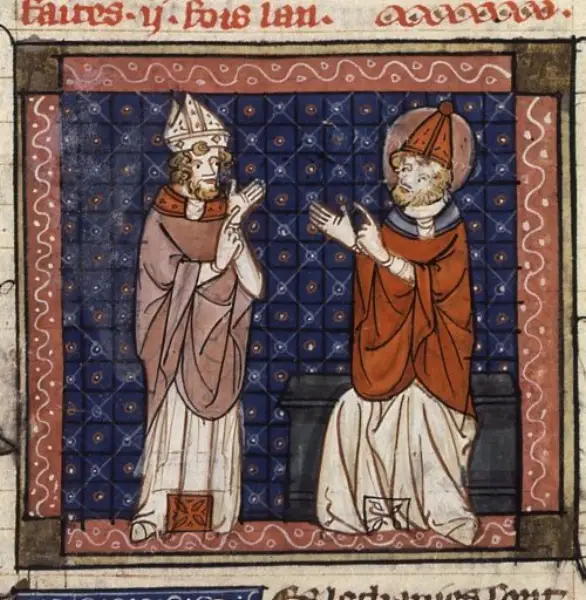
Overview
Mamertinus of Auxerre, in French Saint Mamert, died around the year 462 after a life wholly given to monastic conversion and government. His entry into the religious life came through the preaching and personal influence of Germanus of Auxerre, the great missionary bishop whose name dominated the church of that city. Mamertinus joined the Abbey of Saints Cosmas and Damian at Auxerre, a house later rededicated to Saint Marianus of Auxerre, and in time rose to govern it as abbot. The brevity of the surviving notice is itself the measure of a hidden life: no dates for his birth, no account of his teachings, and only two emblematic details preserve his memory in art, the abbot exhorting his monks, and the dying man stretched on a mat in his cell. He is commemorated in the Roman Catholic Church on 30 March.
The Complete Life
Monastic Life
Everything known of Mamertinus begins with his conversion at the hands of Germanus of Auxerre, the bishop whose missions to Britain made him one of the most celebrated figures of the fifth-century Gallic church. Under that influence Mamertinus left the world and entered the Abbey of Saints Cosmas and Damian in Auxerre itself, a community whose dedication was in later centuries changed to Saint Marianus of Auxerre. There he passed through the ranks of monastic obedience until the brethren set him over the house as abbot. The little church calendar that keeps his feast on 30 March remembers him in two images: standing before his monks, urging them onward in the spiritual combat, and lying on a simple mat in his cell as death drew near. This profile is marked thin_source because the sources allow nothing more to be said with confidence.
§ Introduction
Veneration
Mamertinus is honoured in the Roman Catholic Church on 30 March. His cult is of the ancient local kind, resting on his office as abbot at Auxerre rather than on any formal process, and it survived chiefly through liturgical calendars and the emblem books of sacred art, such as Husenbeth's Emblems of the Saints, which recorded how painters and sculptors were to depict him. Beyond these notices the record is silent; he belongs to the large company of Gallic abbots of the dying Roman world whose sanctity the church preserved in a single line and a single date.
§ Introduction
The Record
- Symbols
- Depicted exhorting monks·Lying on a mat in his cell before his death
- Canonization
- Pre-congregation; ancient liturgical cult
Prayer
Bibliography
Profile text adapted from the Wikipedia article, licensed CC BY-SA 4.0.
Pray with this saint every day
Save St. Mamertinus of Auxerre to your favorites, read the full profile, and get feast-day reminders in the Saints app.
Get the Saints AppFree on the App Store for iPhone and iPad