
died c. 475·Feast 11 May
St. Mamertus
Bishop of Vienne
Overview
Mamertus, bishop of Vienne in Gaul until his death around 475, is remembered above all as the father of the Rogation Days. Coming from a family of substance in the country around Lyons, distinguished alike in secular learning and theology and, before his elevation, apparently married, he was chosen for the see of Vienne shortly before 462. As bishop he ordained his brother Claudianus Mamertus, the theological writer, to the priesthood and made him a partner in the work of the diocese. His episcopate was troubled as well as fruitful: in 463 he consecrated a bishop for Die against the rights of the see of Arles, drawing rebukes and eventually a synodal sentence from Pope Hilarius, though he remained in office. His lasting gift to the church was the institution of the processional litanies of the three days before the Ascension, begun as an intercession against calamity and afterward kept across the West as the Minor Rogations. His name appears in the oldest martyrologies under 11 May, the first of the so-called Ice Saints.
The Complete Life
Early Life
Of Mamertus before his episcopate the record preserves little beyond family inference. His brother Claudianus Mamertus, later known as a theological writer, received in youth a thorough training in rhetoric and enjoyed the personal friendship of Bishop Eucherius of Lyons, facts which point to a well-to-do Gallic household in the neighbourhood of that city. Mamertus himself matched his brother's double cultivation, prized no less for secular learning than for theology, and, in the years before he was raised to the episcopate, seemingly a married man, as was not uncommon in an age when many bishops were drawn from married men of standing. The sources fall silent about the exact course of his career until his election to Vienne.
§ Life
Episcopate and the Dispute with Pope Hilarius
Elected and consecrated shortly before 462, Mamertus at once enlisted his brother, who had withdrawn into cloister, ordaining him priest of Vienne and drawing on his help in the works of the diocese; the activity of the two men is described in a letter of Sidonius Apollinaris. Trouble came in 463. Pope Leo I had settled the boundaries of the provinces of Arles and Vienne, leaving Valence, Tarentaise, Geneva and Grenoble to Vienne and subordinating the rest to Arles. Mamertus nonetheless consecrated a bishop, one Marcel, for the city of Die. King Gundioc of the Burgundians complained to Pope Hilarius, who on 10 October 463 directed Bishop Leontius of Arles to summon a synod of the provinces to inquire into the matter. A further papal letter of 25 February 464 gave the verdict: Mamertus and the bishop he had installed unlawfully deserved deposition, yet the pope offered clemency, sending Veranus of Vence to warn that refusal to accept the regulations of Pope Leo would cost Vienne its four remaining suffragan dioceses, while Marcel might keep his see if Leontius confirmed him. Mamertus submitted, and the episode closed without ending his episcopate.
§ Life
Founder of the Rogation Processions
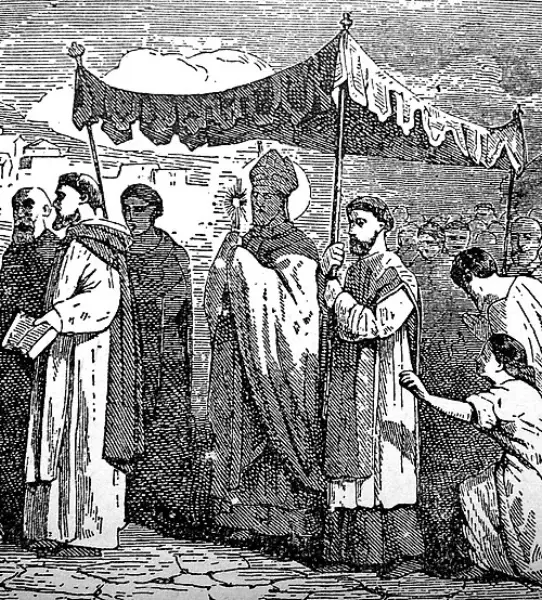
Mamertus's enduring contribution to Christian practice was the institution of the Minor Rogations, the processional litanies of the Monday, Tuesday and Wednesday before the Ascension. The evidence of Sidonius Apollinaris and of Avitus, his second successor, who preached a homily on the rogations, establishes him as their founder. The observance combined fasting with penitential processions, pleading for favourable weather for the crops and for deliverance from pestilence and famine, and in connexion with it Mamertus summoned a synod at Vienne at some point between 471 and 475. William of Auxerre recorded a later tradition that the litanies were first sung after a plague of wolves, when, as the Gospel tells of the swine, demons were said to have entered the beasts to work havoc in villages and even cities. Whatever the immediate occasion, the custom spread through the church, and the Rogation days remain Mamertus's monument.
§ Life
Final Years and Death
In his last years Mamertus continued to serve the wider church of Gaul. During his episcopate the remains of the martyr Ferreolus were discovered, and the bishop translated them to a church he had built in the martyr's honour at Vienne. About 475 he attended the synod of Arles which examined and corrected the predestination doctrine of the Gallic priest Lucidus, a gathering that shows him still taking his place among the bishops of the province in the closing months of his life. He died around that year, leaving to his successors a diocese strengthened by his brother's scholarship and by the processions he had founded.
§ Life
Veneration
After his death the church of Gaul ranked Mamertus among its saints. His name is entered under 11 May in the Martyrologium Hieronymianum and in the martyrology of Florus of Lyons, and his feast is still kept on that date in the Roman Catholic Church, as the historical study of the martyrologies by Henri Quentin records. Folk piety in later centuries made him the first of the Ice Saints, the feast-days around the middle of May from which a late cold snap was feared. He is venerated in both the Roman Catholic and the Eastern Orthodox churches, and the statue of him at Vienne Cathedral keeps his memory in the city he governed.
§ Veneration
Timeline
- 462
Is elected and consecrated bishop of Vienne shortly before this year, and ordains his brother Claudianus Mamertus priest of the city
§ Life
- 463
Consecrates Marcel as bishop of Die, infringing the rights of Arles; King Gundioc of the Burgundians complains to Pope Hilarius
§ Life
- 464
A papal letter of 25 February reports the synod's sentence against him, offering clemency on condition of submission to the rulings of Pope Leo
§ Life
- 471
Summons a synod at Vienne sometime between 471 and 475 in connection with the intercessory processions he has founded
§ Life
- 475
Attends the synod of Arles convened against the predestination teaching of the priest Lucidus, and dies about this time
§ Life
The Record
- Patron of
- Vinegrowers and country people who kept the Rogation litanies
- Symbols
- Bishop with a cross or litany procession·One of the Ice Saints
- Canonization
- Pre-congregation; name stands in the Martyrologium Hieronymianum under 11 May
Prayer
Bibliography
Show 7 sources
- Kirsch, Johann Peter. "St. Mamertus." The Catholic Encyclopedia Vol. 9. New York: Robert Appleton Company, 1910. Public domain.
- Sidonius Apollinaris, Epistulae VII, 1.
- Thiel, "Epist. Rom. Pont.", I, cxlvi, cli; Jaffé, "Regesta Rom. Pont.", I, 2nd ed., dlvi, dlix.
- Gregory of Tours, "De gloria mart.", II, ii.
- Reff, Daniel T. (2005). Plagues, Priests, and Demons: Sacred Narratives and the Rise of Christianity in the Old World and the New. Cambridge University Press. p. 100. ISBN 9781139442787.
- Britannica, The Editors of Encyclopaedia. "Rogation Days". Encyclopedia Britannica.
- William of Auxerre, Summa de Officiis Ecclesiasticis 3.84.1.
Profile text adapted from the Wikipedia article, licensed CC BY-SA 4.0.
Pray with this saint every day
Save St. Mamertus to your favorites, read the full profile, and get feast-day reminders in the Saints app.
Get the Saints AppFree on the App Store for iPhone and iPad