
died 19 October 460·Feast 15 September; 16 June (diocese of Palermo)
St. Mamilian of Palermo
Bishop of Palermo and Confessor
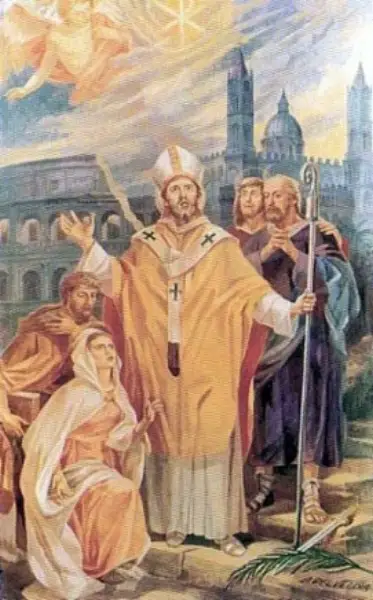
Overview
Mamilian, fifth-century bishop of Palermo, belongs to the generation of Sicilian churchmen who suffered under the Vandal occupation of the island. A native of Palermo, he was driven into exile around 450 by the Arian Vandals, together with a band of Christian companions with whom he is still honoured: Nympha, Eustotius, Proculus and Golbodeus. One tradition sends him to Africa, another to Tuscany at the hands of King Genseric; either way he escaped, helped by the intercession of an African bishop or of sympathetic Christians, made his way to Sardinia and then to the island of Montecristo, where legend credits him with slaying a dragon and renaming the island from Montegiove, Jove's mountain, to Montecristo, Christ's mountain, and finally to Giglio, where he died on 19 October 460. His cult lives on in the Tuscan archipelago and at Palermo, where Archbishop Juan Lozano raised statues to the saint and his companions in the cathedral in 1673.
The Complete Life
Exile and Wanderings
Mamilian shepherded the church of Palermo at the moment the Vandals, adherents of Arianism, extended their power over Sicily. Around the year 450 he was expelled, sharing the fate of orthodox bishops throughout the Vandal domains, and went into exile with a company of fellow Christians. The sources differ on his destination: most place him in Africa, but one account has King Genseric send him to Tuscany instead. From confinement he broke free, aided by the pleas of an African bishop or by Christians who took his part, and found shelter in Sardinia. From there his path led to Montecristo, then called Montegiove after the ancient god of the mountain. The island legend makes him defeat a dragon there and change the island's very name to Montecristo, the mountain of Christ, and it remembers a community of hermits, said to be his followers, out of which a monastery was built around the year 600. His wanderings ended on Giglio, where he died on 19 October 460.
§ Biography
Companions
Mamilian is never honoured alone. The tradition joins to him Nympha, Eustotius, Proculus and Golbodeus, the companions of his exile, whose names stand beside his in the painting in the cathedral of Palermo and in the statues erected there in 1673 by Archbishop Juan Lozano, the work of Travaglia for Mamilian and Golbodeus and of Antonio Anello for Eustotius and Proculus. Scholars have suggested that the name Golbodeus is a corruption of Quodvultdeus, borne by another fifth-century saint, the bishop of Carthage exiled by the same Vandal persecution, a reminder of how tightly the memory of those exiles intertwines.
§ Biography
Veneration
On Giglio the story is told that on the very day of Mamilian's burial men from Elba and Genoa tried to carry off his relics, and that the saint's body was torn to pieces in the struggle, the island keeping his arm. Other traditions hold that his relics were translated to Rome, to the church of Santa Maria in Monticelli, and afterwards to Spoleto, that some reached Palermo, and that in the seventeenth century Cosimo III de' Medici, Grand Duke of Tuscany, restored the whole body to Giglio. Each September the island keeps a festival of four days from the 15th, with a procession of the relics, the saint's arm, games, music and a solemn mass. The diocese of Palermo keeps his feast on 16 June, the wider church on 15 September, and the diocese of Pitigliano-Sovana-Orbetello and the island of Giglio claim him as patron.
§ Veneration
Timeline
- 450
Exiled from his see of Palermo by the Arian Vandals, who then dominated Sicily, together with a group of Christian companions
§ Biography
- 450
Around this period, freed from captivity by the mediation of an African bishop or of Christians well disposed toward him, makes his way first to Sardinia
§ Biography
- 460
Dies on the island of Giglio on 19 October, after years of wandering exile among the islands of the Tyrrhenian Sea
§ Biography
- 600
A monastery is built on Montecristo, where a community of hermits claiming to follow Mamilian had settled
§ Biography
- 1673
Has statues of Mamilian, Eustotius, Proculus and Golbodeus set up in Palermo's cathedral by Archbishop Juan Lozano
§ Veneration
The Record
- Patron of
- Diocese of Pitigliano-Sovana-Orbetello·Isola del Giglio
- Symbols
- Episcopal attire
- Canonization
- Pre-congregation; ancient cult in Sicily, Tuscany and the Tuscan archipelago
Prayer
Bibliography
Show 9 sources
- Antonino Cottone (2003). "San Mamiliano di Palermo". Santi e beati. Retrieved January 15, 2012.
- "St. Patrick Catholic Church: Saint of the Day". St. Patrick Catholic Church. Archived from the original on February 1, 2016.
- "Montecristo Island". Toscana Viva. Archived from the original on January 30, 2016.
- Recueil des notices et mémoires de la Société archéologique du département de Constantine, Volumes 26-27. Société archéologique du département de Constantine (L. Arnolet, 1892), 17.
- "San Mamiliano". Isola del Giglio. Retrieved January 17, 2012.
- George Dennis, John Murray, A handbook for travellers in Sicily: including Palermo, Messina, Catania, Syracuse, Etna, and the ruins of the Greek temples (J. Murray, 1864), 25.
- Marinelli, Michele. San Mamiliano Monaco Vescovo di Palermo, Grosseto 2000.
- Russo, Ugo. San Mamiliano Vescovo e Martire del V secolo, evangelizzatore della Toscana, supporto CD, Palermo, 2002.
- Peria, Gloria e Ferruzzi, Silvestre. L'isola d'Elba e il culto di San Mamiliano, Portoferraio 2010.
Profile text adapted from the Wikipedia article, licensed CC BY-SA 4.0.
Pray with this saint every day
Save St. Mamilian of Palermo to your favorites, read the full profile, and get feast-day reminders in the Saints app.
Get the Saints AppFree on the App Store for iPhone and iPad